

coupling with sterically hindered aryl donors have been reported [58–61]. To
address this challenge, Chen and co-workers introduced a new
pyridylmethylamine-based directing group, which enabled C–H arylation with
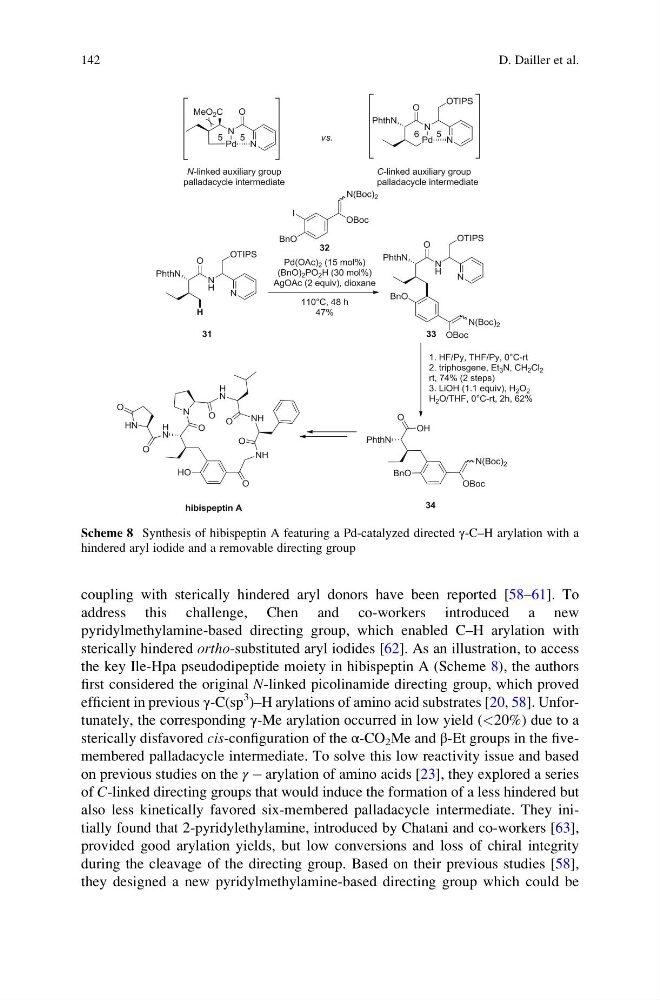
sterically hindered ortho-substituted aryl iodides [62]. As an illustration, to access
the key Ile-Hpa pseudodipeptide moiety in hibispeptin A (Scheme 8), the authors
first considered the original N-linked picolinamide directing group, which proved
efficient in previous γ-C(sp
3 )–H arylations of amino acid substrates [20, 58]. Unfortunately, the corresponding γ-Me arylation occurred in low yield (<20%) due to a
sterically disfavored cis-configuration of the α-CO 2 Me and β-Et groups in the fivemembered palladacycle intermediate. To solve this low reactivity issue and based
on previous studies on the γ À arylation of amino acids [23], they explored a series
of C-linked directing groups that would induce the formation of a less hindered but
also less kinetically favored six-membered palladacycle intermediate. They initially found that 2-pyridylethylamine, introduced by Chatani and co-workers [63],
provided good arylation yields, but low conversions and loss of chiral integrity
during the cleavage of the directing group. Based on their previous studies [58],
they designed a new pyridylmethylamine-based directing group which could be
Scheme 8 Synthesis of hibispeptin A featuring a Pd-catalyzed directed γ-C–H arylation with a
hindered aryl iodide and a removable directing group
142
D. Dailler et al.
address this challenge, Chen and co-workers introduced a new
pyridylmethylamine-based directing group, which enabled C–H arylation with
sterically hindered ortho-substituted aryl iodides [62]. As an illustration, to access
the key Ile-Hpa pseudodipeptide moiety in hibispeptin A (Scheme 8), the authors
first considered the original N-linked picolinamide directing group, which proved
efficient in previous γ-C(sp
3 )–H arylations of amino acid substrates [20, 58]. Unfortunately, the corresponding γ-Me arylation occurred in low yield (<20%) due to a
sterically disfavored cis-configuration of the α-CO 2 Me and β-Et groups in the fivemembered palladacycle intermediate. To solve this low reactivity issue and based
on previous studies on the γ À arylation of amino acids [23], they explored a series
of C-linked directing groups that would induce the formation of a less hindered but
also less kinetically favored six-membered palladacycle intermediate. They initially found that 2-pyridylethylamine, introduced by Chatani and co-workers [63],
provided good arylation yields, but low conversions and loss of chiral integrity
during the cleavage of the directing group. Based on their previous studies [58],
they designed a new pyridylmethylamine-based directing group which could be
Scheme 8 Synthesis of hibispeptin A featuring a Pd-catalyzed directed γ-C–H arylation with a
hindered aryl iodide and a removable directing group
142
D. Dailler et al.