

method provided the most straightforward way to produce 1,1-difluoro substituents
at benzylic position.
2.4 Direct C–SCF 3 Bond Formation
Trifluoromethylthio group (SCF 3 ) is an important structural moiety in new drugs
and agrochemicals owing to its strong electronegativity and high lipophilicity [41–
44]. Very recently, both Tang and Chen groups have reported direct sp
3 C–H
trifluoromethylthiolation using silver (І) trifluoromethanethiolate and persulfate
[45, 46]. These developed methods were applied for the late-stage trifluoromethylthiolation of pharmaceutical and agrochemical compounds.
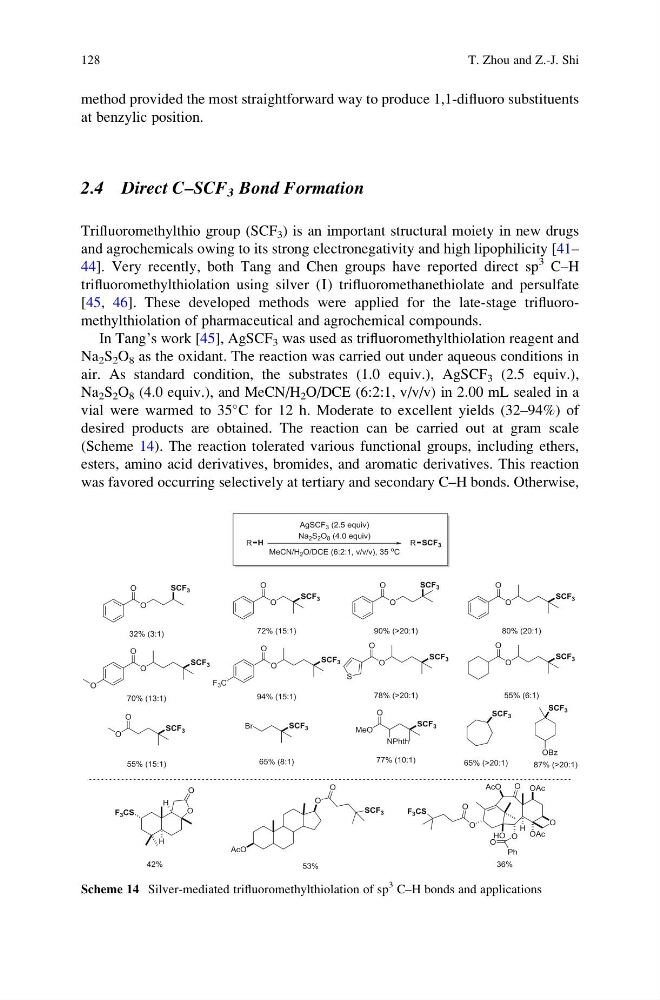
In Tang’s work [45], AgSCF 3 was used as trifluoromethylthiolation reagent and
Na 2 S 2 O 8 as the oxidant. The reaction was carried out under aqueous conditions in
air. As standard condition, the substrates (1.0 equiv.), AgSCF 3 (2.5 equiv.),
Na 2 S 2 O 8 (4.0 equiv.), and MeCN/H 2 O/DCE (6:2:1, v/v/v) in 2.00 mL sealed in a
vial were warmed to 35
C for 12 h. Moderate to excellent yields (32–94%) of
desired products are obtained. The reaction can be carried out at gram scale
(Scheme 14). The reaction tolerated various functional groups, including ethers,
esters, amino acid derivatives, bromides, and aromatic derivatives. This reaction
was favored occurring selectively at tertiary and secondary C–H bonds. Otherwise,
Scheme 14 Silver-mediated trifluoromethylthiolation of sp
3 C–H bonds and applications
128
T. Zhou and Z.-J. Shi
at benzylic position.
2.4 Direct C–SCF 3 Bond Formation
Trifluoromethylthio group (SCF 3 ) is an important structural moiety in new drugs
and agrochemicals owing to its strong electronegativity and high lipophilicity [41–
44]. Very recently, both Tang and Chen groups have reported direct sp
3 C–H
trifluoromethylthiolation using silver (І) trifluoromethanethiolate and persulfate
[45, 46]. These developed methods were applied for the late-stage trifluoromethylthiolation of pharmaceutical and agrochemical compounds.
In Tang’s work [45], AgSCF 3 was used as trifluoromethylthiolation reagent and
Na 2 S 2 O 8 as the oxidant. The reaction was carried out under aqueous conditions in
air. As standard condition, the substrates (1.0 equiv.), AgSCF 3 (2.5 equiv.),
Na 2 S 2 O 8 (4.0 equiv.), and MeCN/H 2 O/DCE (6:2:1, v/v/v) in 2.00 mL sealed in a
vial were warmed to 35
C for 12 h. Moderate to excellent yields (32–94%) of
desired products are obtained. The reaction can be carried out at gram scale
(Scheme 14). The reaction tolerated various functional groups, including ethers,
esters, amino acid derivatives, bromides, and aromatic derivatives. This reaction
was favored occurring selectively at tertiary and secondary C–H bonds. Otherwise,
Scheme 14 Silver-mediated trifluoromethylthiolation of sp
3 C–H bonds and applications
128
T. Zhou and Z.-J. Shi