

this transformation gave a much lower selectivity of trifluoromethylthiolation
products. It is important to note that more complex natural products were successfully applied in this trifluoromethylthiolation, exhibiting the potential of this
method in medicinal chemistry.
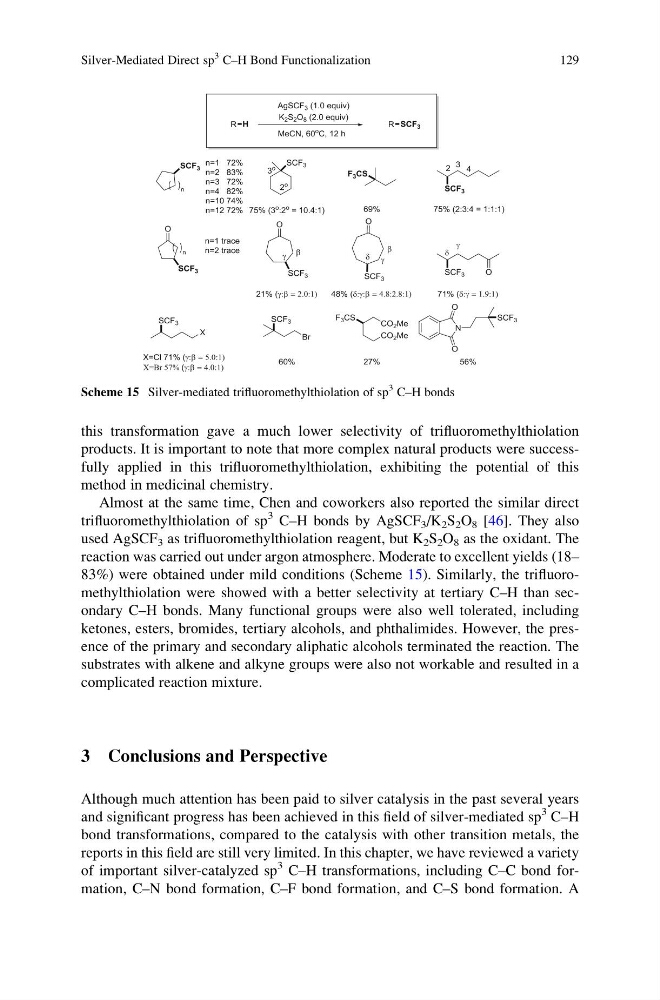
Almost at the same time, Chen and coworkers also reported the similar direct
trifluoromethylthiolation of sp
3 C–H bonds by AgSCF 3 /K 2 S 2 O 8 [46]. They also
used AgSCF 3 as trifluoromethylthiolation reagent, but K 2 S 2 O 8 as the oxidant. The
reaction was carried out under argon atmosphere. Moderate to excellent yields (18–
83%) were obtained under mild conditions (Scheme 15). Similarly, the trifluoromethylthiolation were showed with a better selectivity at tertiary C–H than secondary C–H bonds. Many functional groups were also well tolerated, including
ketones, esters, bromides, tertiary alcohols, and phthalimides. However, the presence of the primary and secondary aliphatic alcohols terminated the reaction. The
substrates with alkene and alkyne groups were also not workable and resulted in a
complicated reaction mixture.
3 Conclusions and Perspective
Although much attention has been paid to silver catalysis in the past several years
and significant progress has been achieved in this field of silver-mediated sp
3 C–H
bond transformations, compared to the catalysis with other transition metals, the
reports in this field are still very limited. In this chapter, we have reviewed a variety
of important silver-catalyzed sp
3 C–H transformations, including C–C bond formation, C–N bond formation, C–F bond formation, and C–S bond formation. A
Scheme 15 Silver-mediated trifluoromethylthiolation of sp
3 C–H bonds
Silver-Mediated Direct sp
3 C–H Bond Functionalization
129
products. It is important to note that more complex natural products were successfully applied in this trifluoromethylthiolation, exhibiting the potential of this
method in medicinal chemistry.
Almost at the same time, Chen and coworkers also reported the similar direct
trifluoromethylthiolation of sp
3 C–H bonds by AgSCF 3 /K 2 S 2 O 8 [46]. They also
used AgSCF 3 as trifluoromethylthiolation reagent, but K 2 S 2 O 8 as the oxidant. The
reaction was carried out under argon atmosphere. Moderate to excellent yields (18–
83%) were obtained under mild conditions (Scheme 15). Similarly, the trifluoromethylthiolation were showed with a better selectivity at tertiary C–H than secondary C–H bonds. Many functional groups were also well tolerated, including
ketones, esters, bromides, tertiary alcohols, and phthalimides. However, the presence of the primary and secondary aliphatic alcohols terminated the reaction. The
substrates with alkene and alkyne groups were also not workable and resulted in a
complicated reaction mixture.
3 Conclusions and Perspective
Although much attention has been paid to silver catalysis in the past several years
and significant progress has been achieved in this field of silver-mediated sp
3 C–H
bond transformations, compared to the catalysis with other transition metals, the
reports in this field are still very limited. In this chapter, we have reviewed a variety
of important silver-catalyzed sp
3 C–H transformations, including C–C bond formation, C–N bond formation, C–F bond formation, and C–S bond formation. A
Scheme 15 Silver-mediated trifluoromethylthiolation of sp
3 C–H bonds
Silver-Mediated Direct sp
3 C–H Bond Functionalization
129