

conversion was obtained for benzylic sp
3 C–H transformation. Important to note,
for sp
3 C–H bond of alkane, the silver catalyst 8 showed high activity and gave
better yields by using much lower amounts of alkanes.
2.3 Direct C–F Bond Formation
Fluorine-containing compounds have unique physical and chemical properties, and
they are widely used in material chemistry and medicinal chemistry [35–37]. For
example,
18 F-labeled organic compounds are used as biological imaging agents for
positron emission tomography (PET) [38, 39]. In 2014, Tang and coworkers
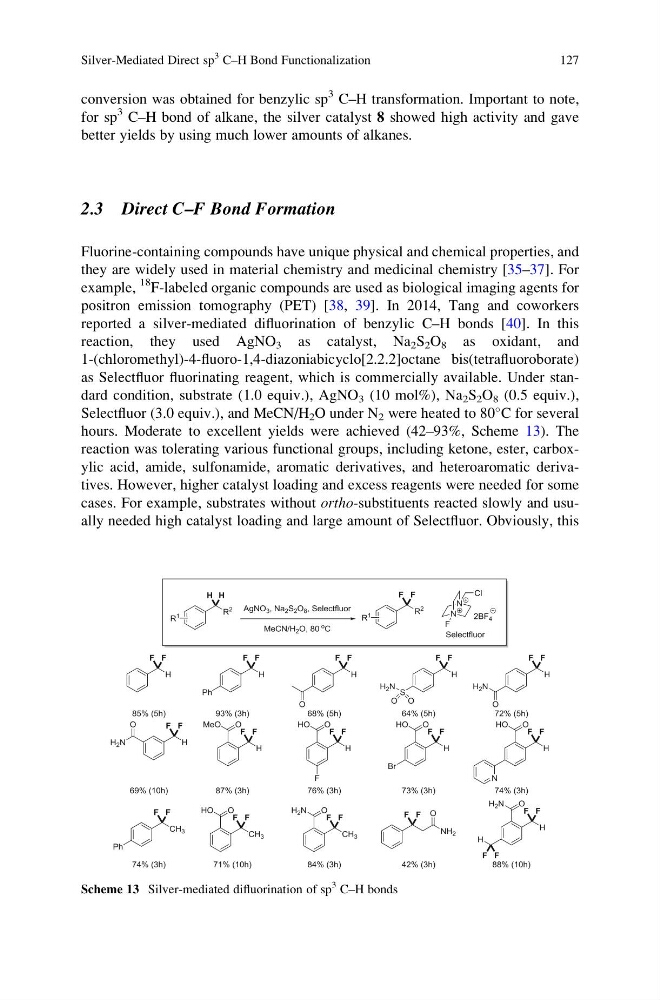
reported a silver-mediated difluorination of benzylic C–H bonds [40]. In this
reaction, they used AgNO 3 as catalyst, Na 2 S 2 O 8 as oxidant, and
1-(chloromethyl)-4-fluoro-1,4-diazoniabicyclo[2.2.2]octane bis(tetrafluoroborate)
as Selectfluor fluorinating reagent, which is commercially available. Under standard condition, substrate (1.0 equiv.), AgNO 3 (10 mol%), Na 2 S 2 O 8 (0.5 equiv.),
Selectfluor (3.0 equiv.), and MeCN/H 2 O under N 2 were heated to 80
C for several
hours. Moderate to excellent yields were achieved (42–93%, Scheme 13). The
reaction was tolerating various functional groups, including ketone, ester, carboxylic acid, amide, sulfonamide, aromatic derivatives, and heteroaromatic derivatives. However, higher catalyst loading and excess reagents were needed for some
cases. For example, substrates without ortho-substituents reacted slowly and usually needed high catalyst loading and large amount of Selectfluor. Obviously, this
Scheme 13 Silver-mediated difluorination of sp
3 C–H bonds
Silver-Mediated Direct sp
3 C–H Bond Functionalization
127
3 C–H transformation. Important to note,
for sp
3 C–H bond of alkane, the silver catalyst 8 showed high activity and gave
better yields by using much lower amounts of alkanes.
2.3 Direct C–F Bond Formation
Fluorine-containing compounds have unique physical and chemical properties, and
they are widely used in material chemistry and medicinal chemistry [35–37]. For
example,
18 F-labeled organic compounds are used as biological imaging agents for
positron emission tomography (PET) [38, 39]. In 2014, Tang and coworkers
reported a silver-mediated difluorination of benzylic C–H bonds [40]. In this
reaction, they used AgNO 3 as catalyst, Na 2 S 2 O 8 as oxidant, and
1-(chloromethyl)-4-fluoro-1,4-diazoniabicyclo[2.2.2]octane bis(tetrafluoroborate)
as Selectfluor fluorinating reagent, which is commercially available. Under standard condition, substrate (1.0 equiv.), AgNO 3 (10 mol%), Na 2 S 2 O 8 (0.5 equiv.),
Selectfluor (3.0 equiv.), and MeCN/H 2 O under N 2 were heated to 80
C for several
hours. Moderate to excellent yields were achieved (42–93%, Scheme 13). The
reaction was tolerating various functional groups, including ketone, ester, carboxylic acid, amide, sulfonamide, aromatic derivatives, and heteroaromatic derivatives. However, higher catalyst loading and excess reagents were needed for some
cases. For example, substrates without ortho-substituents reacted slowly and usually needed high catalyst loading and large amount of Selectfluor. Obviously, this
Scheme 13 Silver-mediated difluorination of sp
3 C–H bonds
Silver-Mediated Direct sp
3 C–H Bond Functionalization
127