

compared to the cyclopropyl C–H bond (~106 kal/mol) (entry 2). The amidation
with both catalysts again was obtained at tertiary C–H bond, and similarly (tpa)
AgOTf was superior to (
t
Bubipy) 2 AgOTf (entry 4).
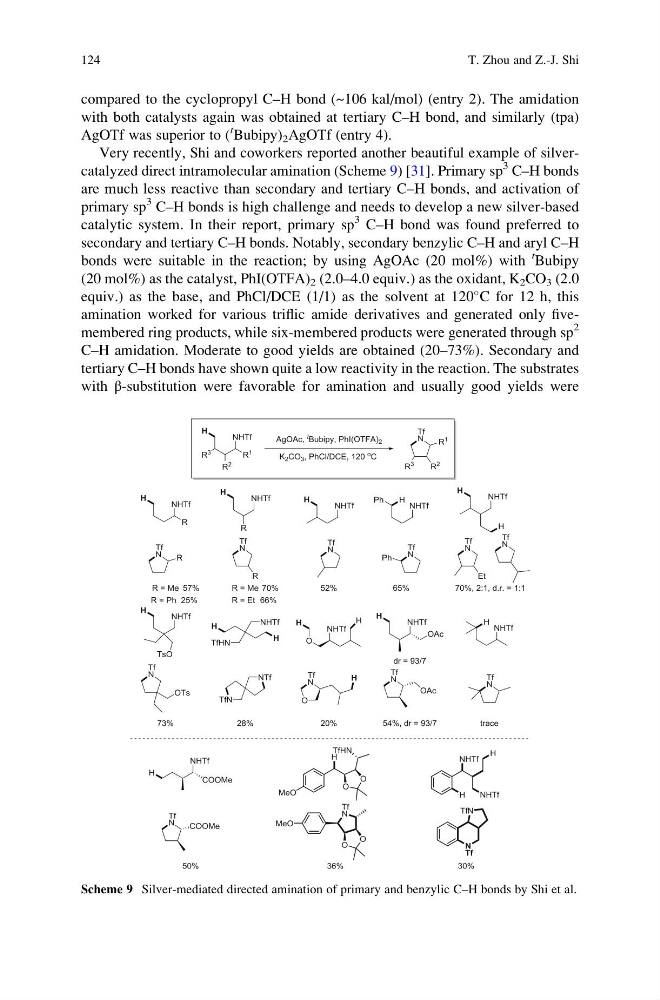
Very recently, Shi and coworkers reported another beautiful example of silvercatalyzed direct intramolecular amination (Scheme 9) [31]. Primary sp
3 C–H bonds
are much less reactive than secondary and tertiary C–H bonds, and activation of
primary sp
3 C–H bonds is high challenge and needs to develop a new silver-based
catalytic system. In their report, primary sp
3 C–H bond was found preferred to
secondary and tertiary C–H bonds. Notably, secondary benzylic C–H and aryl C–H
bonds were suitable in the reaction; by using AgOAc (20 mol%) with
t
Bubipy
(20 mol%) as the catalyst, PhI(OTFA) 2 (2.0–4.0 equiv.) as the oxidant, K 2 CO 3 (2.0
equiv.) as the base, and PhCl/DCE (1/1) as the solvent at 120
C for 12 h, this
amination worked for various triflic amide derivatives and generated only fivemembered ring products, while six-membered products were generated through sp
2
C–H amidation. Moderate to good yields are obtained (20–73%). Secondary and
tertiary C–H bonds have shown quite a low reactivity in the reaction. The substrates
with β-substitution were favorable for amination and usually good yields were
Scheme 9 Silver-mediated directed amination of primary and benzylic C–H bonds by Shi et al.
124
T. Zhou and Z.-J. Shi
with both catalysts again was obtained at tertiary C–H bond, and similarly (tpa)
AgOTf was superior to (
t
Bubipy) 2 AgOTf (entry 4).
Very recently, Shi and coworkers reported another beautiful example of silvercatalyzed direct intramolecular amination (Scheme 9) [31]. Primary sp
3 C–H bonds
are much less reactive than secondary and tertiary C–H bonds, and activation of
primary sp
3 C–H bonds is high challenge and needs to develop a new silver-based
catalytic system. In their report, primary sp
3 C–H bond was found preferred to
secondary and tertiary C–H bonds. Notably, secondary benzylic C–H and aryl C–H
bonds were suitable in the reaction; by using AgOAc (20 mol%) with
t
Bubipy
(20 mol%) as the catalyst, PhI(OTFA) 2 (2.0–4.0 equiv.) as the oxidant, K 2 CO 3 (2.0
equiv.) as the base, and PhCl/DCE (1/1) as the solvent at 120
C for 12 h, this
amination worked for various triflic amide derivatives and generated only fivemembered ring products, while six-membered products were generated through sp
2
C–H amidation. Moderate to good yields are obtained (20–73%). Secondary and
tertiary C–H bonds have shown quite a low reactivity in the reaction. The substrates
with β-substitution were favorable for amination and usually good yields were
Scheme 9 Silver-mediated directed amination of primary and benzylic C–H bonds by Shi et al.
124
T. Zhou and Z.-J. Shi