

obtained. However, α-substitution decreased the yields, possibly due to the steric
effect. Furthermore, protected linear amino acid ester underwent this transformation and formed 3-methylproline with 50% yield. More complicated core structure
of (À)-codonophsinine and (À)-martinellic acid was easily constructed using this
powerful method with moderate yields.
2.2.2 Intermolecular Amination
In comparison, intermolecular reaction met high challenges due to both enthalpy
and entropy reasons. In 2007, He and coworkers developed a disilver-based new
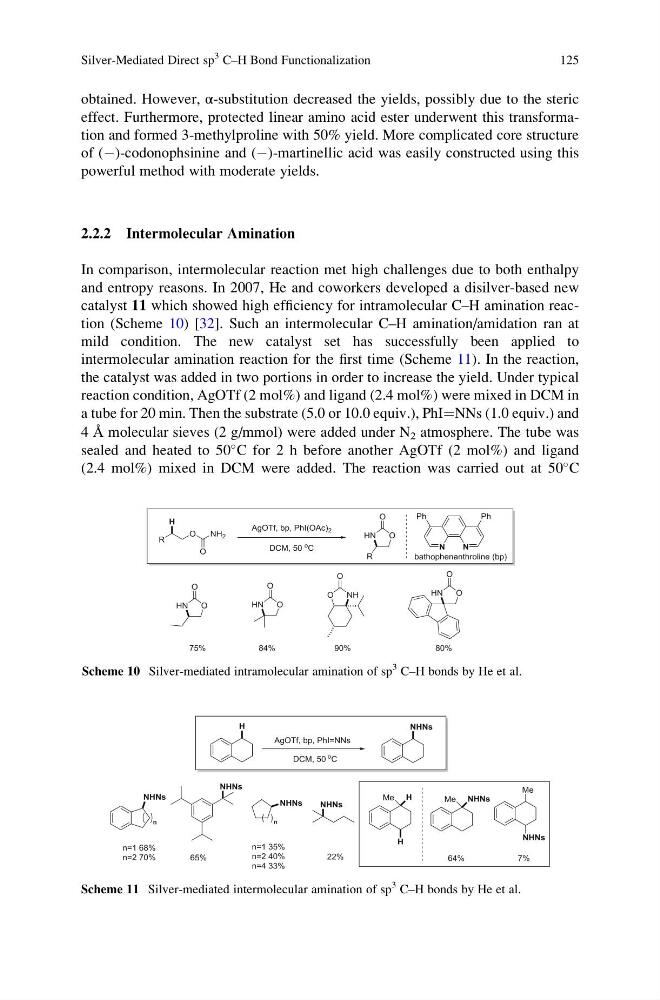
catalyst 11 which showed high efficiency for intramolecular C–H amination reaction (Scheme 10) [32]. Such an intermolecular C–H amination/amidation ran at
mild condition. The new catalyst set has successfully been applied to
intermolecular amination reaction for the first time (Scheme 11). In the reaction,
the catalyst was added in two portions in order to increase the yield. Under typical
reaction condition, AgOTf (2 mol%) and ligand (2.4 mol%) were mixed in DCM in
a tube for 20 min. Then the substrate (5.0 or 10.0 equiv.), PhI¼NNs (1.0 equiv.) and
4 Å molecular sieves (2 g/mmol) were added under N 2 atmosphere. The tube was
sealed and heated to 50
C for 2 h before another AgOTf (2 mol%) and ligand
(2.4 mol%) mixed in DCM were added. The reaction was carried out at 50
C
Scheme 10 Silver-mediated intramolecular amination of sp
3 C–H bonds by He et al.
Scheme 11 Silver-mediated intermolecular amination of sp
3 C–H bonds by He et al.
Silver-Mediated Direct sp
3 C–H Bond Functionalization
125
effect. Furthermore, protected linear amino acid ester underwent this transformation and formed 3-methylproline with 50% yield. More complicated core structure
of (À)-codonophsinine and (À)-martinellic acid was easily constructed using this
powerful method with moderate yields.
2.2.2 Intermolecular Amination
In comparison, intermolecular reaction met high challenges due to both enthalpy
and entropy reasons. In 2007, He and coworkers developed a disilver-based new
catalyst 11 which showed high efficiency for intramolecular C–H amination reaction (Scheme 10) [32]. Such an intermolecular C–H amination/amidation ran at
mild condition. The new catalyst set has successfully been applied to
intermolecular amination reaction for the first time (Scheme 11). In the reaction,
the catalyst was added in two portions in order to increase the yield. Under typical
reaction condition, AgOTf (2 mol%) and ligand (2.4 mol%) were mixed in DCM in
a tube for 20 min. Then the substrate (5.0 or 10.0 equiv.), PhI¼NNs (1.0 equiv.) and
4 Å molecular sieves (2 g/mmol) were added under N 2 atmosphere. The tube was
sealed and heated to 50
C for 2 h before another AgOTf (2 mol%) and ligand
(2.4 mol%) mixed in DCM were added. The reaction was carried out at 50
C
Scheme 10 Silver-mediated intramolecular amination of sp
3 C–H bonds by He et al.
Scheme 11 Silver-mediated intermolecular amination of sp
3 C–H bonds by He et al.
Silver-Mediated Direct sp
3 C–H Bond Functionalization
125