

explored to homoallenic and homoallylic carbamates with various substituents.
Excellent chemoselectivity and high yields were obtained for this amidation of
sp
3 C–H bonds when a 1:3 ratio of AgOTf/ligand was used, while for aziridination
when a 1:1.25 ratio of AgOTf/ligand was used.
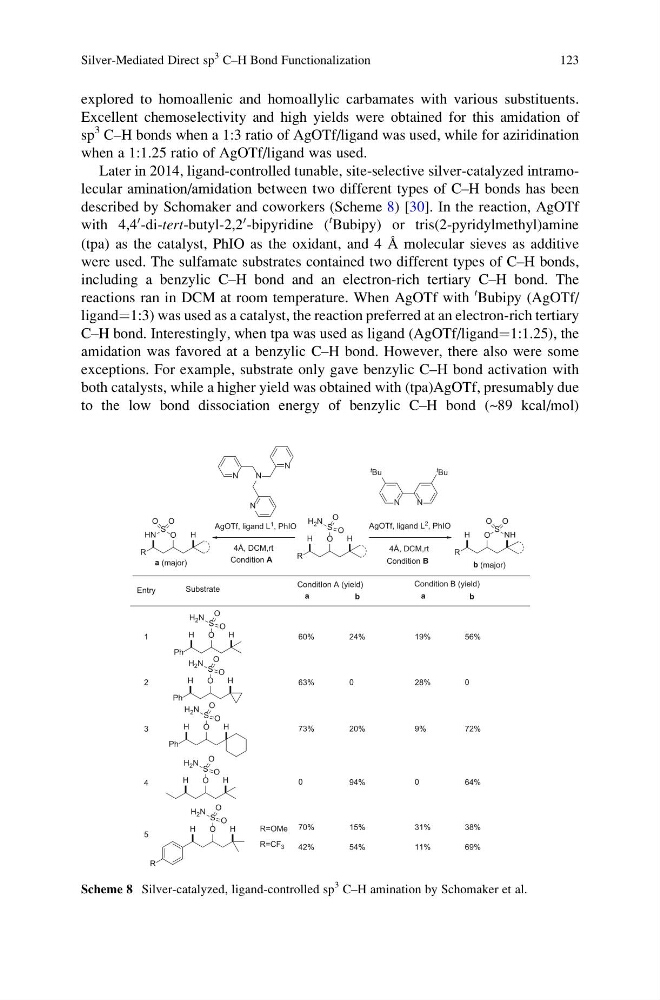
Later in 2014, ligand-controlled tunable, site-selective silver-catalyzed intramolecular amination/amidation between two different types of C–H bonds has been
described by Schomaker and coworkers (Scheme 8) [30]. In the reaction, AgOTf
with 4,4
0 -di-tert-butyl-2,2
0 -bipyridine (
t
Bubipy) or tris(2-pyridylmethyl)amine
(tpa) as the catalyst, PhIO as the oxidant, and 4 Å molecular sieves as additive
were used. The sulfamate substrates contained two different types of C–H bonds,
including a benzylic C–H bond and an electron-rich tertiary C–H bond. The
reactions ran in DCM at room temperature. When AgOTf with
t
Bubipy (AgOTf/
ligand¼1:3) was used as a catalyst, the reaction preferred at an electron-rich tertiary
C–H bond. Interestingly, when tpa was used as ligand (AgOTf/ligand¼1:1.25), the
amidation was favored at a benzylic C–H bond. However, there also were some
exceptions. For example, substrate only gave benzylic C–H bond activation with
both catalysts, while a higher yield was obtained with (tpa)AgOTf, presumably due
to the low bond dissociation energy of benzylic C–H bond (~89 kcal/mol)
O
H
H
R
S
H 2 N
O
O
O
H
HN
R
S
O O
O
NH
H
R
S
O O
AgOTf, ligand L 1 , PhIO
4Å, DCM,rt
4Å, DCM,rt
N
N
t Bu
t Bu
N
N
N
N
AgOTf, ligand L 2 , PhIO
Condition A
Condition B
a (major)
b (major)
O
H
H
Ph
S
H 2 N
O
O
Substrate
ConditIon A (yield)
Condition B (yield)
a
b
a
b
19%
56%
60%
24%
O
H
H
S
H 2 N
O
O
0
64%
0
94%
O
H
H
Ph
S
H 2 N
O
O
28%
0
63%
0
O
H
H
Ph
S
H 2 N
O
O
9%
72%
73%
20%
O
H
H
S
H 2 N
O
O
Entry
1
2
3
4
5
R
R=OMe
R=CF 3
31%
38%
70%
15%
11%
69%
42%
54%
Scheme 8 Silver-catalyzed, ligand-controlled sp
3 C–H amination by Schomaker et al.
Silver-Mediated Direct sp
3 C–H Bond Functionalization
123
Excellent chemoselectivity and high yields were obtained for this amidation of
sp
3 C–H bonds when a 1:3 ratio of AgOTf/ligand was used, while for aziridination
when a 1:1.25 ratio of AgOTf/ligand was used.
Later in 2014, ligand-controlled tunable, site-selective silver-catalyzed intramolecular amination/amidation between two different types of C–H bonds has been
described by Schomaker and coworkers (Scheme 8) [30]. In the reaction, AgOTf
with 4,4
0 -di-tert-butyl-2,2
0 -bipyridine (
t
Bubipy) or tris(2-pyridylmethyl)amine
(tpa) as the catalyst, PhIO as the oxidant, and 4 Å molecular sieves as additive
were used. The sulfamate substrates contained two different types of C–H bonds,
including a benzylic C–H bond and an electron-rich tertiary C–H bond. The
reactions ran in DCM at room temperature. When AgOTf with
t
Bubipy (AgOTf/
ligand¼1:3) was used as a catalyst, the reaction preferred at an electron-rich tertiary
C–H bond. Interestingly, when tpa was used as ligand (AgOTf/ligand¼1:1.25), the
amidation was favored at a benzylic C–H bond. However, there also were some
exceptions. For example, substrate only gave benzylic C–H bond activation with
both catalysts, while a higher yield was obtained with (tpa)AgOTf, presumably due
to the low bond dissociation energy of benzylic C–H bond (~89 kcal/mol)
O
H
H
R
S
H 2 N
O
O
O
H
HN
R
S
O O
O
NH
H
R
S
O O
AgOTf, ligand L 1 , PhIO
4Å, DCM,rt
4Å, DCM,rt
N
N
t Bu
t Bu
N
N
N
N
AgOTf, ligand L 2 , PhIO
Condition A
Condition B
a (major)
b (major)
O
H
H
Ph
S
H 2 N
O
O
Substrate
ConditIon A (yield)
Condition B (yield)
a
b
a
b
19%
56%
60%
24%
O
H
H
S
H 2 N
O
O
0
64%
0
94%
O
H
H
Ph
S
H 2 N
O
O
28%
0
63%
0
O
H
H
Ph
S
H 2 N
O
O
9%
72%
73%
20%
O
H
H
S
H 2 N
O
O
Entry
1
2
3
4
5
R
R=OMe
R=CF 3
31%
38%
70%
15%
11%
69%
42%
54%
Scheme 8 Silver-catalyzed, ligand-controlled sp
3 C–H amination by Schomaker et al.
Silver-Mediated Direct sp
3 C–H Bond Functionalization
123