

source, and Fomblin HVAC 140/13 (4.0 mL, 1.2 mmol) as the fluorous medium, the
desired product and starting material were collected by trap-to-trap vacuum distillation at room temperature after the first catalytic cycle run in good efficiency. Then
the fresh starting material (1 mL) and EDA (10.5 μL) were added to the distillation
which contained soluble catalyst and the fluorous phase for the second run. This
procedure could be repeated several times. The results were shown in Scheme 3.
The catalyst 7 was used 4 times and observed identical chemo- and regioselectivity
with a slight increase of the reaction time.
Besides a series of tris(pyrazolyl)borate silver complexes, another type of silver
complex 9, discovered by Caulton, Mindiola, and coworkers, could also catalyze
carbene insertion into alkane sp
3 C–H bonds [25]. This silver complex was easily
prepared from Ag 2 O with a bidentated ligand (H(3,5-(CF 3 ) 2 PyrPy). This complex
was an air- and water-stable complex, existing as a trinuclear form. A series of
alkanes, including cyclic, linear, and branched alkanes, were functionalized with
complex 9 at 25
C in moderate to excellent yield (Scheme 3). Interestingly,
compared with the results from Dias and Pe ´rez’s groups by using Tp
X Ag complexes, the opposite regioselectivity was observed from Mindiola’s group by using
complex 9. For example, the regioselectivity for the carbene insertion into
2,3-dimethylbutane C–H bond with complex 9 favored at the tertiary site over the
primary site (ratio 6.7:1, Scheme 3), whereas complex 3 favored at the primary site
over tertiary site (ratio 3:1). The yields of functionalization of linear and branched
alkanes with complex 9 were moderate due to the formation of fumarate, maleate
from EDA, and some unreacted EDA.
In 2013, Lee and coworkers reported silver-mediated intramolecular carbene
insertion to sp
3 C–H from alkyne building blocks, mediated by aryne intermediates
[26]. In this reaction, using silver trifluoromethanesulfonate (AgOTf, 10 mol%) or
AgSbF 6 (10 mol%) as the catalyst and toluene as the solvent at 90
C for 5 h, good to
excellent yields were obtained for various unsymmetrical and symmetrical bis-1,3diyne substrates. All primary, secondary, and tertiary C–H bonds could be activated
to generate the desired five-membered ring product, and secondary C–H bond was
more reactive than primary C–H bond when substrates had two different kinds of
available sp
3 C–H bonds (Scheme 5). For example, sp
3 C–H insertion in substrate
with two different C–H bonds (entry 4) afforded a mixture of secondary and
primary insertion products in high yield (80%) and ratio (13:1).
N 2
H
CO 2 Et
H 3 C
CO 2 Et
H H
H 3 C H +
+ N 2
Tp X Ag, sc-CO 2
P T = 250 atm, 40
o C, 14 h
catalyst loading: 0.03 mmol
initial molar ratio EDA:Tp X Ag = 100:1
160 atm
mmol ethyl propionate
Tp
Br3 Ag
F 21 -Tp 4Bo,3CF3 Ag
F 27 -Tp 4Bo,3CF2CF3 Ag
0.024
0.198
0.204
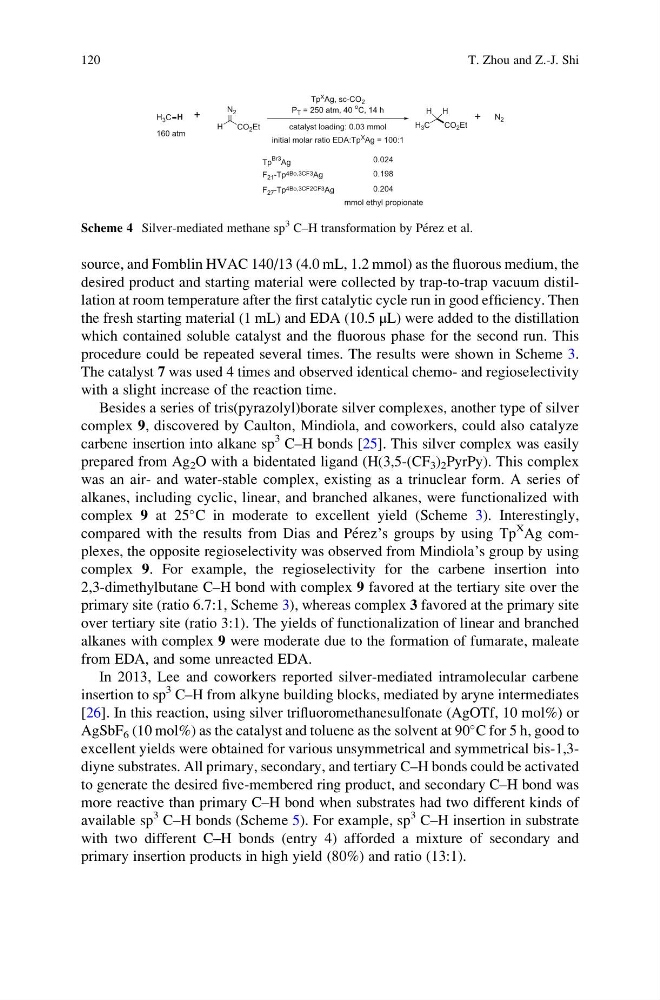
Scheme 4 Silver-mediated methane sp
3 C–H transformation by Pe ´rez et al.
120
T. Zhou and Z.-J. Shi
desired product and starting material were collected by trap-to-trap vacuum distillation at room temperature after the first catalytic cycle run in good efficiency. Then
the fresh starting material (1 mL) and EDA (10.5 μL) were added to the distillation
which contained soluble catalyst and the fluorous phase for the second run. This
procedure could be repeated several times. The results were shown in Scheme 3.
The catalyst 7 was used 4 times and observed identical chemo- and regioselectivity
with a slight increase of the reaction time.
Besides a series of tris(pyrazolyl)borate silver complexes, another type of silver
complex 9, discovered by Caulton, Mindiola, and coworkers, could also catalyze
carbene insertion into alkane sp
3 C–H bonds [25]. This silver complex was easily
prepared from Ag 2 O with a bidentated ligand (H(3,5-(CF 3 ) 2 PyrPy). This complex
was an air- and water-stable complex, existing as a trinuclear form. A series of
alkanes, including cyclic, linear, and branched alkanes, were functionalized with
complex 9 at 25
C in moderate to excellent yield (Scheme 3). Interestingly,
compared with the results from Dias and Pe ´rez’s groups by using Tp
X Ag complexes, the opposite regioselectivity was observed from Mindiola’s group by using
complex 9. For example, the regioselectivity for the carbene insertion into
2,3-dimethylbutane C–H bond with complex 9 favored at the tertiary site over the
primary site (ratio 6.7:1, Scheme 3), whereas complex 3 favored at the primary site
over tertiary site (ratio 3:1). The yields of functionalization of linear and branched
alkanes with complex 9 were moderate due to the formation of fumarate, maleate
from EDA, and some unreacted EDA.
In 2013, Lee and coworkers reported silver-mediated intramolecular carbene
insertion to sp
3 C–H from alkyne building blocks, mediated by aryne intermediates
[26]. In this reaction, using silver trifluoromethanesulfonate (AgOTf, 10 mol%) or
AgSbF 6 (10 mol%) as the catalyst and toluene as the solvent at 90
C for 5 h, good to
excellent yields were obtained for various unsymmetrical and symmetrical bis-1,3diyne substrates. All primary, secondary, and tertiary C–H bonds could be activated
to generate the desired five-membered ring product, and secondary C–H bond was
more reactive than primary C–H bond when substrates had two different kinds of
available sp
3 C–H bonds (Scheme 5). For example, sp
3 C–H insertion in substrate
with two different C–H bonds (entry 4) afforded a mixture of secondary and
primary insertion products in high yield (80%) and ratio (13:1).
N 2
H
CO 2 Et
H 3 C
CO 2 Et
H H
H 3 C H +
+ N 2
Tp X Ag, sc-CO 2
P T = 250 atm, 40
o C, 14 h
catalyst loading: 0.03 mmol
initial molar ratio EDA:Tp X Ag = 100:1
160 atm
mmol ethyl propionate
Tp
Br3 Ag
F 21 -Tp 4Bo,3CF3 Ag
F 27 -Tp 4Bo,3CF2CF3 Ag
0.024
0.198
0.204
Scheme 4 Silver-mediated methane sp
3 C–H transformation by Pe ´rez et al.
120
T. Zhou and Z.-J. Shi