

2.2 Direct C–N Bond Formation
Nitrogen-containing functional groups are basic and important structural motifs,
exiting in biologically active compounds and natural products [27]. The development of new and efficient methods to construct C–N bonds through C–H activation
attracted much attention in medicinal chemistry and organic chemistry. Usually,
there are two ways to introduce C–N bonds via C–H activation, intramolecular and
intermolecular amination/amidation.
2.2.1 Intramolecular Amination/Amidation
In 2004, He and coworkers reported that a disilver (I) complex 10 (Scheme 1)
catalyzed intramolecular amidation of sp
3 C–H bonds in both carbamates and
sulfamates [28]. Using AgNO 3 (4 mol%) with tBu 3 tpy (4-6 mol%) as the catalyst
and PhI(OAc) 2 (2.0 equiv.) as the oxidant in MeCN, the intramolecular amidation
products were obtained in good to excellent yields (53–90%, Scheme 6). The
reaction worked for a range of carbamates and sulfamates, generated fivemembered ring and six-membered ring products. In addition, the optical rotation
of product will remain as an enantiomerically pure sample during the reaction. This
result indicated that the reaction is stereospecific and also provided the evidence to
show that the amination involved a silver-mediated nitrene-transfer mechanism.
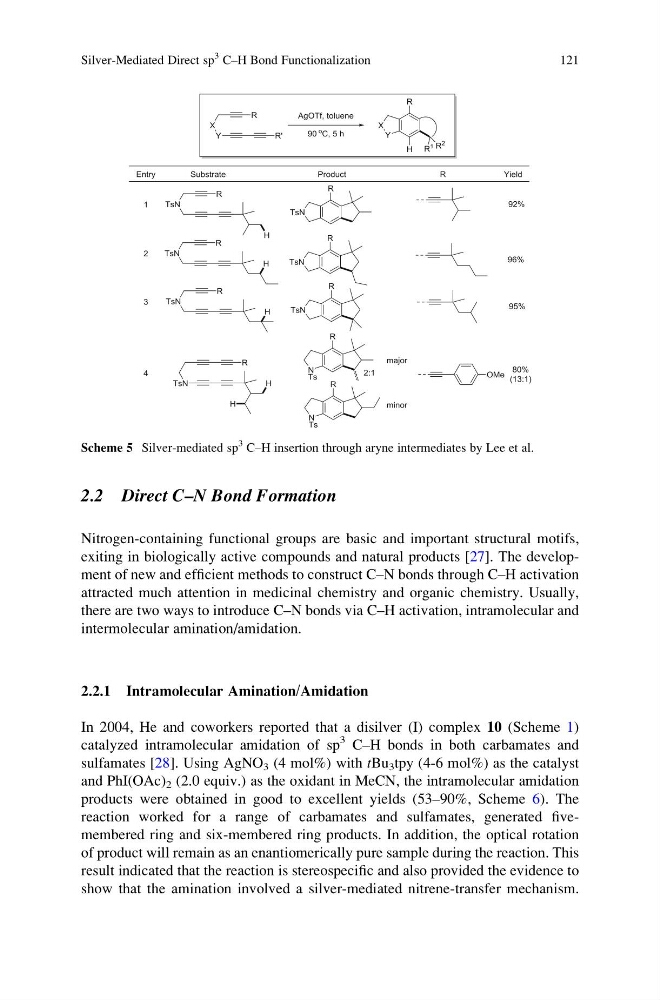
Scheme 5 Silver-mediated sp
3 C–H insertion through aryne intermediates by Lee et al.
Silver-Mediated Direct sp
3 C–H Bond Functionalization
121
Nitrogen-containing functional groups are basic and important structural motifs,
exiting in biologically active compounds and natural products [27]. The development of new and efficient methods to construct C–N bonds through C–H activation
attracted much attention in medicinal chemistry and organic chemistry. Usually,
there are two ways to introduce C–N bonds via C–H activation, intramolecular and
intermolecular amination/amidation.
2.2.1 Intramolecular Amination/Amidation
In 2004, He and coworkers reported that a disilver (I) complex 10 (Scheme 1)
catalyzed intramolecular amidation of sp
3 C–H bonds in both carbamates and
sulfamates [28]. Using AgNO 3 (4 mol%) with tBu 3 tpy (4-6 mol%) as the catalyst
and PhI(OAc) 2 (2.0 equiv.) as the oxidant in MeCN, the intramolecular amidation
products were obtained in good to excellent yields (53–90%, Scheme 6). The
reaction worked for a range of carbamates and sulfamates, generated fivemembered ring and six-membered ring products. In addition, the optical rotation
of product will remain as an enantiomerically pure sample during the reaction. This
result indicated that the reaction is stereospecific and also provided the evidence to
show that the amination involved a silver-mediated nitrene-transfer mechanism.
Scheme 5 Silver-mediated sp
3 C–H insertion through aryne intermediates by Lee et al.
Silver-Mediated Direct sp
3 C–H Bond Functionalization
121