

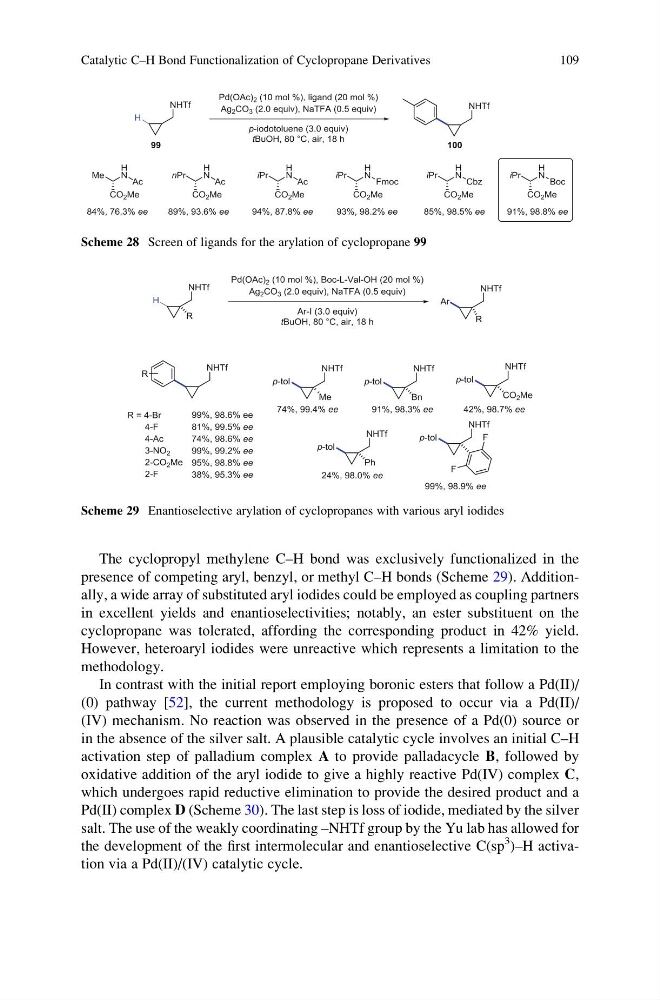
The cyclopropyl methylene C–H bond was exclusively functionalized in the
presence of competing aryl, benzyl, or methyl C–H bonds (Scheme 29). Additionally, a wide array of substituted aryl iodides could be employed as coupling partners
in excellent yields and enantioselectivities; notably, an ester substituent on the
cyclopropane was tolerated, affording the corresponding product in 42% yield.
However, heteroaryl iodides were unreactive which represents a limitation to the
methodology.
In contrast with the initial report employing boronic esters that follow a Pd(II)/
(0) pathway [52], the current methodology is proposed to occur via a Pd(II)/
(IV) mechanism. No reaction was observed in the presence of a Pd(0) source or
in the absence of the silver salt. A plausible catalytic cycle involves an initial C–H
activation step of palladium complex A to provide palladacycle B, followed by
oxidative addition of the aryl iodide to give a highly reactive Pd(IV) complex C,
which undergoes rapid reductive elimination to provide the desired product and a
Pd(II) complex D (Scheme 30). The last step is loss of iodide, mediated by the silver
salt. The use of the weakly coordinating –NHTf group by the Yu lab has allowed for
the development of the first intermolecular and enantioselective C(sp
3 )–H activation via a Pd(II)/(IV) catalytic cycle.
Scheme 28 Screen of ligands for the arylation of cyclopropane 99
Scheme 29 Enantioselective arylation of cyclopropanes with various aryl iodides
Catalytic C–H Bond Functionalization of Cyclopropane Derivatives
109
presence of competing aryl, benzyl, or methyl C–H bonds (Scheme 29). Additionally, a wide array of substituted aryl iodides could be employed as coupling partners
in excellent yields and enantioselectivities; notably, an ester substituent on the
cyclopropane was tolerated, affording the corresponding product in 42% yield.
However, heteroaryl iodides were unreactive which represents a limitation to the
methodology.
In contrast with the initial report employing boronic esters that follow a Pd(II)/
(0) pathway [52], the current methodology is proposed to occur via a Pd(II)/
(IV) mechanism. No reaction was observed in the presence of a Pd(0) source or
in the absence of the silver salt. A plausible catalytic cycle involves an initial C–H
activation step of palladium complex A to provide palladacycle B, followed by
oxidative addition of the aryl iodide to give a highly reactive Pd(IV) complex C,
which undergoes rapid reductive elimination to provide the desired product and a
Pd(II) complex D (Scheme 30). The last step is loss of iodide, mediated by the silver
salt. The use of the weakly coordinating –NHTf group by the Yu lab has allowed for
the development of the first intermolecular and enantioselective C(sp
3 )–H activation via a Pd(II)/(IV) catalytic cycle.
Scheme 28 Screen of ligands for the arylation of cyclopropane 99
Scheme 29 Enantioselective arylation of cyclopropanes with various aryl iodides
Catalytic C–H Bond Functionalization of Cyclopropane Derivatives
109