

6 Conclusion and Outlook
Over the last decade, continued interest in transition-metal-catalyzed C(sp
3 )–H
bond functionalization reactions has allowed for the development of several methodologies for direct transformations of cyclopropanes. Intramolecular reactions
resulted in the synthesis of biologically relevant cyclopropyloxindoles, as well as
access to complex quinoline- or benzazepine-type products. Intermolecular transformations employed strongly binding auxiliaries or weakly coordinating directing
groups to achieve arylation of cyclopropanes. A significant breakthrough
represented the asymmetric direct arylation of cyclopropanes; in particular, contributions from the Yu group have put forward the use of mono-protected amino acids
as chiral ligands in Pd(0)/(II) or Pd(II)/(IV) catalysis. Although at the moment the
use of Pd salts as catalysts for the activation of cyclopropanes is predominant, it is
desirable that less expensive metals such as Cu, Fe, Ni, or Co are also explored for
the transformation.
References
1. Wong HNC, Hon MY, Tse CW, Yip YC, Tanko J, Hudlicky T (1989) Use of cyclopropanes
and their derivatives in organic synthesis. Chem Rev 89(1):165–198
2. de Meijere A (1979) Bonding properties of cyclopropane and their chemical consequences.
Angew Chem Int Ed 18(11):809–826
3. Exner K, Schleyer PR (2001) Theoretical bond energies: a critical evaluation. J Phys Chem A
105(13):3407–3416
4. Chen DYK, Pouwer RH, Richard J-A (2012) Recent advances in the total synthesis of
cyclopropane-containing natural products. Chem Soc Rev 41(13):4631–4642
5. Pietruszka J (2003) Synthesis and properties of oligocyclopropyl-containing natural products
and model compounds. Chem Rev 103(4):1051–1070
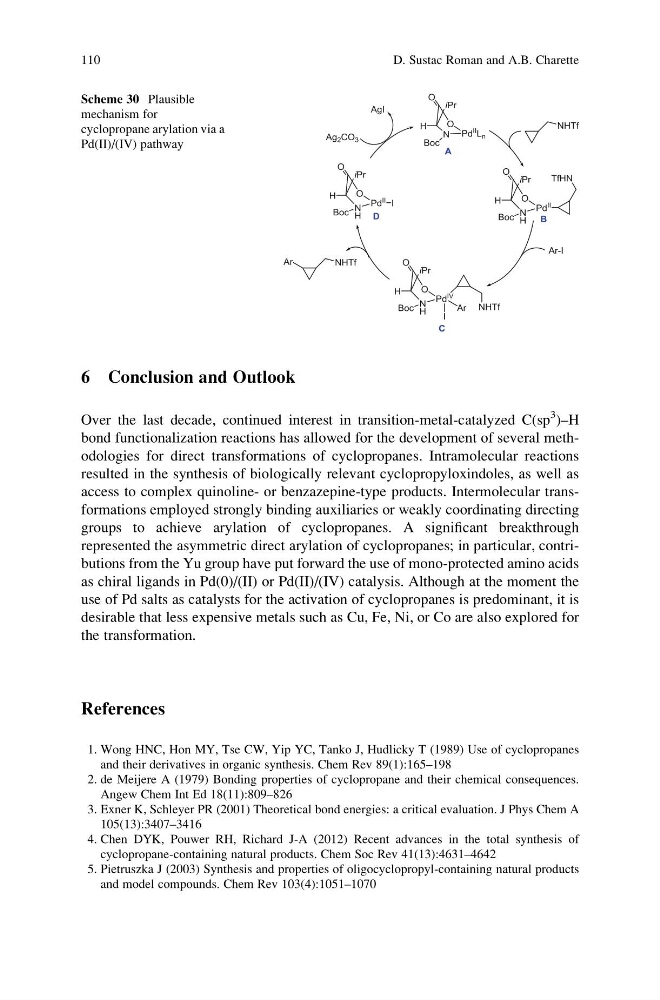
Scheme 30 Plausible
mechanism for
cyclopropane arylation via a
Pd(II)/(IV) pathway
110
D. Sustac Roman and A.B. Charette
Over the last decade, continued interest in transition-metal-catalyzed C(sp
3 )–H
bond functionalization reactions has allowed for the development of several methodologies for direct transformations of cyclopropanes. Intramolecular reactions
resulted in the synthesis of biologically relevant cyclopropyloxindoles, as well as
access to complex quinoline- or benzazepine-type products. Intermolecular transformations employed strongly binding auxiliaries or weakly coordinating directing
groups to achieve arylation of cyclopropanes. A significant breakthrough
represented the asymmetric direct arylation of cyclopropanes; in particular, contributions from the Yu group have put forward the use of mono-protected amino acids
as chiral ligands in Pd(0)/(II) or Pd(II)/(IV) catalysis. Although at the moment the
use of Pd salts as catalysts for the activation of cyclopropanes is predominant, it is
desirable that less expensive metals such as Cu, Fe, Ni, or Co are also explored for
the transformation.
References
1. Wong HNC, Hon MY, Tse CW, Yip YC, Tanko J, Hudlicky T (1989) Use of cyclopropanes
and their derivatives in organic synthesis. Chem Rev 89(1):165–198
2. de Meijere A (1979) Bonding properties of cyclopropane and their chemical consequences.
Angew Chem Int Ed 18(11):809–826
3. Exner K, Schleyer PR (2001) Theoretical bond energies: a critical evaluation. J Phys Chem A
105(13):3407–3416
4. Chen DYK, Pouwer RH, Richard J-A (2012) Recent advances in the total synthesis of
cyclopropane-containing natural products. Chem Soc Rev 41(13):4631–4642
5. Pietruszka J (2003) Synthesis and properties of oligocyclopropyl-containing natural products
and model compounds. Chem Rev 103(4):1051–1070
Scheme 30 Plausible
mechanism for
cyclopropane arylation via a
Pd(II)/(IV) pathway
110
D. Sustac Roman and A.B. Charette