

temperatures (70
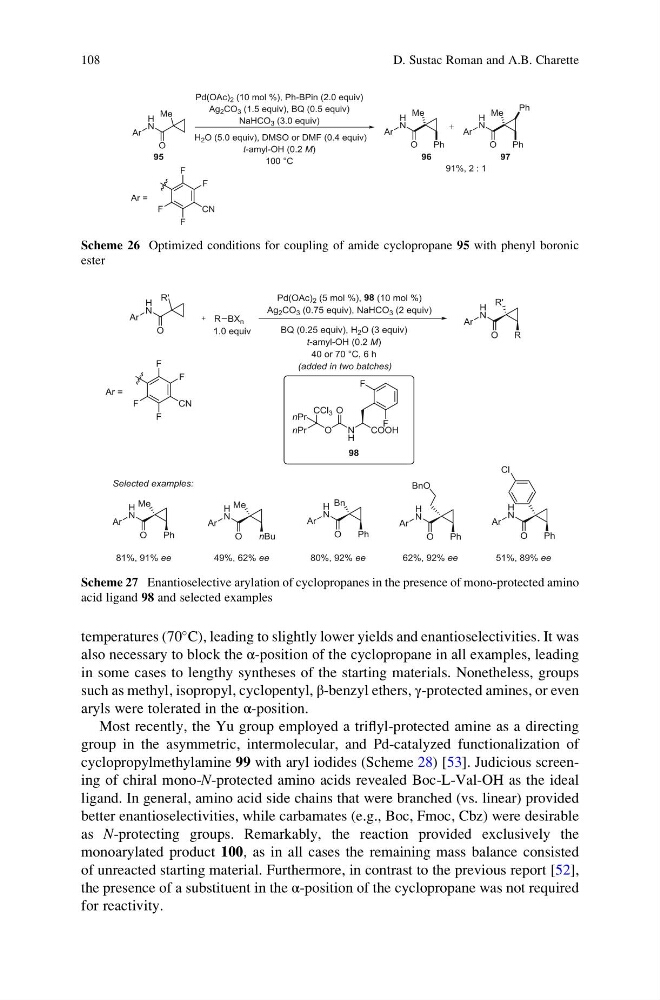
C), leading to slightly lower yields and enantioselectivities. It was
also necessary to block the α-position of the cyclopropane in all examples, leading
in some cases to lengthy syntheses of the starting materials. Nonetheless, groups
such as methyl, isopropyl, cyclopentyl, β-benzyl ethers, γ-protected amines, or even
aryls were tolerated in the α-position.
Most recently, the Yu group employed a triflyl-protected amine as a directing
group in the asymmetric, intermolecular, and Pd-catalyzed functionalization of
cyclopropylmethylamine 99 with aryl iodides (Scheme 28) [53]. Judicious screening of chiral mono-N-protected amino acids revealed Boc-L-Val-OH as the ideal
ligand. In general, amino acid side chains that were branched (vs. linear) provided
better enantioselectivities, while carbamates (e.g., Boc, Fmoc, Cbz) were desirable
as N-protecting groups. Remarkably, the reaction provided exclusively the
monoarylated product 100, as in all cases the remaining mass balance consisted
of unreacted starting material. Furthermore, in contrast to the previous report [52],
the presence of a substituent in the α-position of the cyclopropane was not required
for reactivity.
Scheme 26 Optimized conditions for coupling of amide cyclopropane 95 with phenyl boronic
ester
Scheme 27 Enantioselective arylation of cyclopropanes in the presence of mono-protected amino
acid ligand 98 and selected examples
108
D. Sustac Roman and A.B. Charette
C), leading to slightly lower yields and enantioselectivities. It was
also necessary to block the α-position of the cyclopropane in all examples, leading
in some cases to lengthy syntheses of the starting materials. Nonetheless, groups
such as methyl, isopropyl, cyclopentyl, β-benzyl ethers, γ-protected amines, or even
aryls were tolerated in the α-position.
Most recently, the Yu group employed a triflyl-protected amine as a directing
group in the asymmetric, intermolecular, and Pd-catalyzed functionalization of
cyclopropylmethylamine 99 with aryl iodides (Scheme 28) [53]. Judicious screening of chiral mono-N-protected amino acids revealed Boc-L-Val-OH as the ideal
ligand. In general, amino acid side chains that were branched (vs. linear) provided
better enantioselectivities, while carbamates (e.g., Boc, Fmoc, Cbz) were desirable
as N-protecting groups. Remarkably, the reaction provided exclusively the
monoarylated product 100, as in all cases the remaining mass balance consisted
of unreacted starting material. Furthermore, in contrast to the previous report [52],
the presence of a substituent in the α-position of the cyclopropane was not required
for reactivity.
Scheme 26 Optimized conditions for coupling of amide cyclopropane 95 with phenyl boronic
ester
Scheme 27 Enantioselective arylation of cyclopropanes in the presence of mono-protected amino
acid ligand 98 and selected examples
108
D. Sustac Roman and A.B. Charette