

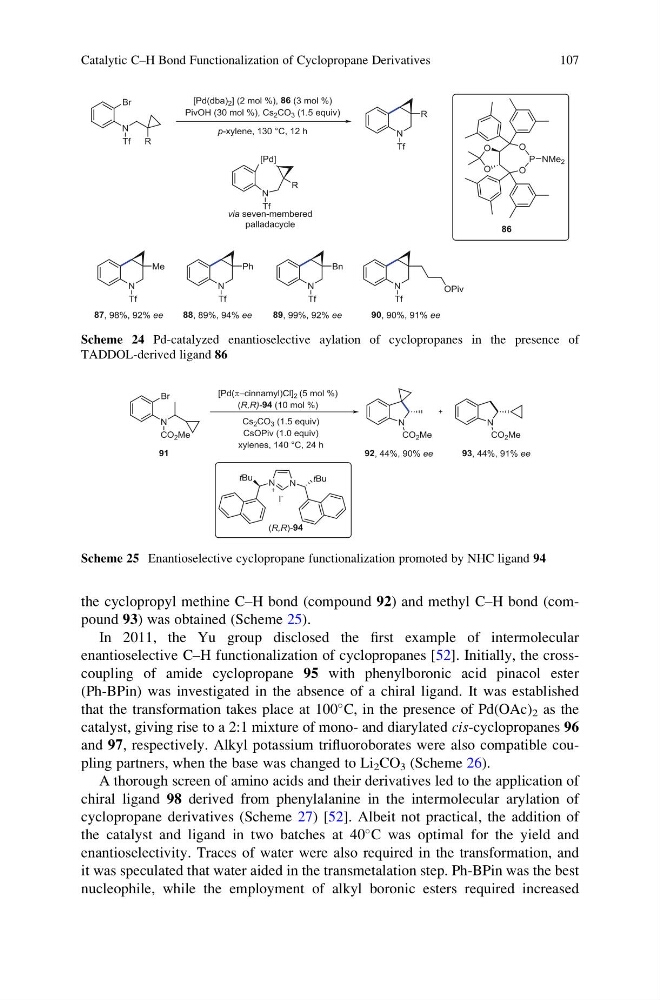
the cyclopropyl methine C–H bond (compound 92) and methyl C–H bond (compound 93) was obtained (Scheme 25).
In 2011, the Yu group disclosed the first example of intermolecular
enantioselective C–H functionalization of cyclopropanes [52]. Initially, the crosscoupling of amide cyclopropane 95 with phenylboronic acid pinacol ester
(Ph-BPin) was investigated in the absence of a chiral ligand. It was established
that the transformation takes place at 100
C, in the presence of Pd(OAc) 2 as the
catalyst, giving rise to a 2:1 mixture of mono- and diarylated cis-cyclopropanes 96
and 97, respectively. Alkyl potassium trifluoroborates were also compatible coupling partners, when the base was changed to Li 2 CO 3 (Scheme 26).
A thorough screen of amino acids and their derivatives led to the application of
chiral ligand 98 derived from phenylalanine in the intermolecular arylation of
cyclopropane derivatives (Scheme 27) [52]. Albeit not practical, the addition of
the catalyst and ligand in two batches at 40
C was optimal for the yield and
enantioselectivity. Traces of water were also required in the transformation, and
it was speculated that water aided in the transmetalation step. Ph-BPin was the best
nucleophile, while the employment of alkyl boronic esters required increased
Scheme 24 Pd-catalyzed enantioselective aylation of cyclopropanes in the presence of
TADDOL-derived ligand 86
Scheme 25 Enantioselective cyclopropane functionalization promoted by NHC ligand 94
Catalytic C–H Bond Functionalization of Cyclopropane Derivatives
107
In 2011, the Yu group disclosed the first example of intermolecular
enantioselective C–H functionalization of cyclopropanes [52]. Initially, the crosscoupling of amide cyclopropane 95 with phenylboronic acid pinacol ester
(Ph-BPin) was investigated in the absence of a chiral ligand. It was established
that the transformation takes place at 100
C, in the presence of Pd(OAc) 2 as the
catalyst, giving rise to a 2:1 mixture of mono- and diarylated cis-cyclopropanes 96
and 97, respectively. Alkyl potassium trifluoroborates were also compatible coupling partners, when the base was changed to Li 2 CO 3 (Scheme 26).
A thorough screen of amino acids and their derivatives led to the application of
chiral ligand 98 derived from phenylalanine in the intermolecular arylation of
cyclopropane derivatives (Scheme 27) [52]. Albeit not practical, the addition of
the catalyst and ligand in two batches at 40
C was optimal for the yield and
enantioselectivity. Traces of water were also required in the transformation, and
it was speculated that water aided in the transmetalation step. Ph-BPin was the best
nucleophile, while the employment of alkyl boronic esters required increased
Scheme 24 Pd-catalyzed enantioselective aylation of cyclopropanes in the presence of
TADDOL-derived ligand 86
Scheme 25 Enantioselective cyclopropane functionalization promoted by NHC ligand 94
Catalytic C–H Bond Functionalization of Cyclopropane Derivatives
107