

5 Enantioselective Direct Functionalization
of Cyclopropanes
The asymmetric synthesis of cyclopropanes has attracted continual efforts in
organic synthesis, due to their relevance in natural products and biologically active
compounds. The prevalent methods employed include halomethylmetal mediated
processes in the presence of chiral auxiliaries/catalysts (Simmons–Smith-type
reactions), transition-metal-catalyzed decomposition of diazoalkanes, Michaelinduced ring closures, or asymmetric metalations [8–10, 46]. However, the asymmetric preparation of unfunctionalized cyclopropanes remains relatively
undisclosed. The enantioselective activation of unactivated C–H bonds via
transition-metal catalysis is an area of active research in organic chemistry [47–
49]. Recently, a few groups investigated the enantioselective synthesis of cyclopropanes by direct functionalization reactions.
An intramolecular process for the asymmetric Pd-catalyzed C–H arylation of
cyclopropanes was published by the Cramer group [50]. An initial screening of
different classes of ligands found TADDOL-type phosphoramidites promising in
the synthesis of tetrahydroquinoline 87. Fine-tuning of the TADDOL structure
revealed that ligand 86, containing 3,5-xylyl substituents, along with the addition
of catalytic amounts of pivalic acid to the reaction, provided the best yields and
enantiomeric excesses (Scheme 24). The transformation also represented a rare
example of the formation of a seven-membered palladacycle as a reaction intermediate. Notably, the cyclization can be performed with catalyst loadings as low as
1 mol%, without affecting the yield or enantioselectivity. Various α-substituted
cyclopropanes were tolerated in the reaction to provide the corresponding
tetrahydroquinolines 87–90. Of note, the presence of a phenyl or benzyl group in
compounds 88 and 89, respectively, did not result in a competing C(sp
2 )–H
functionalization. In contrast, the absence of α-substitution led to the synthesis of
spiroindolines (Scheme 14, vide supra). The triflyl group of 88 was cleaved by
reaction with Red-Al in an excellent 99% yield.
A system consisting of a chiral NHC ligand and a Pd(0) catalyst was shown to
activate racemic cyclopropyl substrate 91 in a publication by Ku ¨ndig et al. [51]. The
reaction was not selective as a 1:1 mixture of products arising from the reaction of
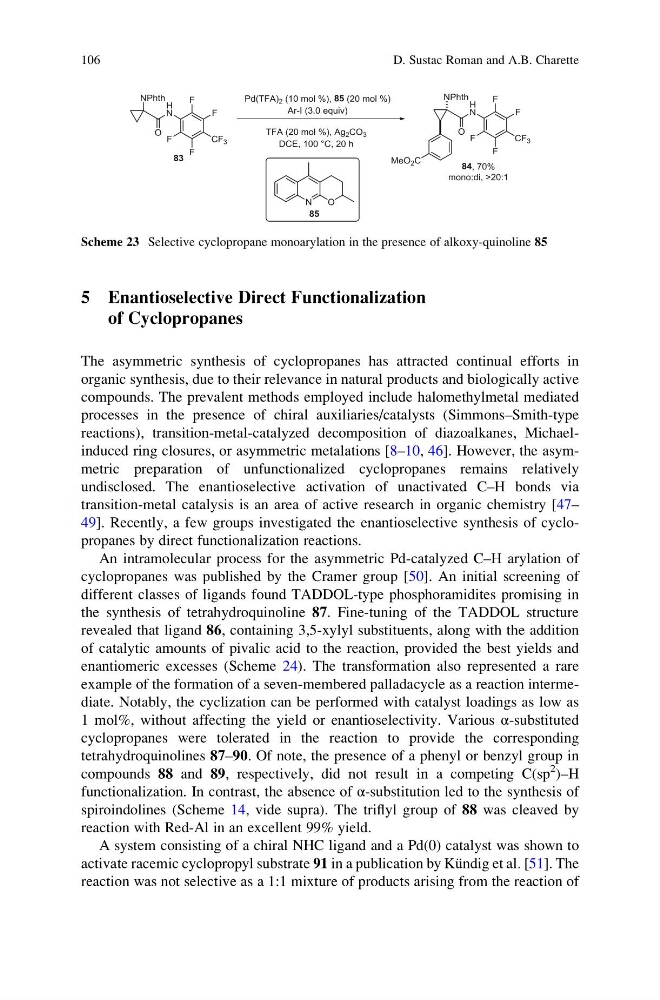
Scheme 23 Selective cyclopropane monoarylation in the presence of alkoxy-quinoline 85
106
D. Sustac Roman and A.B. Charette
of Cyclopropanes
The asymmetric synthesis of cyclopropanes has attracted continual efforts in
organic synthesis, due to their relevance in natural products and biologically active
compounds. The prevalent methods employed include halomethylmetal mediated
processes in the presence of chiral auxiliaries/catalysts (Simmons–Smith-type
reactions), transition-metal-catalyzed decomposition of diazoalkanes, Michaelinduced ring closures, or asymmetric metalations [8–10, 46]. However, the asymmetric preparation of unfunctionalized cyclopropanes remains relatively
undisclosed. The enantioselective activation of unactivated C–H bonds via
transition-metal catalysis is an area of active research in organic chemistry [47–
49]. Recently, a few groups investigated the enantioselective synthesis of cyclopropanes by direct functionalization reactions.
An intramolecular process for the asymmetric Pd-catalyzed C–H arylation of
cyclopropanes was published by the Cramer group [50]. An initial screening of
different classes of ligands found TADDOL-type phosphoramidites promising in
the synthesis of tetrahydroquinoline 87. Fine-tuning of the TADDOL structure
revealed that ligand 86, containing 3,5-xylyl substituents, along with the addition
of catalytic amounts of pivalic acid to the reaction, provided the best yields and
enantiomeric excesses (Scheme 24). The transformation also represented a rare
example of the formation of a seven-membered palladacycle as a reaction intermediate. Notably, the cyclization can be performed with catalyst loadings as low as
1 mol%, without affecting the yield or enantioselectivity. Various α-substituted
cyclopropanes were tolerated in the reaction to provide the corresponding
tetrahydroquinolines 87–90. Of note, the presence of a phenyl or benzyl group in
compounds 88 and 89, respectively, did not result in a competing C(sp
2 )–H
functionalization. In contrast, the absence of α-substitution led to the synthesis of
spiroindolines (Scheme 14, vide supra). The triflyl group of 88 was cleaved by
reaction with Red-Al in an excellent 99% yield.
A system consisting of a chiral NHC ligand and a Pd(0) catalyst was shown to
activate racemic cyclopropyl substrate 91 in a publication by Ku ¨ndig et al. [51]. The
reaction was not selective as a 1:1 mixture of products arising from the reaction of
Scheme 23 Selective cyclopropane monoarylation in the presence of alkoxy-quinoline 85
106
D. Sustac Roman and A.B. Charette