

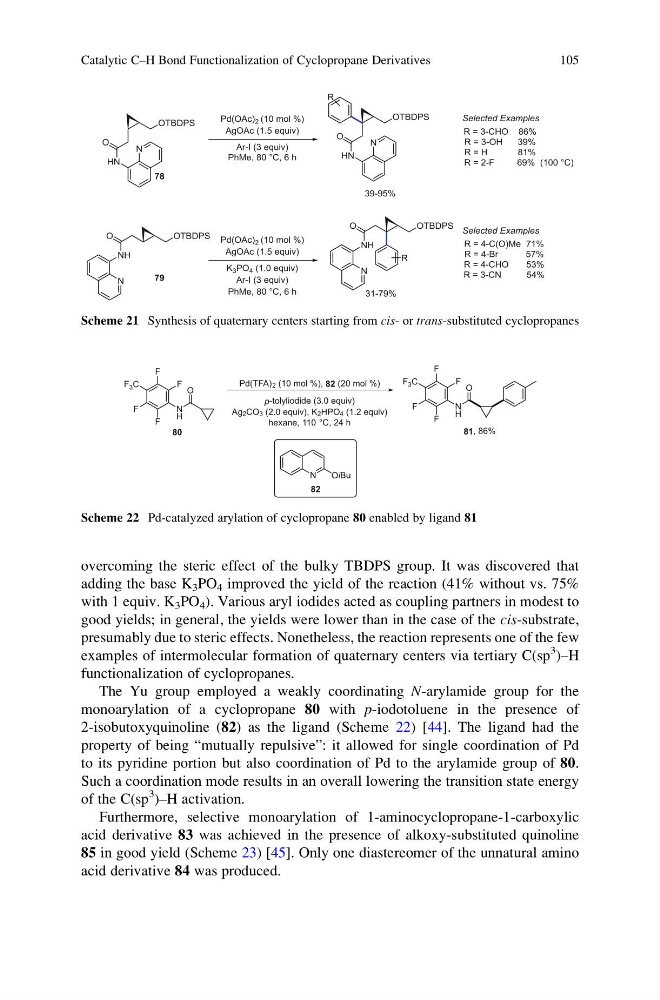
overcoming the steric effect of the bulky TBDPS group. It was discovered that
adding the base K 3 PO 4 improved the yield of the reaction (41% without vs. 75%
with 1 equiv. K 3 PO 4 ). Various aryl iodides acted as coupling partners in modest to
good yields; in general, the yields were lower than in the case of the cis-substrate,
presumably due to steric effects. Nonetheless, the reaction represents one of the few
examples of intermolecular formation of quaternary centers via tertiary C(sp
3 )–H
functionalization of cyclopropanes.
The Yu group employed a weakly coordinating N-arylamide group for the
monoarylation of a cyclopropane 80 with p-iodotoluene in the presence of
2-isobutoxyquinoline (82) as the ligand (Scheme 22) [44]. The ligand had the
property of being “mutually repulsive”: it allowed for single coordination of Pd
to its pyridine portion but also coordination of Pd to the arylamide group of 80.
Such a coordination mode results in an overall lowering the transition state energy
of the C(sp
3
)–H activation.
Furthermore, selective monoarylation of 1-aminocyclopropane-1-carboxylic
acid derivative 83 was achieved in the presence of alkoxy-substituted quinoline
85 in good yield (Scheme 23) [45]. Only one diastereomer of the unnatural amino
acid derivative 84 was produced.
Scheme 21 Synthesis of quaternary centers starting from cis- or trans-substituted cyclopropanes
O
N
H
F
F
F
F 3 C
F
Pd(TFA)2 (10 mol %), 82 (20 mol %)
80
p-tolyliodide (3.0 equiv)
Ag2CO3 (2.0 equiv), K2HPO4 (1.2 equiv)
hexane, 110 °C, 24 h
O
N
H
F
F
F
F 3 C
F
81, 86%
N
OiBu
82
Scheme 22 Pd-catalyzed arylation of cyclopropane 80 enabled by ligand 81
Catalytic C–H Bond Functionalization of Cyclopropane Derivatives
105
adding the base K 3 PO 4 improved the yield of the reaction (41% without vs. 75%
with 1 equiv. K 3 PO 4 ). Various aryl iodides acted as coupling partners in modest to
good yields; in general, the yields were lower than in the case of the cis-substrate,
presumably due to steric effects. Nonetheless, the reaction represents one of the few
examples of intermolecular formation of quaternary centers via tertiary C(sp
3 )–H
functionalization of cyclopropanes.
The Yu group employed a weakly coordinating N-arylamide group for the
monoarylation of a cyclopropane 80 with p-iodotoluene in the presence of
2-isobutoxyquinoline (82) as the ligand (Scheme 22) [44]. The ligand had the
property of being “mutually repulsive”: it allowed for single coordination of Pd
to its pyridine portion but also coordination of Pd to the arylamide group of 80.
Such a coordination mode results in an overall lowering the transition state energy
of the C(sp
3
)–H activation.
Furthermore, selective monoarylation of 1-aminocyclopropane-1-carboxylic
acid derivative 83 was achieved in the presence of alkoxy-substituted quinoline
85 in good yield (Scheme 23) [45]. Only one diastereomer of the unnatural amino
acid derivative 84 was produced.
Scheme 21 Synthesis of quaternary centers starting from cis- or trans-substituted cyclopropanes
O
N
H
F
F
F
F 3 C
F
Pd(TFA)2 (10 mol %), 82 (20 mol %)
80
p-tolyliodide (3.0 equiv)
Ag2CO3 (2.0 equiv), K2HPO4 (1.2 equiv)
hexane, 110 °C, 24 h
O
N
H
F
F
F
F 3 C
F
81, 86%
N
OiBu
82
Scheme 22 Pd-catalyzed arylation of cyclopropane 80 enabled by ligand 81
Catalytic C–H Bond Functionalization of Cyclopropane Derivatives
105