

Mechanistic evidence from the Daugulis lab [36, 37] and others [42] supports a
Pd(II)/(IV) pathway for bidentate-directed C–H functionalization. Sustac and
Charette also investigated the mechanism of their cyclopropane arylation [40]. It
was determined that an acetate source was necessary for the reaction to proceed,
because it is presumably involved in the CMD step. Both Pd(0) and Pd(II) sources
could be employed in the Ag-mediated reaction. The silver source is proposed to aid
with catalyst regeneration by removing iodide or, in the case of Pd(0) sources, to
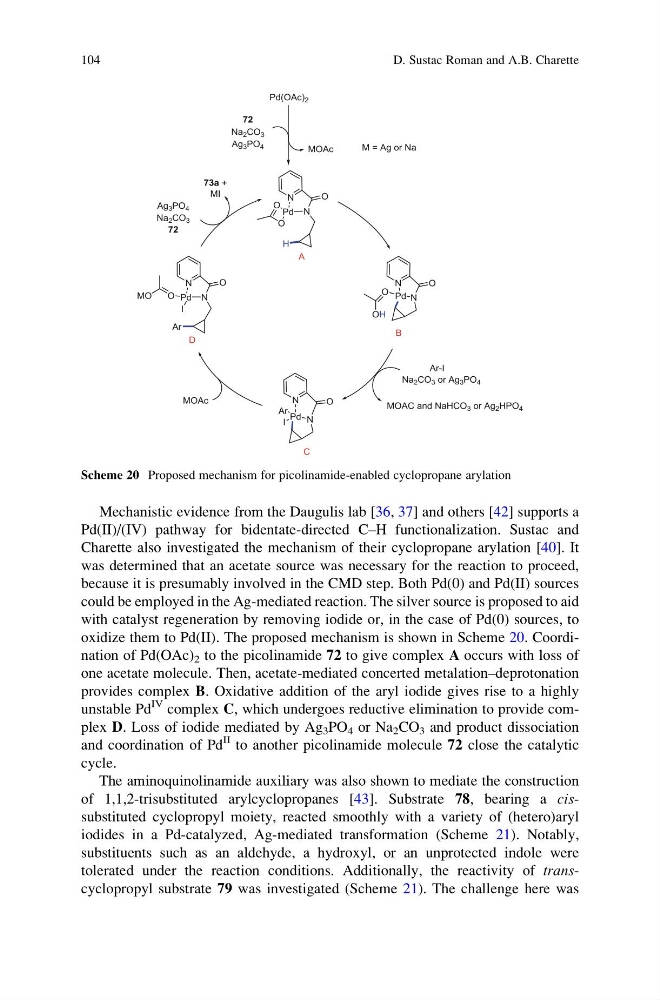
oxidize them to Pd(II). The proposed mechanism is shown in Scheme 20. Coordination of Pd(OAc) 2 to the picolinamide 72 to give complex A occurs with loss of
one acetate molecule. Then, acetate-mediated concerted metalation–deprotonation
provides complex B. Oxidative addition of the aryl iodide gives rise to a highly
unstable Pd
IV complex C, which undergoes reductive elimination to provide complex D. Loss of iodide mediated by Ag 3 PO 4 or Na 2 CO 3 and product dissociation
and coordination of Pd
II to another picolinamide molecule 72 close the catalytic
cycle.
The aminoquinolinamide auxiliary was also shown to mediate the construction
of 1,1,2-trisubstituted arylcyclopropanes [43]. Substrate 78, bearing a cissubstituted cyclopropyl moiety, reacted smoothly with a variety of (hetero)aryl
iodides in a Pd-catalyzed, Ag-mediated transformation (Scheme 21). Notably,
substituents such as an aldehyde, a hydroxyl, or an unprotected indole were
tolerated under the reaction conditions. Additionally, the reactivity of transcyclopropyl substrate 79 was investigated (Scheme 21). The challenge here was
Scheme 20 Proposed mechanism for picolinamide-enabled cyclopropane arylation
104
D. Sustac Roman and A.B. Charette
Pd(II)/(IV) pathway for bidentate-directed C–H functionalization. Sustac and
Charette also investigated the mechanism of their cyclopropane arylation [40]. It
was determined that an acetate source was necessary for the reaction to proceed,
because it is presumably involved in the CMD step. Both Pd(0) and Pd(II) sources
could be employed in the Ag-mediated reaction. The silver source is proposed to aid
with catalyst regeneration by removing iodide or, in the case of Pd(0) sources, to
oxidize them to Pd(II). The proposed mechanism is shown in Scheme 20. Coordination of Pd(OAc) 2 to the picolinamide 72 to give complex A occurs with loss of
one acetate molecule. Then, acetate-mediated concerted metalation–deprotonation
provides complex B. Oxidative addition of the aryl iodide gives rise to a highly
unstable Pd
IV complex C, which undergoes reductive elimination to provide complex D. Loss of iodide mediated by Ag 3 PO 4 or Na 2 CO 3 and product dissociation
and coordination of Pd
II to another picolinamide molecule 72 close the catalytic
cycle.
The aminoquinolinamide auxiliary was also shown to mediate the construction
of 1,1,2-trisubstituted arylcyclopropanes [43]. Substrate 78, bearing a cissubstituted cyclopropyl moiety, reacted smoothly with a variety of (hetero)aryl
iodides in a Pd-catalyzed, Ag-mediated transformation (Scheme 21). Notably,
substituents such as an aldehyde, a hydroxyl, or an unprotected indole were
tolerated under the reaction conditions. Additionally, the reactivity of transcyclopropyl substrate 79 was investigated (Scheme 21). The challenge here was
Scheme 20 Proposed mechanism for picolinamide-enabled cyclopropane arylation
104
D. Sustac Roman and A.B. Charette