

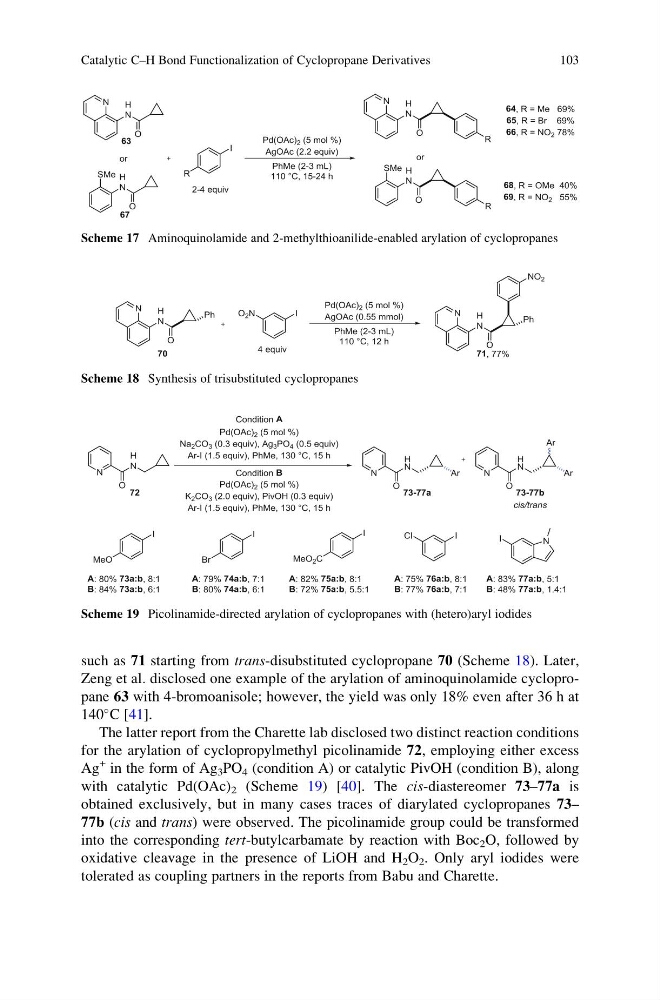
such as 71 starting from trans-disubstituted cyclopropane 70 (Scheme 18). Later,
Zeng et al. disclosed one example of the arylation of aminoquinolamide cyclopropane 63 with 4-bromoanisole; however, the yield was only 18% even after 36 h at
140
C [41].
The latter report from the Charette lab disclosed two distinct reaction conditions
for the arylation of cyclopropylmethyl picolinamide 72, employing either excess
Ag
+ in the form of Ag 3 PO 4 (condition A) or catalytic PivOH (condition B), along
with catalytic Pd(OAc) 2 (Scheme 19) [40]. The cis-diastereomer 73–77a is
obtained exclusively, but in many cases traces of diarylated cyclopropanes 73–
77b (cis and trans) were observed. The picolinamide group could be transformed
into the corresponding tert-butylcarbamate by reaction with Boc 2 O, followed by
oxidative cleavage in the presence of LiOH and H 2 O 2 . Only aryl iodides were
tolerated as coupling partners in the reports from Babu and Charette.
Scheme 17 Aminoquinolamide and 2-methylthioanilide-enabled arylation of cyclopropanes
Scheme 18 Synthesis of trisubstituted cyclopropanes
Scheme 19 Picolinamide-directed arylation of cyclopropanes with (hetero)aryl iodides
Catalytic C–H Bond Functionalization of Cyclopropane Derivatives
103
Zeng et al. disclosed one example of the arylation of aminoquinolamide cyclopropane 63 with 4-bromoanisole; however, the yield was only 18% even after 36 h at
140
C [41].
The latter report from the Charette lab disclosed two distinct reaction conditions
for the arylation of cyclopropylmethyl picolinamide 72, employing either excess
Ag
+ in the form of Ag 3 PO 4 (condition A) or catalytic PivOH (condition B), along
with catalytic Pd(OAc) 2 (Scheme 19) [40]. The cis-diastereomer 73–77a is
obtained exclusively, but in many cases traces of diarylated cyclopropanes 73–
77b (cis and trans) were observed. The picolinamide group could be transformed
into the corresponding tert-butylcarbamate by reaction with Boc 2 O, followed by
oxidative cleavage in the presence of LiOH and H 2 O 2 . Only aryl iodides were
tolerated as coupling partners in the reports from Babu and Charette.
Scheme 17 Aminoquinolamide and 2-methylthioanilide-enabled arylation of cyclopropanes
Scheme 18 Synthesis of trisubstituted cyclopropanes
Scheme 19 Picolinamide-directed arylation of cyclopropanes with (hetero)aryl iodides
Catalytic C–H Bond Functionalization of Cyclopropane Derivatives
103