

4 Intermolecular Direct Functionalization
of Cyclopropanes
The concept of bidentate coordination being able to promote sp
2 or sp
3 C–H
activation has been well known in the literature [35]. In comparison to monodentate
coordination, bidentate groups maintain a higher degree of stereochemical control
around the metal center, which enables the formation of more rigid cyclometalated
species. Daugulis et al. introduced the picolinamide and aminoquinolinamide
auxiliaries for Pd-catalyzed direct arylation of C(sp
2 )–H and C(sp
3 )–H centers
with aryl iodides [36, 37]. The initial report by Daugulis inspired many other
groups to utilize the abovementioned auxiliaries in a wide range of transformations,
including C(sp
3 )–H arylation or C–heteroatom bond formation [38].
In 2013, Babu et al. [39] and Charette et al. [40] disclosed the direct arylation of
cyclopropanes employing the aminoquinolamide and picolinamide auxiliaries,
respectively. Thus, the Babu group showed that the methylene C–H bond of
cyclopropyl substrate 63 can be functionalized with excess aryl iodide in the
presence of catalytic Pd(OAc) 2 and stoichiometric AgOAc (Scheme 17) [39]. 2Methylthioanilide 67 could also be employed as auxiliary; however the arylated
cyclopropanes 68 and 69 were obtained in lower yields. Monoarylated cyclopropanes 64–66 and 68–69 were obtained as the cis-diastereomer; moreover, cisdiarylated cyclopropanes can be obtained when excess (8 equiv.) aryl iodide is
employed. It is also possible to access mixed triarylated cyclopropylcarboxamides
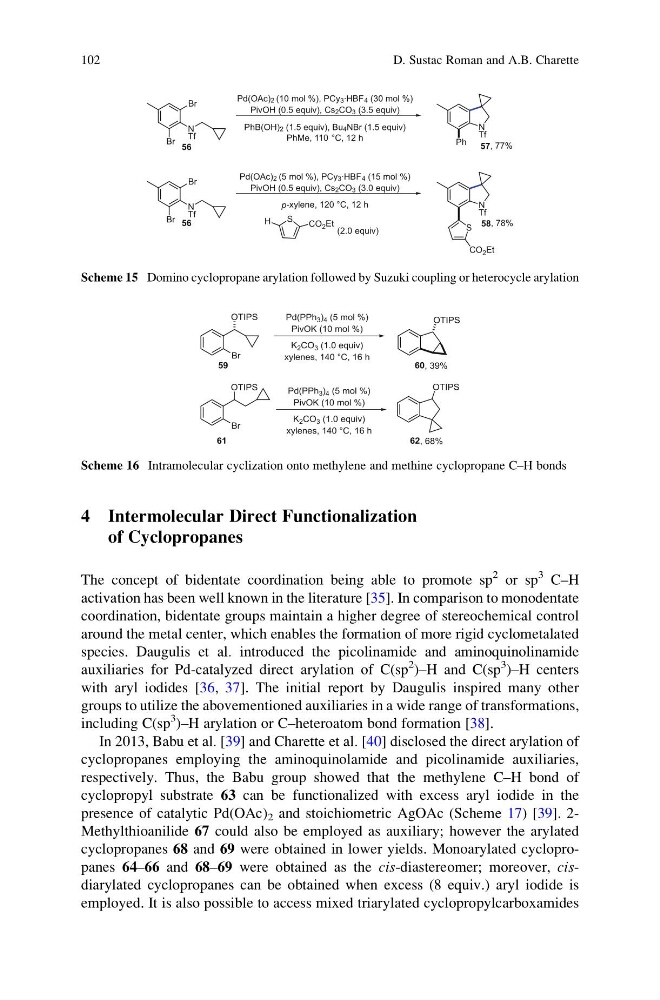
Scheme 16 Intramolecular cyclization onto methylene and methine cyclopropane C–H bonds
Br
N
Tf
Br
Pd(OAc)2 (10 mol %), PCy3·HBF4 (30 mol %)
PivOH (0.5 equiv), Cs2CO3 (3.5 equiv)
PhB(OH)2 (1.5 equiv), Bu4NBr (1.5 equiv)
PhMe, 110 °C, 12 h
N
Tf
Ph
57, 77%
Br
N
Tf
Br
Pd(OAc)2 (5 mol %), PCy3·HBF4 (15 mol %)
PivOH (0.5 equiv), Cs2CO3 (3.0 equiv)
p-xylene, 120 °C, 12 h
N
Tf
58, 78%
S
CO 2 Et
56
56
S
CO 2 Et
H
(2.0 equiv)
Scheme 15 Domino cyclopropane arylation followed by Suzuki coupling or heterocycle arylation
102
D. Sustac Roman and A.B. Charette
of Cyclopropanes
The concept of bidentate coordination being able to promote sp
2 or sp
3 C–H
activation has been well known in the literature [35]. In comparison to monodentate
coordination, bidentate groups maintain a higher degree of stereochemical control
around the metal center, which enables the formation of more rigid cyclometalated
species. Daugulis et al. introduced the picolinamide and aminoquinolinamide
auxiliaries for Pd-catalyzed direct arylation of C(sp
2 )–H and C(sp
3 )–H centers
with aryl iodides [36, 37]. The initial report by Daugulis inspired many other
groups to utilize the abovementioned auxiliaries in a wide range of transformations,
including C(sp
3 )–H arylation or C–heteroatom bond formation [38].
In 2013, Babu et al. [39] and Charette et al. [40] disclosed the direct arylation of
cyclopropanes employing the aminoquinolamide and picolinamide auxiliaries,
respectively. Thus, the Babu group showed that the methylene C–H bond of
cyclopropyl substrate 63 can be functionalized with excess aryl iodide in the
presence of catalytic Pd(OAc) 2 and stoichiometric AgOAc (Scheme 17) [39]. 2Methylthioanilide 67 could also be employed as auxiliary; however the arylated
cyclopropanes 68 and 69 were obtained in lower yields. Monoarylated cyclopropanes 64–66 and 68–69 were obtained as the cis-diastereomer; moreover, cisdiarylated cyclopropanes can be obtained when excess (8 equiv.) aryl iodide is
employed. It is also possible to access mixed triarylated cyclopropylcarboxamides
Scheme 16 Intramolecular cyclization onto methylene and methine cyclopropane C–H bonds
Br
N
Tf
Br
Pd(OAc)2 (10 mol %), PCy3·HBF4 (30 mol %)
PivOH (0.5 equiv), Cs2CO3 (3.5 equiv)
PhB(OH)2 (1.5 equiv), Bu4NBr (1.5 equiv)
PhMe, 110 °C, 12 h
N
Tf
Ph
57, 77%
Br
N
Tf
Br
Pd(OAc)2 (5 mol %), PCy3·HBF4 (15 mol %)
PivOH (0.5 equiv), Cs2CO3 (3.0 equiv)
p-xylene, 120 °C, 12 h
N
Tf
58, 78%
S
CO 2 Et
56
56
S
CO 2 Et
H
(2.0 equiv)
Scheme 15 Domino cyclopropane arylation followed by Suzuki coupling or heterocycle arylation
102
D. Sustac Roman and A.B. Charette