

cyclization on the cyclopropane C–H bond versus ethyl (48), methyl (49), phenyl
(50), and alkene (51). The order of reactivity under the optimized conditions was
determined to be the Heck reaction > cyclopropyl C(sp
3 )–H activation > C(sp
2 )–H
activation > methyl C(sp
3 )–H activation. In addition, the stereochemistry of the
starting material is transmitted to the substrate, as trans-substituted 52 provided
the corresponding trans-spirooxindole in 85% yield.
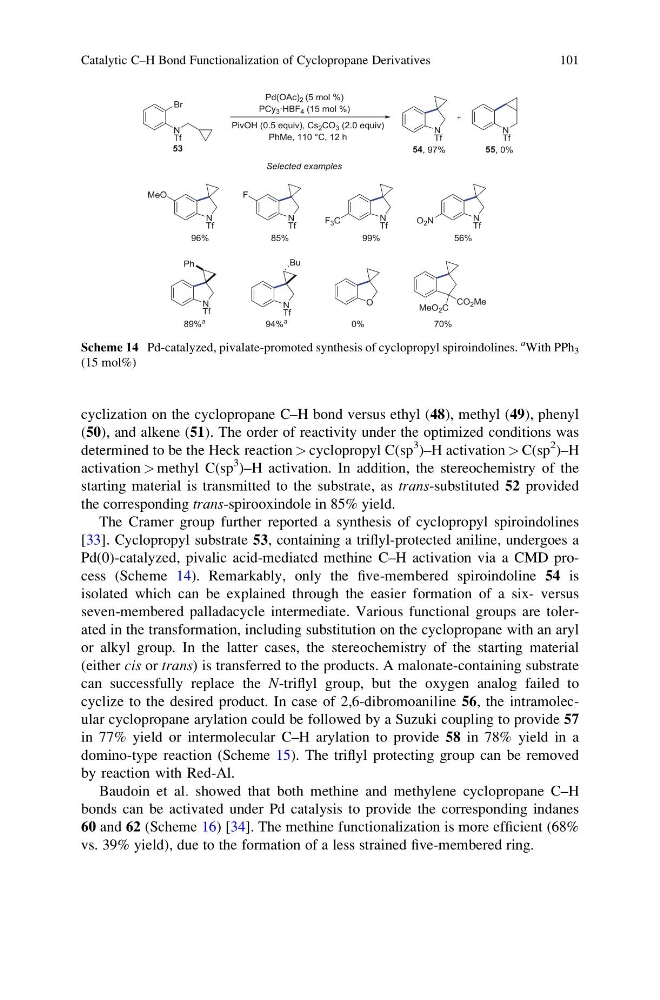
The Cramer group further reported a synthesis of cyclopropyl spiroindolines
[33]. Cyclopropyl substrate 53, containing a triflyl-protected aniline, undergoes a
Pd(0)-catalyzed, pivalic acid-mediated methine C–H activation via a CMD process (Scheme 14). Remarkably, only the five-membered spiroindoline 54 is
isolated which can be explained through the easier formation of a six- versus
seven-membered palladacycle intermediate. Various functional groups are tolerated in the transformation, including substitution on the cyclopropane with an aryl
or alkyl group. In the latter cases, the stereochemistry of the starting material
(either cis or trans) is transferred to the products. A malonate-containing substrate
can successfully replace the N-triflyl group, but the oxygen analog failed to
cyclize to the desired product. In case of 2,6-dibromoaniline 56, the intramolecular cyclopropane arylation could be followed by a Suzuki coupling to provide 57
in 77% yield or intermolecular C–H arylation to provide 58 in 78% yield in a
domino-type reaction (Scheme 15). The triflyl protecting group can be removed
by reaction with Red-Al.
Baudoin et al. showed that both methine and methylene cyclopropane C–H
bonds can be activated under Pd catalysis to provide the corresponding indanes
60 and 62 (Scheme 16) [34]. The methine functionalization is more efficient (68%
vs. 39% yield), due to the formation of a less strained five-membered ring.
Scheme 14 Pd-catalyzed, pivalate-promoted synthesis of cyclopropyl spiroindolines.
a
With PPh 3
(15 mol%)
Catalytic C–H Bond Functionalization of Cyclopropane Derivatives
101
(50), and alkene (51). The order of reactivity under the optimized conditions was
determined to be the Heck reaction > cyclopropyl C(sp
3 )–H activation > C(sp
2 )–H
activation > methyl C(sp
3 )–H activation. In addition, the stereochemistry of the
starting material is transmitted to the substrate, as trans-substituted 52 provided
the corresponding trans-spirooxindole in 85% yield.
The Cramer group further reported a synthesis of cyclopropyl spiroindolines
[33]. Cyclopropyl substrate 53, containing a triflyl-protected aniline, undergoes a
Pd(0)-catalyzed, pivalic acid-mediated methine C–H activation via a CMD process (Scheme 14). Remarkably, only the five-membered spiroindoline 54 is
isolated which can be explained through the easier formation of a six- versus
seven-membered palladacycle intermediate. Various functional groups are tolerated in the transformation, including substitution on the cyclopropane with an aryl
or alkyl group. In the latter cases, the stereochemistry of the starting material
(either cis or trans) is transferred to the products. A malonate-containing substrate
can successfully replace the N-triflyl group, but the oxygen analog failed to
cyclize to the desired product. In case of 2,6-dibromoaniline 56, the intramolecular cyclopropane arylation could be followed by a Suzuki coupling to provide 57
in 77% yield or intermolecular C–H arylation to provide 58 in 78% yield in a
domino-type reaction (Scheme 15). The triflyl protecting group can be removed
by reaction with Red-Al.
Baudoin et al. showed that both methine and methylene cyclopropane C–H
bonds can be activated under Pd catalysis to provide the corresponding indanes
60 and 62 (Scheme 16) [34]. The methine functionalization is more efficient (68%
vs. 39% yield), due to the formation of a less strained five-membered ring.
Scheme 14 Pd-catalyzed, pivalate-promoted synthesis of cyclopropyl spiroindolines.
a
With PPh 3
(15 mol%)
Catalytic C–H Bond Functionalization of Cyclopropane Derivatives
101