

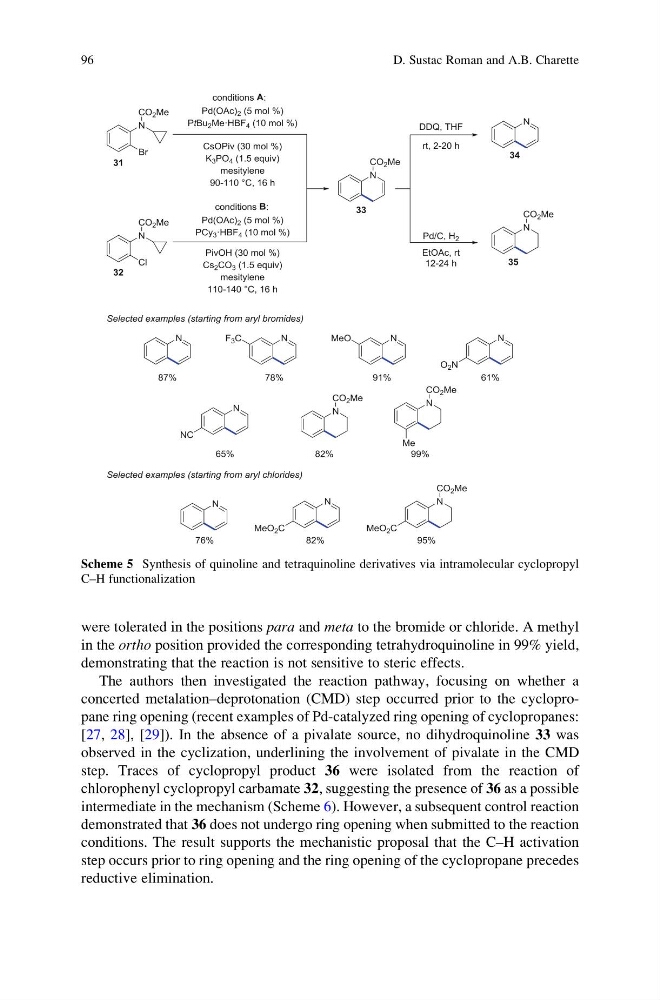
were tolerated in the positions para and meta to the bromide or chloride. A methyl
in the ortho position provided the corresponding tetrahydroquinoline in 99% yield,
demonstrating that the reaction is not sensitive to steric effects.
The authors then investigated the reaction pathway, focusing on whether a
concerted metalation–deprotonation (CMD) step occurred prior to the cyclopropane ring opening (recent examples of Pd-catalyzed ring opening of cyclopropanes:
[27, 28], [29]). In the absence of a pivalate source, no dihydroquinoline 33 was
observed in the cyclization, underlining the involvement of pivalate in the CMD
step. Traces of cyclopropyl product 36 were isolated from the reaction of
chlorophenyl cyclopropyl carbamate 32, suggesting the presence of 36 as a possible
intermediate in the mechanism (Scheme 6). However, a subsequent control reaction
demonstrated that 36 does not undergo ring opening when submitted to the reaction
conditions. The result supports the mechanistic proposal that the C–H activation
step occurs prior to ring opening and the ring opening of the cyclopropane precedes
reductive elimination.
Scheme 5 Synthesis of quinoline and tetraquinoline derivatives via intramolecular cyclopropyl
C–H functionalization
96
D. Sustac Roman and A.B. Charette
in the ortho position provided the corresponding tetrahydroquinoline in 99% yield,
demonstrating that the reaction is not sensitive to steric effects.
The authors then investigated the reaction pathway, focusing on whether a
concerted metalation–deprotonation (CMD) step occurred prior to the cyclopropane ring opening (recent examples of Pd-catalyzed ring opening of cyclopropanes:
[27, 28], [29]). In the absence of a pivalate source, no dihydroquinoline 33 was
observed in the cyclization, underlining the involvement of pivalate in the CMD
step. Traces of cyclopropyl product 36 were isolated from the reaction of
chlorophenyl cyclopropyl carbamate 32, suggesting the presence of 36 as a possible
intermediate in the mechanism (Scheme 6). However, a subsequent control reaction
demonstrated that 36 does not undergo ring opening when submitted to the reaction
conditions. The result supports the mechanistic proposal that the C–H activation
step occurs prior to ring opening and the ring opening of the cyclopropane precedes
reductive elimination.
Scheme 5 Synthesis of quinoline and tetraquinoline derivatives via intramolecular cyclopropyl
C–H functionalization
96
D. Sustac Roman and A.B. Charette