

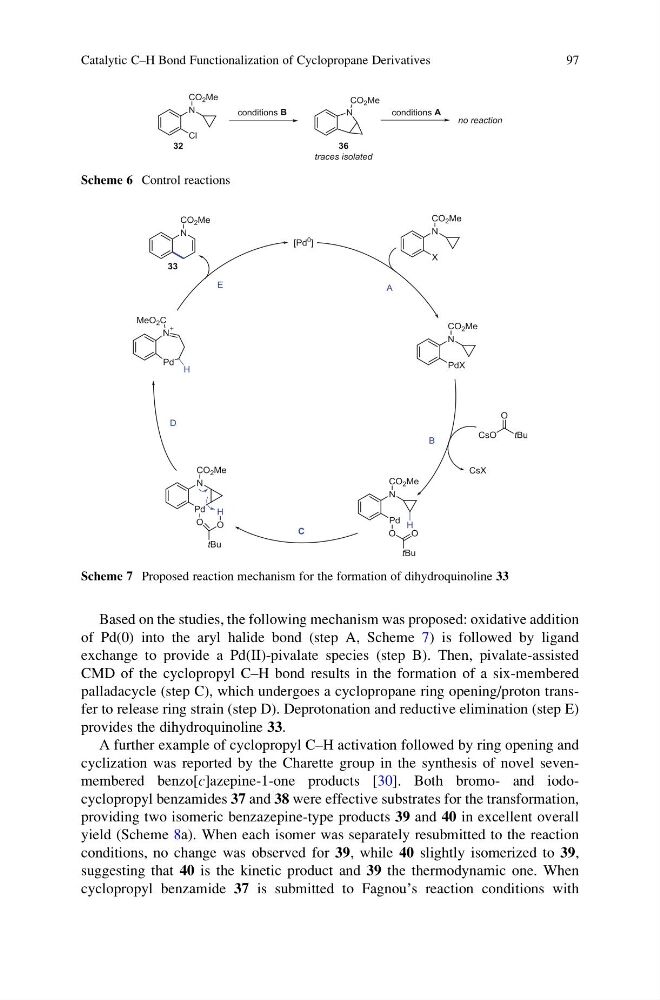
Based on the studies, the following mechanism was proposed: oxidative addition
of Pd(0) into the aryl halide bond (step A, Scheme 7) is followed by ligand
exchange to provide a Pd(II)-pivalate species (step B). Then, pivalate-assisted
CMD of the cyclopropyl C–H bond results in the formation of a six-membered
palladacycle (step C), which undergoes a cyclopropane ring opening/proton transfer to release ring strain (step D). Deprotonation and reductive elimination (step E)
provides the dihydroquinoline 33.
A further example of cyclopropyl C–H activation followed by ring opening and
cyclization was reported by the Charette group in the synthesis of novel sevenmembered benzo[c]azepine-1-one products [30]. Both bromo- and iodocyclopropyl benzamides 37 and 38 were effective substrates for the transformation,
providing two isomeric benzazepine-type products 39 and 40 in excellent overall
yield (Scheme 8a). When each isomer was separately resubmitted to the reaction
conditions, no change was observed for 39, while 40 slightly isomerized to 39,
suggesting that 40 is the kinetic product and 39 the thermodynamic one. When
cyclopropyl benzamide 37 is submitted to Fagnou’s reaction conditions with
Scheme 6 Control reactions
Scheme 7 Proposed reaction mechanism for the formation of dihydroquinoline 33
Catalytic C–H Bond Functionalization of Cyclopropane Derivatives
97
of Pd(0) into the aryl halide bond (step A, Scheme 7) is followed by ligand
exchange to provide a Pd(II)-pivalate species (step B). Then, pivalate-assisted
CMD of the cyclopropyl C–H bond results in the formation of a six-membered
palladacycle (step C), which undergoes a cyclopropane ring opening/proton transfer to release ring strain (step D). Deprotonation and reductive elimination (step E)
provides the dihydroquinoline 33.
A further example of cyclopropyl C–H activation followed by ring opening and
cyclization was reported by the Charette group in the synthesis of novel sevenmembered benzo[c]azepine-1-one products [30]. Both bromo- and iodocyclopropyl benzamides 37 and 38 were effective substrates for the transformation,
providing two isomeric benzazepine-type products 39 and 40 in excellent overall
yield (Scheme 8a). When each isomer was separately resubmitted to the reaction
conditions, no change was observed for 39, while 40 slightly isomerized to 39,
suggesting that 40 is the kinetic product and 39 the thermodynamic one. When
cyclopropyl benzamide 37 is submitted to Fagnou’s reaction conditions with
Scheme 6 Control reactions
Scheme 7 Proposed reaction mechanism for the formation of dihydroquinoline 33
Catalytic C–H Bond Functionalization of Cyclopropane Derivatives
97