

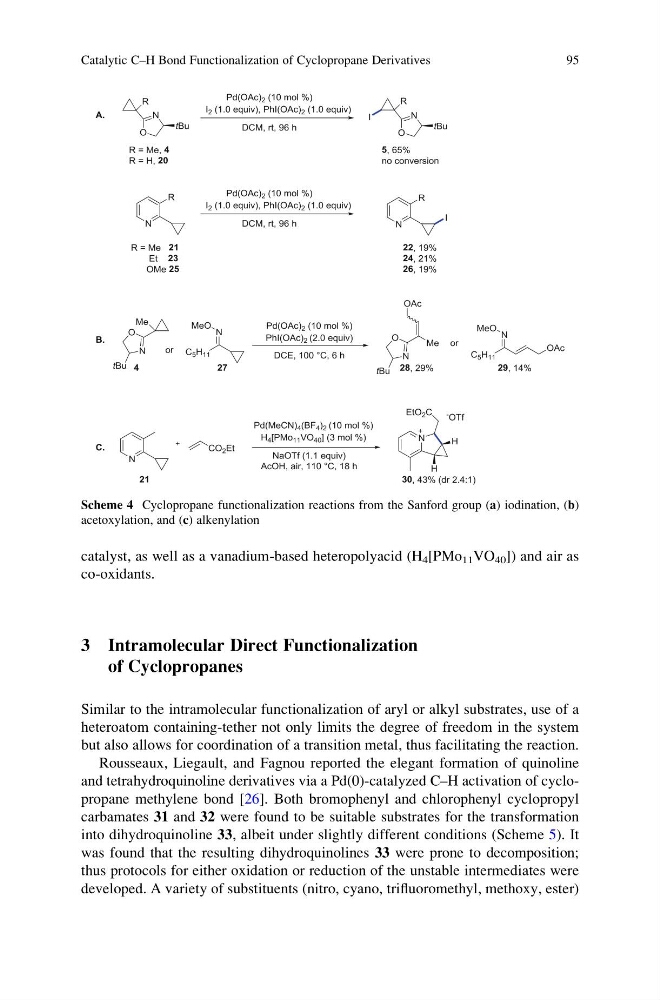
catalyst, as well as a vanadium-based heteropolyacid (H 4 [PMo 11 VO 40 ]) and air as
co-oxidants.
3 Intramolecular Direct Functionalization
of Cyclopropanes
Similar to the intramolecular functionalization of aryl or alkyl substrates, use of a
heteroatom containing-tether not only limits the degree of freedom in the system
but also allows for coordination of a transition metal, thus facilitating the reaction.
Rousseaux, Liegault, and Fagnou reported the elegant formation of quinoline
and tetrahydroquinoline derivatives via a Pd(0)-catalyzed C–H activation of cyclopropane methylene bond [26]. Both bromophenyl and chlorophenyl cyclopropyl
carbamates 31 and 32 were found to be suitable substrates for the transformation
into dihydroquinoline 33, albeit under slightly different conditions (Scheme 5). It
was found that the resulting dihydroquinolines 33 were prone to decomposition;
thus protocols for either oxidation or reduction of the unstable intermediates were
developed. A variety of substituents (nitro, cyano, trifluoromethyl, methoxy, ester)
Scheme 4 Cyclopropane functionalization reactions from the Sanford group (a) iodination, (b)
acetoxylation, and (c) alkenylation
Catalytic C–H Bond Functionalization of Cyclopropane Derivatives
95
co-oxidants.
3 Intramolecular Direct Functionalization
of Cyclopropanes
Similar to the intramolecular functionalization of aryl or alkyl substrates, use of a
heteroatom containing-tether not only limits the degree of freedom in the system
but also allows for coordination of a transition metal, thus facilitating the reaction.
Rousseaux, Liegault, and Fagnou reported the elegant formation of quinoline
and tetrahydroquinoline derivatives via a Pd(0)-catalyzed C–H activation of cyclopropane methylene bond [26]. Both bromophenyl and chlorophenyl cyclopropyl
carbamates 31 and 32 were found to be suitable substrates for the transformation
into dihydroquinoline 33, albeit under slightly different conditions (Scheme 5). It
was found that the resulting dihydroquinolines 33 were prone to decomposition;
thus protocols for either oxidation or reduction of the unstable intermediates were
developed. A variety of substituents (nitro, cyano, trifluoromethyl, methoxy, ester)
Scheme 4 Cyclopropane functionalization reactions from the Sanford group (a) iodination, (b)
acetoxylation, and (c) alkenylation
Catalytic C–H Bond Functionalization of Cyclopropane Derivatives
95