

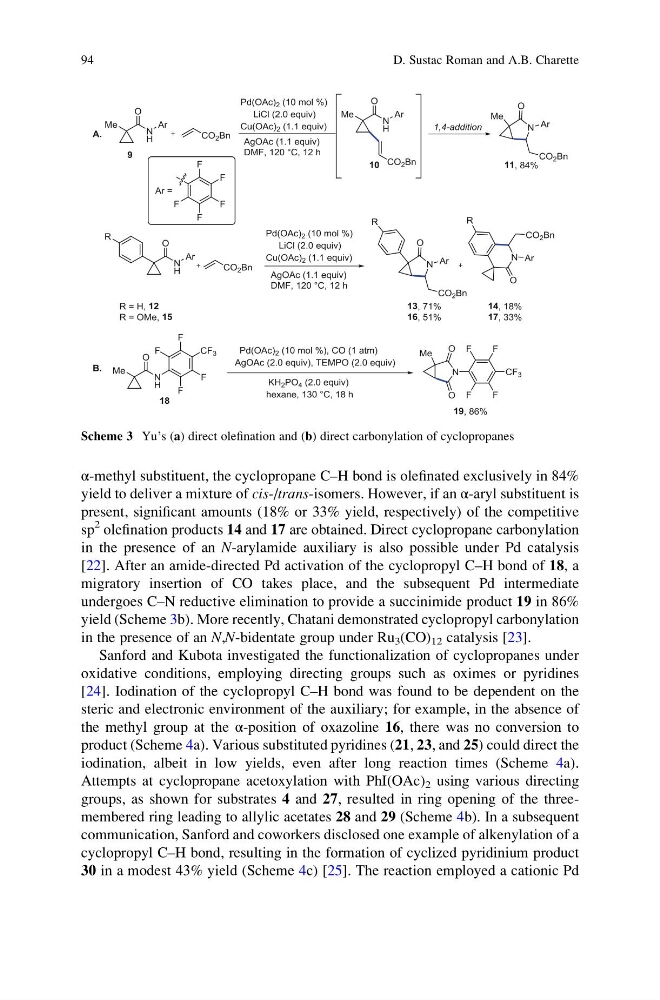
α-methyl substituent, the cyclopropane C–H bond is olefinated exclusively in 84%
yield to deliver a mixture of cis-/trans-isomers. However, if an α-aryl substituent is
present, significant amounts (18% or 33% yield, respectively) of the competitive
sp
2 olefination products 14 and 17 are obtained. Direct cyclopropane carbonylation
in the presence of an N-arylamide auxiliary is also possible under Pd catalysis
[22]. After an amide-directed Pd activation of the cyclopropyl C–H bond of 18, a
migratory insertion of CO takes place, and the subsequent Pd intermediate
undergoes C–N reductive elimination to provide a succinimide product 19 in 86%
yield (Scheme 3b). More recently, Chatani demonstrated cyclopropyl carbonylation
in the presence of an N,N-bidentate group under Ru 3 (CO) 12 catalysis [23].
Sanford and Kubota investigated the functionalization of cyclopropanes under
oxidative conditions, employing directing groups such as oximes or pyridines
[24]. Iodination of the cyclopropyl C–H bond was found to be dependent on the
steric and electronic environment of the auxiliary; for example, in the absence of
the methyl group at the α-position of oxazoline 16, there was no conversion to
product (Scheme 4a). Various substituted pyridines (21, 23, and 25) could direct the
iodination, albeit in low yields, even after long reaction times (Scheme 4a).
Attempts at cyclopropane acetoxylation with PhI(OAc) 2 using various directing
groups, as shown for substrates 4 and 27, resulted in ring opening of the threemembered ring leading to allylic acetates 28 and 29 (Scheme 4b). In a subsequent
communication, Sanford and coworkers disclosed one example of alkenylation of a
cyclopropyl C–H bond, resulting in the formation of cyclized pyridinium product
30 in a modest 43% yield (Scheme 4c) [25]. The reaction employed a cationic Pd
Scheme 3 Yu’s (a) direct olefination and (b) direct carbonylation of cyclopropanes
94
D. Sustac Roman and A.B. Charette
yield to deliver a mixture of cis-/trans-isomers. However, if an α-aryl substituent is
present, significant amounts (18% or 33% yield, respectively) of the competitive
sp
2 olefination products 14 and 17 are obtained. Direct cyclopropane carbonylation
in the presence of an N-arylamide auxiliary is also possible under Pd catalysis
[22]. After an amide-directed Pd activation of the cyclopropyl C–H bond of 18, a
migratory insertion of CO takes place, and the subsequent Pd intermediate
undergoes C–N reductive elimination to provide a succinimide product 19 in 86%
yield (Scheme 3b). More recently, Chatani demonstrated cyclopropyl carbonylation
in the presence of an N,N-bidentate group under Ru 3 (CO) 12 catalysis [23].
Sanford and Kubota investigated the functionalization of cyclopropanes under
oxidative conditions, employing directing groups such as oximes or pyridines
[24]. Iodination of the cyclopropyl C–H bond was found to be dependent on the
steric and electronic environment of the auxiliary; for example, in the absence of
the methyl group at the α-position of oxazoline 16, there was no conversion to
product (Scheme 4a). Various substituted pyridines (21, 23, and 25) could direct the
iodination, albeit in low yields, even after long reaction times (Scheme 4a).
Attempts at cyclopropane acetoxylation with PhI(OAc) 2 using various directing
groups, as shown for substrates 4 and 27, resulted in ring opening of the threemembered ring leading to allylic acetates 28 and 29 (Scheme 4b). In a subsequent
communication, Sanford and coworkers disclosed one example of alkenylation of a
cyclopropyl C–H bond, resulting in the formation of cyclized pyridinium product
30 in a modest 43% yield (Scheme 4c) [25]. The reaction employed a cationic Pd
Scheme 3 Yu’s (a) direct olefination and (b) direct carbonylation of cyclopropanes
94
D. Sustac Roman and A.B. Charette