

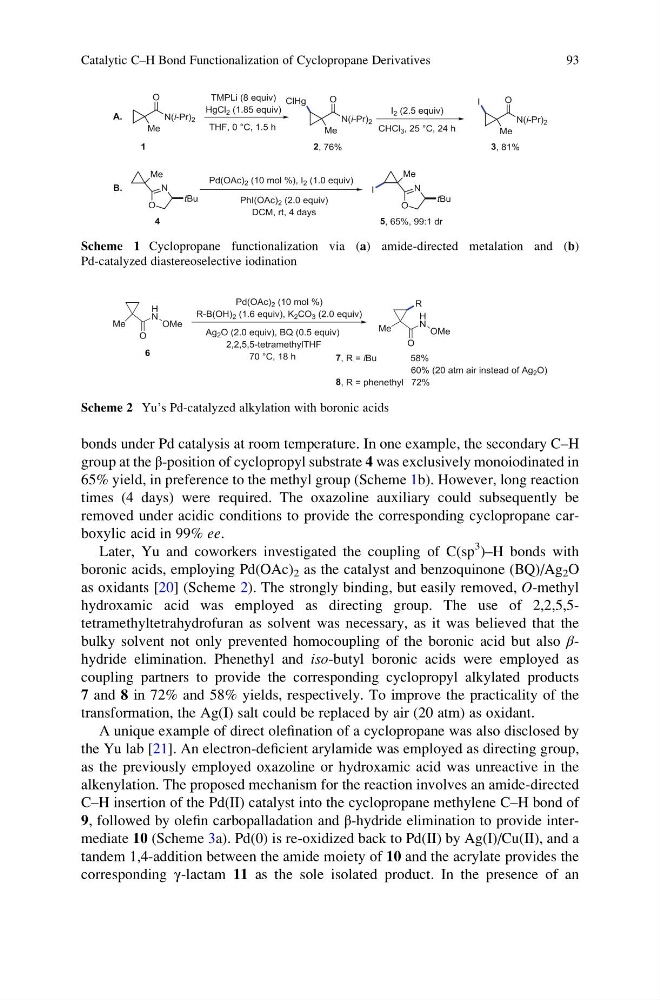
bonds under Pd catalysis at room temperature. In one example, the secondary C–H
group at the β-position of cyclopropyl substrate 4 was exclusively monoiodinated in
65% yield, in preference to the methyl group (Scheme 1b). However, long reaction
times (4 days) were required. The oxazoline auxiliary could subsequently be
removed under acidic conditions to provide the corresponding cyclopropane carboxylic acid in 99% ee.
Later, Yu and coworkers investigated the coupling of C(sp
3 )–H bonds with
boronic acids, employing Pd(OAc) 2 as the catalyst and benzoquinone (BQ)/Ag 2 O
as oxidants [20] (Scheme 2). The strongly binding, but easily removed, O-methyl
hydroxamic acid was employed as directing group. The use of 2,2,5,5tetramethyltetrahydrofuran as solvent was necessary, as it was believed that the
bulky solvent not only prevented homocoupling of the boronic acid but also βhydride elimination. Phenethyl and iso-butyl boronic acids were employed as
coupling partners to provide the corresponding cyclopropyl alkylated products
7 and 8 in 72% and 58% yields, respectively. To improve the practicality of the
transformation, the Ag(I) salt could be replaced by air (20 atm) as oxidant.
A unique example of direct olefination of a cyclopropane was also disclosed by
the Yu lab [21]. An electron-deficient arylamide was employed as directing group,
as the previously employed oxazoline or hydroxamic acid was unreactive in the
alkenylation. The proposed mechanism for the reaction involves an amide-directed
C–H insertion of the Pd(II) catalyst into the cyclopropane methylene C–H bond of
9, followed by olefin carbopalladation and β-hydride elimination to provide intermediate 10 (Scheme 3a). Pd(0) is re-oxidized back to Pd(II) by Ag(I)/Cu(II), and a
tandem 1,4-addition between the amide moiety of 10 and the acrylate provides the
corresponding γ-lactam 11 as the sole isolated product. In the presence of an
Scheme 1 Cyclopropane functionalization via (a) amide-directed metalation and (b)
Pd-catalyzed diastereoselective iodination
Scheme 2 Yu’s Pd-catalyzed alkylation with boronic acids
Catalytic C–H Bond Functionalization of Cyclopropane Derivatives
93
group at the β-position of cyclopropyl substrate 4 was exclusively monoiodinated in
65% yield, in preference to the methyl group (Scheme 1b). However, long reaction
times (4 days) were required. The oxazoline auxiliary could subsequently be
removed under acidic conditions to provide the corresponding cyclopropane carboxylic acid in 99% ee.
Later, Yu and coworkers investigated the coupling of C(sp
3 )–H bonds with
boronic acids, employing Pd(OAc) 2 as the catalyst and benzoquinone (BQ)/Ag 2 O
as oxidants [20] (Scheme 2). The strongly binding, but easily removed, O-methyl
hydroxamic acid was employed as directing group. The use of 2,2,5,5tetramethyltetrahydrofuran as solvent was necessary, as it was believed that the
bulky solvent not only prevented homocoupling of the boronic acid but also βhydride elimination. Phenethyl and iso-butyl boronic acids were employed as
coupling partners to provide the corresponding cyclopropyl alkylated products
7 and 8 in 72% and 58% yields, respectively. To improve the practicality of the
transformation, the Ag(I) salt could be replaced by air (20 atm) as oxidant.
A unique example of direct olefination of a cyclopropane was also disclosed by
the Yu lab [21]. An electron-deficient arylamide was employed as directing group,
as the previously employed oxazoline or hydroxamic acid was unreactive in the
alkenylation. The proposed mechanism for the reaction involves an amide-directed
C–H insertion of the Pd(II) catalyst into the cyclopropane methylene C–H bond of
9, followed by olefin carbopalladation and β-hydride elimination to provide intermediate 10 (Scheme 3a). Pd(0) is re-oxidized back to Pd(II) by Ag(I)/Cu(II), and a
tandem 1,4-addition between the amide moiety of 10 and the acrylate provides the
corresponding γ-lactam 11 as the sole isolated product. In the presence of an
Scheme 1 Cyclopropane functionalization via (a) amide-directed metalation and (b)
Pd-catalyzed diastereoselective iodination
Scheme 2 Yu’s Pd-catalyzed alkylation with boronic acids
Catalytic C–H Bond Functionalization of Cyclopropane Derivatives
93