

71
3 Formation of DNA Lesions, its Prevention and Repair
with regard to the reactions of various nutritional anti-oxidants including different
vitamins and certain other important anti-oxidants which scavenge the different free
radicals.
3.4.1 Superoxide Radical Anion Scavengers
As superoxide radical anion (O 2
•−
) is a negatively charged radical, its behaviour in
charge transfer processes differs significantly from those of the uncharged ROS and
RNOS. In addition to superoxide dismutase (SOD), dietary polyphenols including
flavonoids and non-flavonoids can potentially scavenge O 2
•−
from cells. Among
other chemical agents, quercetins, and chlorogenic acids are shown to be potential
superoxide scavengers [134, 135]. In an early study, it has been shown that ascorbic
acid has a better O 2
•−
scavenging ability than SOD [136]. However, in a subsequent
study, on the basis of calculated rate constants involving reactions between different
superoxide scavengers and O 2
•−
, it has been shown that the superoxide inhibitory
ability follows the order SOD > L-ascorbic acid > eugenol > guaiacol > phenol [137].
Carotenoids (Figs. 3.7a–3.7c) are the naturally occurring organic pigments abundant in human diet mainly in carrots, pumpkins and sweet potatoes. Among this
general class of carotenoids, β-carotene is distinguished by its beta rings at both the
ends of the molecule. In nature, β-carotene is a precursor (inactive form) to vitamin
A and the corresponding reaction occurs via the action of β-carotene 15,15’-monooxygenase. Carotenoids are very strong anti-oxidants having ability to scavenge
almost all ROS and RNOS [138]. They have been found to have an excellent ability
to directly scavenge O 2
•−
[139, 140]. Carotenoids scavenge O 2
•−
through the SET
mechanism. In a recent theoretical study [141], it was proposed that O 2
•−
inverts
the direction of electron transfer in comparison to other ROS and RNOS. The SET
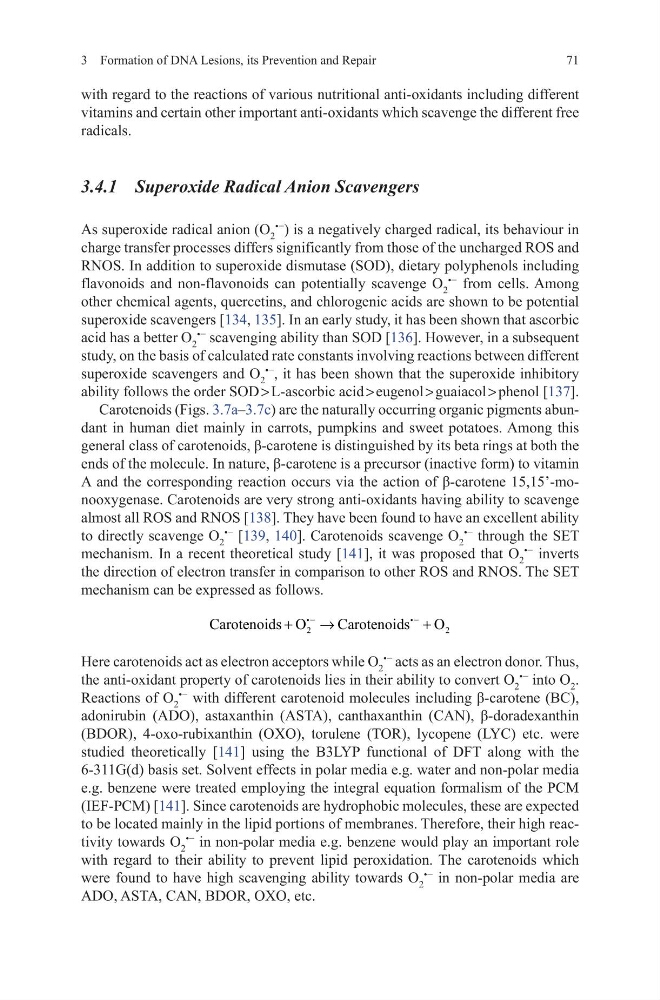
mechanism can be expressed as follows.
Here carotenoids act as electron acceptors while O 2
•−
acts as an electron donor. Thus,
the anti-oxidant property of carotenoids lies in their ability to convert O 2
•−
into O 2 .
Reactions of O 2
•−
with different carotenoid molecules including β-carotene (BC),
adonirubin (ADO), astaxanthin (ASTA), canthaxanthin (CAN), β-doradexanthin
(BDOR), 4-oxo-rubixanthin (OXO), torulene (TOR), lycopene (LYC) etc. were
studied theoretically [141] using the B3LYP functional of DFT along with the
6-311G(d) basis set. Solvent effects in polar media e.g. water and non-polar media
e.g. benzene were treated employing the integral equation formalism of the PCM
(IEF-PCM) [141]. Since carotenoids are hydrophobic molecules, these are expected
to be located mainly in the lipid portions of membranes. Therefore, their high reactivity towards O 2
•−
in non-polar media e.g. benzene would play an important role
with regard to their ability to prevent lipid peroxidation. The carotenoids which
were found to have high scavenging ability towards O 2
•−
in non-polar media are
ADO, ASTA, CAN, BDOR, OXO, etc.
2
2
Carotenoids O
Carotenoids
O
-
-
+
→
+
3 Formation of DNA Lesions, its Prevention and Repair
with regard to the reactions of various nutritional anti-oxidants including different
vitamins and certain other important anti-oxidants which scavenge the different free
radicals.
3.4.1 Superoxide Radical Anion Scavengers
As superoxide radical anion (O 2
•−
) is a negatively charged radical, its behaviour in
charge transfer processes differs significantly from those of the uncharged ROS and
RNOS. In addition to superoxide dismutase (SOD), dietary polyphenols including
flavonoids and non-flavonoids can potentially scavenge O 2
•−
from cells. Among
other chemical agents, quercetins, and chlorogenic acids are shown to be potential
superoxide scavengers [134, 135]. In an early study, it has been shown that ascorbic
acid has a better O 2
•−
scavenging ability than SOD [136]. However, in a subsequent
study, on the basis of calculated rate constants involving reactions between different
superoxide scavengers and O 2
•−
, it has been shown that the superoxide inhibitory
ability follows the order SOD > L-ascorbic acid > eugenol > guaiacol > phenol [137].
Carotenoids (Figs. 3.7a–3.7c) are the naturally occurring organic pigments abundant in human diet mainly in carrots, pumpkins and sweet potatoes. Among this
general class of carotenoids, β-carotene is distinguished by its beta rings at both the
ends of the molecule. In nature, β-carotene is a precursor (inactive form) to vitamin
A and the corresponding reaction occurs via the action of β-carotene 15,15’-monooxygenase. Carotenoids are very strong anti-oxidants having ability to scavenge
almost all ROS and RNOS [138]. They have been found to have an excellent ability
to directly scavenge O 2
•−
[139, 140]. Carotenoids scavenge O 2
•−
through the SET
mechanism. In a recent theoretical study [141], it was proposed that O 2
•−
inverts
the direction of electron transfer in comparison to other ROS and RNOS. The SET
mechanism can be expressed as follows.
Here carotenoids act as electron acceptors while O 2
•−
acts as an electron donor. Thus,
the anti-oxidant property of carotenoids lies in their ability to convert O 2
•−
into O 2 .
Reactions of O 2
•−
with different carotenoid molecules including β-carotene (BC),
adonirubin (ADO), astaxanthin (ASTA), canthaxanthin (CAN), β-doradexanthin
(BDOR), 4-oxo-rubixanthin (OXO), torulene (TOR), lycopene (LYC) etc. were
studied theoretically [141] using the B3LYP functional of DFT along with the
6-311G(d) basis set. Solvent effects in polar media e.g. water and non-polar media
e.g. benzene were treated employing the integral equation formalism of the PCM
(IEF-PCM) [141]. Since carotenoids are hydrophobic molecules, these are expected
to be located mainly in the lipid portions of membranes. Therefore, their high reactivity towards O 2
•−
in non-polar media e.g. benzene would play an important role
with regard to their ability to prevent lipid peroxidation. The carotenoids which
were found to have high scavenging ability towards O 2
•−
in non-polar media are
ADO, ASTA, CAN, BDOR, OXO, etc.
2
2
Carotenoids O
Carotenoids
O
-
-
+
→
+