

70
N. R. Jena et al.
the C8 position of guanine to generate the above mentioned species. In addition
to this, HOCl also reacts with the C8 position of adenine (A) and C5 position of
cytosine (C), thereby generating 8-chloroA and 5-chloroC respectively. It is further
found that HOCl facilitated the formation of 8-chloroG which is more efficient than
that of 8-oxoG. As activated neutrophils secrete myeloperoxidase produced HOCl,
8-chloroG can be a potential biomarker of inflammation [130, 131].
3.3.7 By NO 2 Cl
It has been shown that the reaction of NO 2 Cl with guanine can lead to its oxidation,
chlorination and nitration, thereby forming 8-oxoG, 8-chloroG and 8-NO 2 G respectively. Among these reactions, NO 2 Cl has been proposed to efficiently induce nitration of guanine producing 8-NO 2 G [68, 132]. However, epithelial cells at the site of
inflection near the human stomach and respiratory tract can form NO 2 Cl-mediated
oxidized guanine lesions efficiently, as speculated earlier [132]. Both 8-oxoG and
8-NO 2 G are mutagenic and can induce guanine to thymine transversion mutation
in mammalian cells. In addition to this, 8-NO 2 G can cause depurination to produce
different cytotoxic products in DNA [132].
3.4 Prevention of Formation of Lesions by Anti-oxidants
As mentioned earlier, anti-oxidants can readily scavenge reactive species from
biological media. Fruits, vegetables, whole grains and certain Indian spices are in
general good sources of anti-oxidants [133]. Depending on their ability to scavenge
reactive species, they can be classified in different categories [133]. There are three
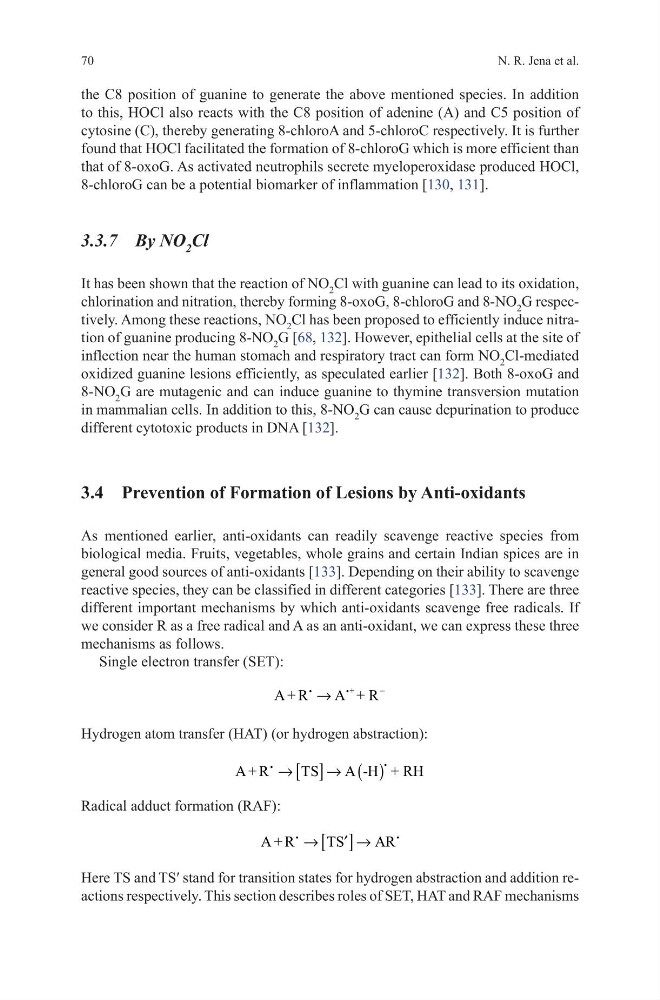
different important mechanisms by which anti-oxidants scavenge free radicals. If
we consider R as a free radical and A as an anti-oxidant, we can express these three
mechanisms as follows.
Single electron transfer (SET):
Hydrogen atom transfer (HAT) (or hydrogen abstraction):
Radical adduct formation (RAF):
Here TS and TS′ stand for transition states for hydrogen abstraction and addition reactions respectively. This section describes roles of SET, HAT and RAF mechanisms
+
A + R
A + R
-
→
[ ]
( )
A + R
TS
A -H + RH
→
→
[ ]
A + R
TS
AR
→
′ →
N. R. Jena et al.
the C8 position of guanine to generate the above mentioned species. In addition
to this, HOCl also reacts with the C8 position of adenine (A) and C5 position of
cytosine (C), thereby generating 8-chloroA and 5-chloroC respectively. It is further
found that HOCl facilitated the formation of 8-chloroG which is more efficient than
that of 8-oxoG. As activated neutrophils secrete myeloperoxidase produced HOCl,
8-chloroG can be a potential biomarker of inflammation [130, 131].
3.3.7 By NO 2 Cl
It has been shown that the reaction of NO 2 Cl with guanine can lead to its oxidation,
chlorination and nitration, thereby forming 8-oxoG, 8-chloroG and 8-NO 2 G respectively. Among these reactions, NO 2 Cl has been proposed to efficiently induce nitration of guanine producing 8-NO 2 G [68, 132]. However, epithelial cells at the site of
inflection near the human stomach and respiratory tract can form NO 2 Cl-mediated
oxidized guanine lesions efficiently, as speculated earlier [132]. Both 8-oxoG and
8-NO 2 G are mutagenic and can induce guanine to thymine transversion mutation
in mammalian cells. In addition to this, 8-NO 2 G can cause depurination to produce
different cytotoxic products in DNA [132].
3.4 Prevention of Formation of Lesions by Anti-oxidants
As mentioned earlier, anti-oxidants can readily scavenge reactive species from
biological media. Fruits, vegetables, whole grains and certain Indian spices are in
general good sources of anti-oxidants [133]. Depending on their ability to scavenge
reactive species, they can be classified in different categories [133]. There are three
different important mechanisms by which anti-oxidants scavenge free radicals. If
we consider R as a free radical and A as an anti-oxidant, we can express these three
mechanisms as follows.
Single electron transfer (SET):
Hydrogen atom transfer (HAT) (or hydrogen abstraction):
Radical adduct formation (RAF):
Here TS and TS′ stand for transition states for hydrogen abstraction and addition reactions respectively. This section describes roles of SET, HAT and RAF mechanisms
+
A + R
A + R
-
→
[ ]
( )
A + R
TS
A -H + RH
→
→
[ ]
A + R
TS
AR
→
′ →