

69
3 Formation of DNA Lesions, its Prevention and Repair
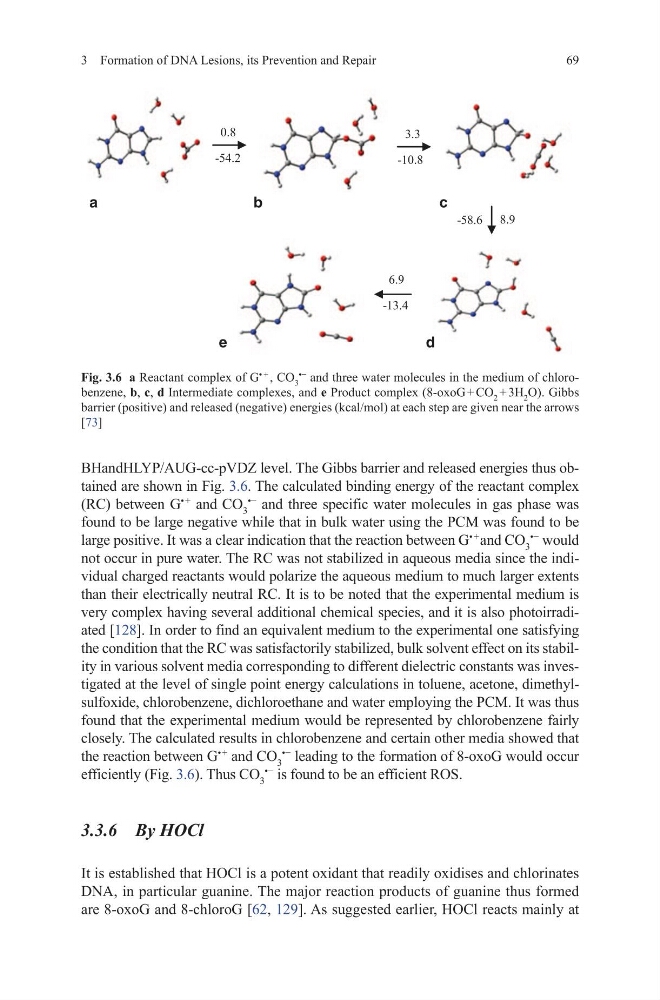
BHandHLYP/AUG-cc-pVDZ level. The Gibbs barrier and released energies thus obtained are shown in Fig. 3.6. The calculated binding energy of the reactant complex
(RC) between G
• +
and CO 3
•−
and three specific water molecules in gas phase was
found to be large negative while that in bulk water using the PCM was found to be
large positive. It was a clear indication that the reaction between G
• +
and CO 3
•−
would
not occur in pure water. The RC was not stabilized in aqueous media since the individual charged reactants would polarize the aqueous medium to much larger extents
than their electrically neutral RC. It is to be noted that the experimental medium is
very complex having several additional chemical species, and it is also photoirradiated [128]. In order to find an equivalent medium to the experimental one satisfying
the condition that the RC was satisfactorily stabilized, bulk solvent effect on its stability in various solvent media corresponding to different dielectric constants was investigated at the level of single point energy calculations in toluene, acetone, dimethylsulfoxide, chlorobenzene, dichloroethane and water employing the PCM. It was thus
found that the experimental medium would be represented by chlorobenzene fairly
closely. The calculated results in chlorobenzene and certain other media showed that
the reaction between G
• +
and CO 3
•−
leading to the formation of 8-oxoG would occur
efficiently (Fig. 3.6). Thus CO 3
•−
is found to be an efficient ROS.
3.3.6 By HOCl
It is established that HOCl is a potent oxidant that readily oxidises and chlorinates
DNA, in particular guanine. The major reaction products of guanine thus formed
are 8-oxoG and 8-chloroG [62, 129]. As suggested earlier, HOCl reacts mainly at
a
c
b
e
d
Fig. 3.6 a Reactant complex of G
• +
, CO 3
•−
and three water molecules in the medium of chlorobenzene, b, c, d Intermediate complexes, and e Product complex (8-oxoG + CO 2 + 3H 2 O). Gibbs
barrier (positive) and released (negative) energies (kcal/mol) at each step are given near the arrows
[73]
3 Formation of DNA Lesions, its Prevention and Repair
BHandHLYP/AUG-cc-pVDZ level. The Gibbs barrier and released energies thus obtained are shown in Fig. 3.6. The calculated binding energy of the reactant complex
(RC) between G
• +
and CO 3
•−
and three specific water molecules in gas phase was
found to be large negative while that in bulk water using the PCM was found to be
large positive. It was a clear indication that the reaction between G
• +
and CO 3
•−
would
not occur in pure water. The RC was not stabilized in aqueous media since the individual charged reactants would polarize the aqueous medium to much larger extents
than their electrically neutral RC. It is to be noted that the experimental medium is
very complex having several additional chemical species, and it is also photoirradiated [128]. In order to find an equivalent medium to the experimental one satisfying
the condition that the RC was satisfactorily stabilized, bulk solvent effect on its stability in various solvent media corresponding to different dielectric constants was investigated at the level of single point energy calculations in toluene, acetone, dimethylsulfoxide, chlorobenzene, dichloroethane and water employing the PCM. It was thus
found that the experimental medium would be represented by chlorobenzene fairly
closely. The calculated results in chlorobenzene and certain other media showed that
the reaction between G
• +
and CO 3
•−
leading to the formation of 8-oxoG would occur
efficiently (Fig. 3.6). Thus CO 3
•−
is found to be an efficient ROS.
3.3.6 By HOCl
It is established that HOCl is a potent oxidant that readily oxidises and chlorinates
DNA, in particular guanine. The major reaction products of guanine thus formed
are 8-oxoG and 8-chloroG [62, 129]. As suggested earlier, HOCl reacts mainly at
a
c
b
e
d
Fig. 3.6 a Reactant complex of G
• +
, CO 3
•−
and three water molecules in the medium of chlorobenzene, b, c, d Intermediate complexes, and e Product complex (8-oxoG + CO 2 + 3H 2 O). Gibbs
barrier (positive) and released (negative) energies (kcal/mol) at each step are given near the arrows
[73]