

68
N. R. Jena et al.
of this reaction obtained by geometry optimization at the B3LYP/AUG-cc-pVDZ
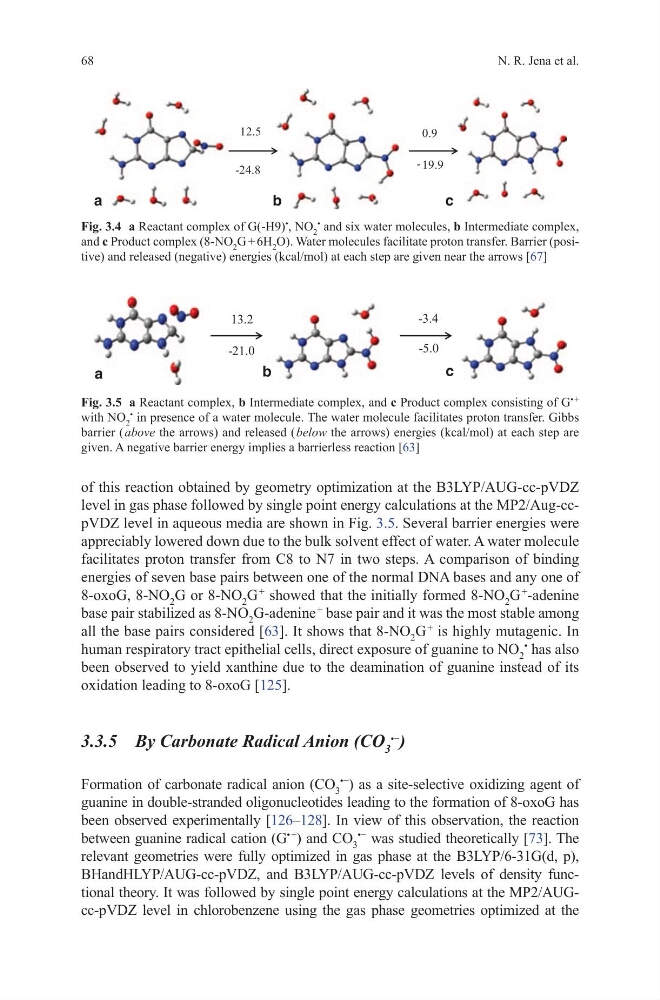
level in gas phase followed by single point energy calculations at the MP2/Aug-ccpVDZ level in aqueous media are shown in Fig. 3.5. Several barrier energies were
appreciably lowered down due to the bulk solvent effect of water. A water molecule
facilitates proton transfer from C8 to N7 in two steps. A comparison of binding
energies of seven base pairs between one of the normal DNA bases and any one of
8-oxoG, 8-NO 2 G or 8-NO 2 G
+
showed that the initially formed 8-NO 2 G
+
-adenine
base pair stabilized as 8-NO 2 G-adenine
+
base pair and it was the most stable among
all the base pairs considered [63]. It shows that 8-NO 2 G
+
is highly mutagenic. In
human respiratory tract epithelial cells, direct exposure of guanine to NO 2
•
has also
been observed to yield xanthine due to the deamination of guanine instead of its
oxidation leading to 8-oxoG [125].
3.3.5 By Carbonate Radical Anion (CO 3
•−
)
Formation of carbonate radical anion (CO 3
•−
) as a site-selective oxidizing agent of
guanine in double-stranded oligonucleotides leading to the formation of 8-oxoG has
been observed experimentally [126–128]. In view of this observation, the reaction
between guanine radical cation (G
• +
) and CO 3
•−
was studied theoretically [73]. The
relevant geometries were fully optimized in gas phase at the B3LYP/6-31G(d, p),
BHandHLYP/AUG-cc-pVDZ, and B3LYP/AUG-cc-pVDZ levels of density functional theory. It was followed by single point energy calculations at the MP2/AUGcc-pVDZ level in chlorobenzene using the gas phase geometries optimized at the
a
b
c
Fig. 3.5 a Reactant complex, b Intermediate complex, and c Product complex consisting of G
• +
with NO 2
•
in presence of a water molecule. The water molecule facilitates proton transfer. Gibbs
barrier ( above the arrows) and released ( below the arrows) energies (kcal/mol) at each step are
given. A negative barrier energy implies a barrierless reaction [63]
a
b
c
Fig. 3.4 a Reactant complex of G(-H9)
•
, NO 2
•
and six water molecules, b Intermediate complex,
and c Product complex (8-NO 2 G + 6H 2 O). Water molecules facilitate proton transfer. Barrier (positive) and released (negative) energies (kcal/mol) at each step are given near the arrows [67]
N. R. Jena et al.
of this reaction obtained by geometry optimization at the B3LYP/AUG-cc-pVDZ
level in gas phase followed by single point energy calculations at the MP2/Aug-ccpVDZ level in aqueous media are shown in Fig. 3.5. Several barrier energies were
appreciably lowered down due to the bulk solvent effect of water. A water molecule
facilitates proton transfer from C8 to N7 in two steps. A comparison of binding
energies of seven base pairs between one of the normal DNA bases and any one of
8-oxoG, 8-NO 2 G or 8-NO 2 G
+
showed that the initially formed 8-NO 2 G
+
-adenine
base pair stabilized as 8-NO 2 G-adenine
+
base pair and it was the most stable among
all the base pairs considered [63]. It shows that 8-NO 2 G
+
is highly mutagenic. In
human respiratory tract epithelial cells, direct exposure of guanine to NO 2
•
has also
been observed to yield xanthine due to the deamination of guanine instead of its
oxidation leading to 8-oxoG [125].
3.3.5 By Carbonate Radical Anion (CO 3
•−
)
Formation of carbonate radical anion (CO 3
•−
) as a site-selective oxidizing agent of
guanine in double-stranded oligonucleotides leading to the formation of 8-oxoG has
been observed experimentally [126–128]. In view of this observation, the reaction
between guanine radical cation (G
• +
) and CO 3
•−
was studied theoretically [73]. The
relevant geometries were fully optimized in gas phase at the B3LYP/6-31G(d, p),
BHandHLYP/AUG-cc-pVDZ, and B3LYP/AUG-cc-pVDZ levels of density functional theory. It was followed by single point energy calculations at the MP2/AUGcc-pVDZ level in chlorobenzene using the gas phase geometries optimized at the
a
b
c
Fig. 3.5 a Reactant complex, b Intermediate complex, and c Product complex consisting of G
• +
with NO 2
•
in presence of a water molecule. The water molecule facilitates proton transfer. Gibbs
barrier ( above the arrows) and released ( below the arrows) energies (kcal/mol) at each step are
given. A negative barrier energy implies a barrierless reaction [63]
a
b
c
Fig. 3.4 a Reactant complex of G(-H9)
•
, NO 2
•
and six water molecules, b Intermediate complex,
and c Product complex (8-NO 2 G + 6H 2 O). Water molecules facilitate proton transfer. Barrier (positive) and released (negative) energies (kcal/mol) at each step are given near the arrows [67]