

64
N. R. Jena et al.
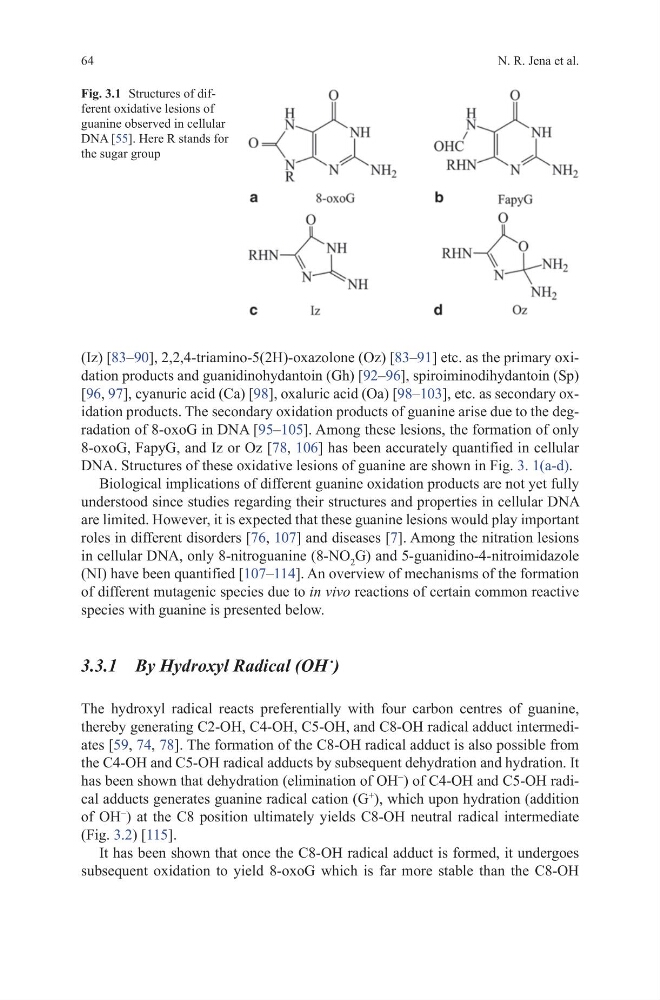
(Iz) [83–90], 2,2,4-triamino-5(2H)-oxazolone (Oz) [83–91] etc. as the primary oxidation products and guanidinohydantoin (Gh) [92–96], spiroiminodihydantoin (Sp)
[96, 97], cyanuric acid (Ca) [98], oxaluric acid (Oa) [98–103], etc. as secondary oxidation products. The secondary oxidation products of guanine arise due to the degradation of 8-oxoG in DNA [95–105]. Among these lesions, the formation of only
8-oxoG, FapyG, and Iz or Oz [78, 106] has been accurately quantified in cellular
DNA. Structures of these oxidative lesions of guanine are shown in Fig. 3. 1(a-d).
Biological implications of different guanine oxidation products are not yet fully
understood since studies regarding their structures and properties in cellular DNA
are limited. However, it is expected that these guanine lesions would play important
roles in different disorders [76, 107] and diseases [7]. Among the nitration lesions
in cellular DNA, only 8-nitroguanine (8-NO 2 G) and 5-guanidino-4-nitroimidazole
(NI) have been quantified [107–114]. An overview of mechanisms of the formation
of different mutagenic species due to in vivo reactions of certain common reactive
species with guanine is presented below.
3.3.1 By Hydroxyl Radical (OH
•
)
The hydroxyl radical reacts preferentially with four carbon centres of guanine,
thereby generating C2-OH, C4-OH, C5-OH, and C8-OH radical adduct intermediates [59, 74, 78]. The formation of the C8-OH radical adduct is also possible from
the C4-OH and C5-OH radical adducts by subsequent dehydration and hydration. It
has been shown that dehydration (elimination of OH
−
) of C4-OH and C5-OH radical adducts generates guanine radical cation (G
+
), which upon hydration (addition
of OH
−
) at the C8 position ultimately yields C8-OH neutral radical intermediate
(Fig. 3.2) [115].
It has been shown that once the C8-OH radical adduct is formed, it undergoes
subsequent oxidation to yield 8-oxoG which is far more stable than the C8-OH
Fig. 3.1 Structures of different oxidative lesions of
guanine observed in cellular
DNA [55]. Here R stands for
the sugar group
N. R. Jena et al.
(Iz) [83–90], 2,2,4-triamino-5(2H)-oxazolone (Oz) [83–91] etc. as the primary oxidation products and guanidinohydantoin (Gh) [92–96], spiroiminodihydantoin (Sp)
[96, 97], cyanuric acid (Ca) [98], oxaluric acid (Oa) [98–103], etc. as secondary oxidation products. The secondary oxidation products of guanine arise due to the degradation of 8-oxoG in DNA [95–105]. Among these lesions, the formation of only
8-oxoG, FapyG, and Iz or Oz [78, 106] has been accurately quantified in cellular
DNA. Structures of these oxidative lesions of guanine are shown in Fig. 3. 1(a-d).
Biological implications of different guanine oxidation products are not yet fully
understood since studies regarding their structures and properties in cellular DNA
are limited. However, it is expected that these guanine lesions would play important
roles in different disorders [76, 107] and diseases [7]. Among the nitration lesions
in cellular DNA, only 8-nitroguanine (8-NO 2 G) and 5-guanidino-4-nitroimidazole
(NI) have been quantified [107–114]. An overview of mechanisms of the formation
of different mutagenic species due to in vivo reactions of certain common reactive
species with guanine is presented below.
3.3.1 By Hydroxyl Radical (OH
•
)
The hydroxyl radical reacts preferentially with four carbon centres of guanine,
thereby generating C2-OH, C4-OH, C5-OH, and C8-OH radical adduct intermediates [59, 74, 78]. The formation of the C8-OH radical adduct is also possible from
the C4-OH and C5-OH radical adducts by subsequent dehydration and hydration. It
has been shown that dehydration (elimination of OH
−
) of C4-OH and C5-OH radical adducts generates guanine radical cation (G
+
), which upon hydration (addition
of OH
−
) at the C8 position ultimately yields C8-OH neutral radical intermediate
(Fig. 3.2) [115].
It has been shown that once the C8-OH radical adduct is formed, it undergoes
subsequent oxidation to yield 8-oxoG which is far more stable than the C8-OH
Fig. 3.1 Structures of different oxidative lesions of
guanine observed in cellular
DNA [55]. Here R stands for
the sugar group