

63
3 Formation of DNA Lesions, its Prevention and Repair
During the respiratory burst, H 2 O 2 and O 2
•−
are rapidly released by immune
cells to kill pathogens. During this process, reaction of H 2 O 2 with chloride anion
(Cl
−
), catalysed by heme myeloperoxidases produces hypochlorous acid (HClO)
[48]. HClO is a powerful RHS and is quite cytotoxic. Due to this property, neutrophil cells use HClO to kill bacteria and different pathogens. However, it has been
found that HOCl interferes with gene function by modifying different components
of DNA. Another RHS, HBrO is also generated in living cells by human eosinophils that readily brominate DNA bases [49]. NO 2 Cl is believed to be produced in
cells by reaction of HOCl with nitrite (NO 2
−
) [50]. NO 2 Cl is quite cytotoxic and is
capable of causing oxidation, nitration and halogenation of almost all biomolecules
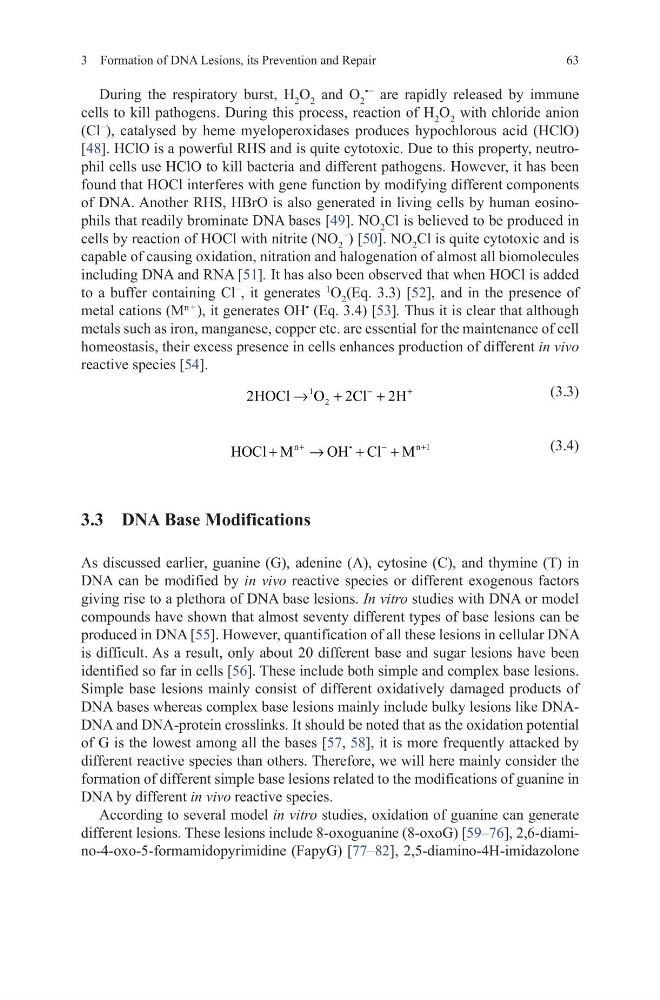
including DNA and RNA [51]. It has also been observed that when HOCl is added
to a buffer containing Cl
−
, it generates
1
O 2 (Eq. 3.3) [52], and in the presence of
metal cations (M
n +
), it generates OH
•
(Eq. 3.4) [53]. Thus it is clear that although
metals such as iron, manganese, copper etc. are essential for the maintenance of cell
homeostasis, their excess presence in cells enhances production of different in vivo
reactive species [54].
(3.3)
(3.4)
3.3 DNA Base Modifications
As discussed earlier, guanine (G), adenine (A), cytosine (C), and thymine (T) in
DNA can be modified by in vivo reactive species or different exogenous factors
giving rise to a plethora of DNA base lesions. In vitro studies with DNA or model
compounds have shown that almost seventy different types of base lesions can be
produced in DNA [55]. However, quantification of all these lesions in cellular DNA
is difficult. As a result, only about 20 different base and sugar lesions have been
identified so far in cells [56]. These include both simple and complex base lesions.
Simple base lesions mainly consist of different oxidatively damaged products of
DNA bases whereas complex base lesions mainly include bulky lesions like DNADNA and DNA-protein crosslinks. It should be noted that as the oxidation potential
of G is the lowest among all the bases [57, 58], it is more frequently attacked by
different reactive species than others. Therefore, we will here mainly consider the
formation of different simple base lesions related to the modifications of guanine in
DNA by different in vivo reactive species.
According to several model in vitro studies, oxidation of guanine can generate
different lesions. These lesions include 8-oxoguanine (8-oxoG) [59–76], 2,6-diamino-4-oxo-5-formamidopyrimidine (FapyG) [77–82], 2,5-diamino-4H-imidazolone
1
2
2HOCl
O 2Cl 2H
-
+
→
+
+
n
n 1
HOCl M
OH Cl M
+
-
+
+
→
+
+
3 Formation of DNA Lesions, its Prevention and Repair
During the respiratory burst, H 2 O 2 and O 2
•−
are rapidly released by immune
cells to kill pathogens. During this process, reaction of H 2 O 2 with chloride anion
(Cl
−
), catalysed by heme myeloperoxidases produces hypochlorous acid (HClO)
[48]. HClO is a powerful RHS and is quite cytotoxic. Due to this property, neutrophil cells use HClO to kill bacteria and different pathogens. However, it has been
found that HOCl interferes with gene function by modifying different components
of DNA. Another RHS, HBrO is also generated in living cells by human eosinophils that readily brominate DNA bases [49]. NO 2 Cl is believed to be produced in
cells by reaction of HOCl with nitrite (NO 2
−
) [50]. NO 2 Cl is quite cytotoxic and is
capable of causing oxidation, nitration and halogenation of almost all biomolecules
including DNA and RNA [51]. It has also been observed that when HOCl is added
to a buffer containing Cl
−
, it generates
1
O 2 (Eq. 3.3) [52], and in the presence of
metal cations (M
n +
), it generates OH
•
(Eq. 3.4) [53]. Thus it is clear that although
metals such as iron, manganese, copper etc. are essential for the maintenance of cell
homeostasis, their excess presence in cells enhances production of different in vivo
reactive species [54].
(3.3)
(3.4)
3.3 DNA Base Modifications
As discussed earlier, guanine (G), adenine (A), cytosine (C), and thymine (T) in
DNA can be modified by in vivo reactive species or different exogenous factors
giving rise to a plethora of DNA base lesions. In vitro studies with DNA or model
compounds have shown that almost seventy different types of base lesions can be
produced in DNA [55]. However, quantification of all these lesions in cellular DNA
is difficult. As a result, only about 20 different base and sugar lesions have been
identified so far in cells [56]. These include both simple and complex base lesions.
Simple base lesions mainly consist of different oxidatively damaged products of
DNA bases whereas complex base lesions mainly include bulky lesions like DNADNA and DNA-protein crosslinks. It should be noted that as the oxidation potential
of G is the lowest among all the bases [57, 58], it is more frequently attacked by
different reactive species than others. Therefore, we will here mainly consider the
formation of different simple base lesions related to the modifications of guanine in
DNA by different in vivo reactive species.
According to several model in vitro studies, oxidation of guanine can generate
different lesions. These lesions include 8-oxoguanine (8-oxoG) [59–76], 2,6-diamino-4-oxo-5-formamidopyrimidine (FapyG) [77–82], 2,5-diamino-4H-imidazolone
1
2
2HOCl
O 2Cl 2H
-
+
→
+
+
n
n 1
HOCl M
OH Cl M
+
-
+
+
→
+
+