

62
N. R. Jena et al.
thine oxidases and produce O 2
•−
. Superoxide radical anion (O 2
•−
) is quite reactive,
having the half-life of 10
−6
s, and has been observed in many pathological conditions including cancer [37, 38]. It is rapidly converted to nonreactive H 2 O 2 by superoxide dismutatse (SOD) [39]. H 2 O 2 is quite unreactive and does not participate
in biochemical reactions directly. Further, enzymatic anti-oxidants like catalase and
glutathione peroxidase transform H 2 O 2 to H 2 O.
It is believed that under stress conditions, in living cells, larger numbers of O 2
•−
are formed which act as oxidants for certain enzymes which release Fe
2 +
. Subsequently, Fe
2 +
catalyzes the formation of OH
•
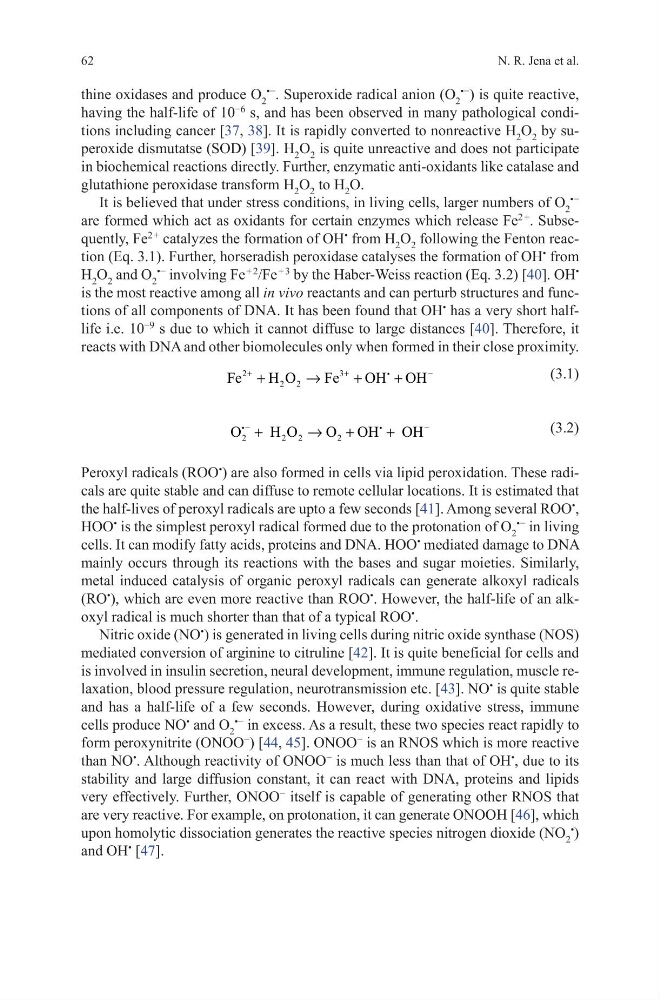
from H 2 O 2 following the Fenton reaction (Eq. 3.1). Further, horseradish peroxidase catalyses the formation of OH
•
from
H 2 O 2 and O 2
•−
involving Fe
+ 2
/Fe
+ 3
by the Haber-Weiss reaction (Eq. 3.2) [40]. OH
•
is the most reactive among all in vivo reactants and can perturb structures and functions of all components of DNA. It has been found that OH
•
has a very short halflife i.e. 10
−9
s due to which it cannot diffuse to large distances [40]. Therefore, it
reacts with DNA and other biomolecules only when formed in their close proximity.
(3.1)
(3.2)
Peroxyl radicals (ROO
•
) are also formed in cells via lipid peroxidation. These radicals are quite stable and can diffuse to remote cellular locations. It is estimated that
the half-lives of peroxyl radicals are upto a few seconds [41]. Among several ROO
•
,
HOO
•
is the simplest peroxyl radical formed due to the protonation of O 2
•−
in living
cells. It can modify fatty acids, proteins and DNA. HOO
•
mediated damage to DNA
mainly occurs through its reactions with the bases and sugar moieties. Similarly,
metal induced catalysis of organic peroxyl radicals can generate alkoxyl radicals
(RO
•
), which are even more reactive than ROO
•
. However, the half-life of an alkoxyl radical is much shorter than that of a typical ROO
•
.
Nitric oxide (NO
•
) is generated in living cells during nitric oxide synthase (NOS)
mediated conversion of arginine to citruline [42]. It is quite beneficial for cells and
is involved in insulin secretion, neural development, immune regulation, muscle relaxation, blood pressure regulation, neurotransmission etc. [43]. NO
•
is quite stable
and has a half-life of a few seconds. However, during oxidative stress, immune
cells produce NO
•
and O 2
•−
in excess. As a result, these two species react rapidly to
form peroxynitrite (ONOO
−
) [44, 45]. ONOO
−
is an RNOS which is more reactive
than NO
•
. Although reactivity of ONOO
−
is much less than that of OH
•
, due to its
stability and large diffusion constant, it can react with DNA, proteins and lipids
very effectively. Further, ONOO
−
itself is capable of generating other RNOS that
are very reactive. For example, on protonation, it can generate ONOOH [46], which
upon homolytic dissociation generates the reactive species nitrogen dioxide (NO 2
•
)
and OH
•
[47].
2
3
2 2
Fe
H O
Fe
OH OH
+
+
-
+
→
+
+
2
2 2
2
O
H O
O OH
OH
-
-
+
→
+
+
N. R. Jena et al.
thine oxidases and produce O 2
•−
. Superoxide radical anion (O 2
•−
) is quite reactive,
having the half-life of 10
−6
s, and has been observed in many pathological conditions including cancer [37, 38]. It is rapidly converted to nonreactive H 2 O 2 by superoxide dismutatse (SOD) [39]. H 2 O 2 is quite unreactive and does not participate
in biochemical reactions directly. Further, enzymatic anti-oxidants like catalase and
glutathione peroxidase transform H 2 O 2 to H 2 O.
It is believed that under stress conditions, in living cells, larger numbers of O 2
•−
are formed which act as oxidants for certain enzymes which release Fe
2 +
. Subsequently, Fe
2 +
catalyzes the formation of OH
•
from H 2 O 2 following the Fenton reaction (Eq. 3.1). Further, horseradish peroxidase catalyses the formation of OH
•
from
H 2 O 2 and O 2
•−
involving Fe
+ 2
/Fe
+ 3
by the Haber-Weiss reaction (Eq. 3.2) [40]. OH
•
is the most reactive among all in vivo reactants and can perturb structures and functions of all components of DNA. It has been found that OH
•
has a very short halflife i.e. 10
−9
s due to which it cannot diffuse to large distances [40]. Therefore, it
reacts with DNA and other biomolecules only when formed in their close proximity.
(3.1)
(3.2)
Peroxyl radicals (ROO
•
) are also formed in cells via lipid peroxidation. These radicals are quite stable and can diffuse to remote cellular locations. It is estimated that
the half-lives of peroxyl radicals are upto a few seconds [41]. Among several ROO
•
,
HOO
•
is the simplest peroxyl radical formed due to the protonation of O 2
•−
in living
cells. It can modify fatty acids, proteins and DNA. HOO
•
mediated damage to DNA
mainly occurs through its reactions with the bases and sugar moieties. Similarly,
metal induced catalysis of organic peroxyl radicals can generate alkoxyl radicals
(RO
•
), which are even more reactive than ROO
•
. However, the half-life of an alkoxyl radical is much shorter than that of a typical ROO
•
.
Nitric oxide (NO
•
) is generated in living cells during nitric oxide synthase (NOS)
mediated conversion of arginine to citruline [42]. It is quite beneficial for cells and
is involved in insulin secretion, neural development, immune regulation, muscle relaxation, blood pressure regulation, neurotransmission etc. [43]. NO
•
is quite stable
and has a half-life of a few seconds. However, during oxidative stress, immune
cells produce NO
•
and O 2
•−
in excess. As a result, these two species react rapidly to
form peroxynitrite (ONOO
−
) [44, 45]. ONOO
−
is an RNOS which is more reactive
than NO
•
. Although reactivity of ONOO
−
is much less than that of OH
•
, due to its
stability and large diffusion constant, it can react with DNA, proteins and lipids
very effectively. Further, ONOO
−
itself is capable of generating other RNOS that
are very reactive. For example, on protonation, it can generate ONOOH [46], which
upon homolytic dissociation generates the reactive species nitrogen dioxide (NO 2
•
)
and OH
•
[47].
2
3
2 2
Fe
H O
Fe
OH OH
+
+
-
+
→
+
+
2
2 2
2
O
H O
O OH
OH
-
-
+
→
+
+