

65
3 Formation of DNA Lesions, its Prevention and Repair
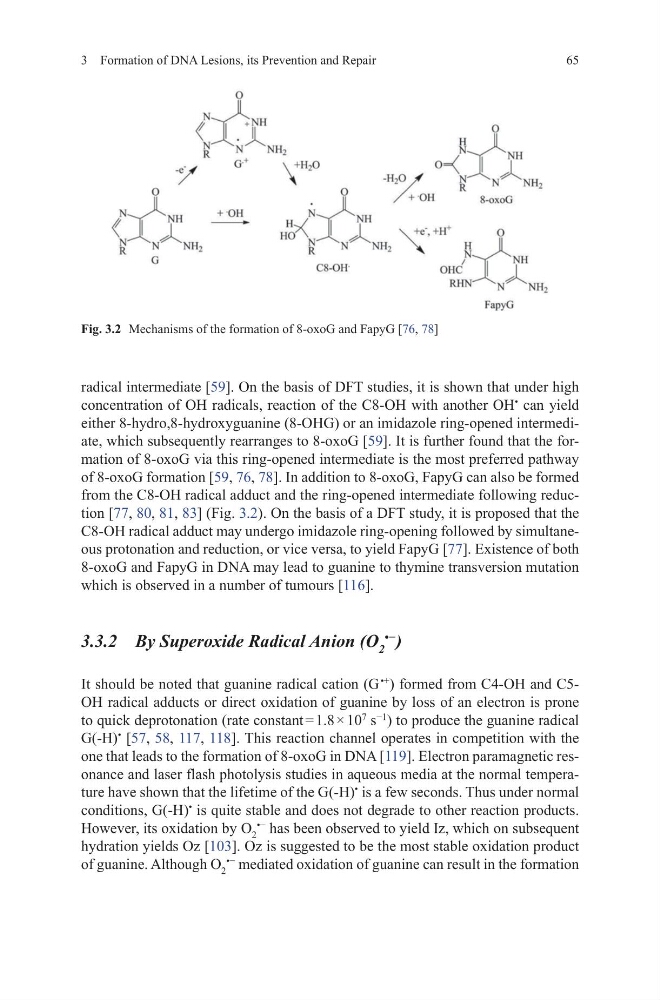
radical intermediate [59]. On the basis of DFT studies, it is shown that under high
concentration of OH radicals, reaction of the C8-OH with another OH
•
can yield
either 8-hydro,8-hydroxyguanine (8-OHG) or an imidazole ring-opened intermediate, which subsequently rearranges to 8-oxoG [59]. It is further found that the formation of 8-oxoG via this ring-opened intermediate is the most preferred pathway
of 8-oxoG formation [59, 76, 78]. In addition to 8-oxoG, FapyG can also be formed
from the C8-OH radical adduct and the ring-opened intermediate following reduction [77, 80, 81, 83] (Fig. 3.2). On the basis of a DFT study, it is proposed that the
C8-OH radical adduct may undergo imidazole ring-opening followed by simultaneous protonation and reduction, or vice versa, to yield FapyG [77]. Existence of both
8-oxoG and FapyG in DNA may lead to guanine to thymine transversion mutation
which is observed in a number of tumours [116].
3.3.2 By Superoxide Radical Anion (O 2
•−
)
It should be noted that guanine radical cation (G
•+
) formed from C4-OH and C5OH radical adducts or direct oxidation of guanine by loss of an electron is prone
to quick deprotonation (rate constant = 1.8 × 10
7
s
−1
) to produce the guanine radical
G(-H)
•
[57, 58, 117, 118]. This reaction channel operates in competition with the
one that leads to the formation of 8-oxoG in DNA [119]. Electron paramagnetic resonance and laser flash photolysis studies in aqueous media at the normal temperature have shown that the lifetime of the G(-H)
•
is a few seconds. Thus under normal
conditions, G(-H)
•
is quite stable and does not degrade to other reaction products.
However, its oxidation by O 2
•−
has been observed to yield Iz, which on subsequent
hydration yields Oz [103]. Oz is suggested to be the most stable oxidation product
of guanine. Although O 2
•−
mediated oxidation of guanine can result in the formation
Fig. 3.2 Mechanisms of the formation of 8-oxoG and FapyG [76, 78]
3 Formation of DNA Lesions, its Prevention and Repair
radical intermediate [59]. On the basis of DFT studies, it is shown that under high
concentration of OH radicals, reaction of the C8-OH with another OH
•
can yield
either 8-hydro,8-hydroxyguanine (8-OHG) or an imidazole ring-opened intermediate, which subsequently rearranges to 8-oxoG [59]. It is further found that the formation of 8-oxoG via this ring-opened intermediate is the most preferred pathway
of 8-oxoG formation [59, 76, 78]. In addition to 8-oxoG, FapyG can also be formed
from the C8-OH radical adduct and the ring-opened intermediate following reduction [77, 80, 81, 83] (Fig. 3.2). On the basis of a DFT study, it is proposed that the
C8-OH radical adduct may undergo imidazole ring-opening followed by simultaneous protonation and reduction, or vice versa, to yield FapyG [77]. Existence of both
8-oxoG and FapyG in DNA may lead to guanine to thymine transversion mutation
which is observed in a number of tumours [116].
3.3.2 By Superoxide Radical Anion (O 2
•−
)
It should be noted that guanine radical cation (G
•+
) formed from C4-OH and C5OH radical adducts or direct oxidation of guanine by loss of an electron is prone
to quick deprotonation (rate constant = 1.8 × 10
7
s
−1
) to produce the guanine radical
G(-H)
•
[57, 58, 117, 118]. This reaction channel operates in competition with the
one that leads to the formation of 8-oxoG in DNA [119]. Electron paramagnetic resonance and laser flash photolysis studies in aqueous media at the normal temperature have shown that the lifetime of the G(-H)
•
is a few seconds. Thus under normal
conditions, G(-H)
•
is quite stable and does not degrade to other reaction products.
However, its oxidation by O 2
•−
has been observed to yield Iz, which on subsequent
hydration yields Oz [103]. Oz is suggested to be the most stable oxidation product
of guanine. Although O 2
•−
mediated oxidation of guanine can result in the formation
Fig. 3.2 Mechanisms of the formation of 8-oxoG and FapyG [76, 78]