

45
2.4.3.7 Entropic Contribution, ΔG entr
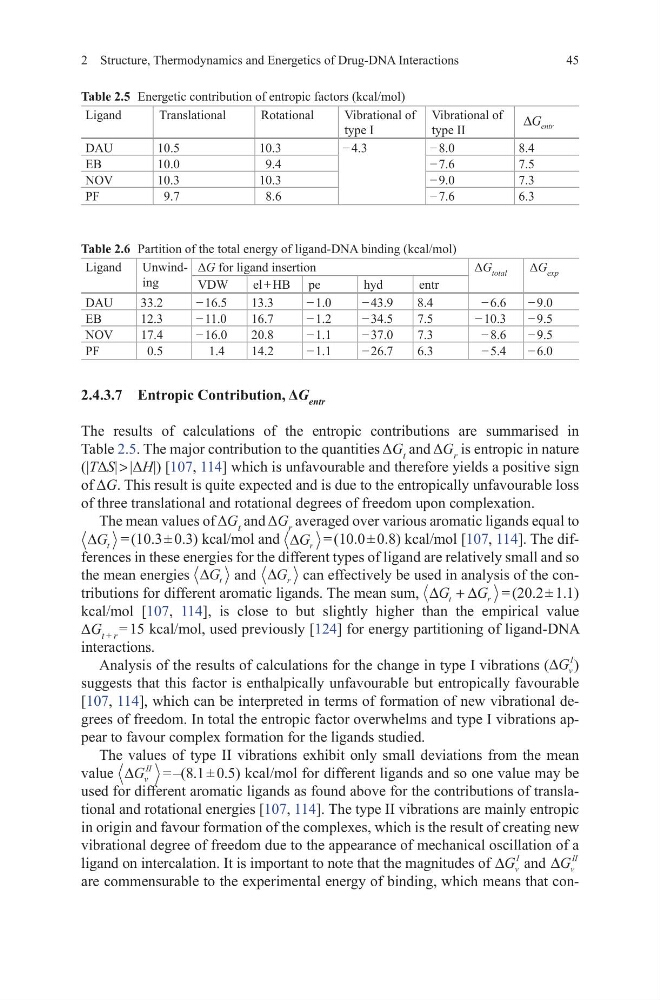
The results of calculations of the entropic contributions are summarised in
Table 2.5. The major contribution to the quantities ΔG t and ΔG r is entropic in nature
(|TΔS| > |ΔH|) [107, 114] which is unfavourable and therefore yields a positive sign
of ΔG. This result is quite expected and is due to the entropically unfavourable loss
of three translational and rotational degrees of freedom upon complexation.
The mean values of ΔG t and ΔG r averaged over various aromatic ligands equal to
∆G t = (10.3 ± 0.3) kcal/mol and ∆G r = (10.0 ± 0.8) kcal/mol [107, 114]. The differences in these energies for the different types of ligand are relatively small and so
the mean energies ∆G t and ∆G r can effectively be used in analysis of the contributions for different aromatic ligands. The mean sum, ∆
∆
G
G
t
r
+
= (20.2 ± 1.1)
kcal/mol [107, 114], is close to but slightly higher than the empirical value
ΔG t + r = 15 kcal/mol, used previously [124] for energy partitioning of ligand-DNA
interactions.
Analysis of the results of calculations for the change in type I vibrations (∆G v
I
)
suggests that this factor is enthalpically unfavourable but entropically favourable
[107, 114], which can be interpreted in terms of formation of new vibrational degrees of freedom. In total the entropic factor overwhelms and type I vibrations appear to favour complex formation for the ligands studied.
The values of type II vibrations exhibit only small deviations from the mean
value ∆G v
II
= –(8.1 ± 0.5) kcal/mol for different ligands and so one value may be
used for different aromatic ligands as found above for the contributions of translational and rotational energies [107, 114]. The type II vibrations are mainly entropic
in origin and favour formation of the complexes, which is the result of creating new
vibrational degree of freedom due to the appearance of mechanical oscillation of a
ligand on intercalation. It is important to note that the magnitudes of ∆G v
I
and ∆G v
II
are commensurable to the experimental energy of binding, which means that conTable 2.5 Energetic contribution of entropic factors (kcal/mol)
Ligand
Translational
Rotational
Vibrational of
type I
Vibrational of
type II
∆G entr
DAU
10.5
10.3
− 4.3
− 8.0
8.4
EB
10.0
9.4
− 7.6
7.5
NOV
10.3
10.3
− 9.0
7.3
PF
9.7
8.6
− 7.6
6.3
Table 2.6 Partition of the total energy of ligand-DNA binding (kcal/mol)
Ligand
Unwinding
ΔG for ligand insertion
ΔG total
ΔG exp
VDW
el + HB pe
hyd
entr
DAU
33.2
− 16.5
13.3
− 1.0
− 43.9
8.4
− 6.6
− 9.0
EB
12.3
− 11.0
16.7
− 1.2
− 34.5
7.5
− 10.3
− 9.5
NOV
17.4
− 16.0
20.8
− 1.1
− 37.0
7.3
− 8.6
− 9.5
PF
0.5
1.4
14.2
− 1.1
− 26.7
6.3
− 5.4
− 6.0
2 Structure, Thermodynamics and Energetics of Drug-DNA Interactions
2.4.3.7 Entropic Contribution, ΔG entr
The results of calculations of the entropic contributions are summarised in
Table 2.5. The major contribution to the quantities ΔG t and ΔG r is entropic in nature
(|TΔS| > |ΔH|) [107, 114] which is unfavourable and therefore yields a positive sign
of ΔG. This result is quite expected and is due to the entropically unfavourable loss
of three translational and rotational degrees of freedom upon complexation.
The mean values of ΔG t and ΔG r averaged over various aromatic ligands equal to
∆G t = (10.3 ± 0.3) kcal/mol and ∆G r = (10.0 ± 0.8) kcal/mol [107, 114]. The differences in these energies for the different types of ligand are relatively small and so
the mean energies ∆G t and ∆G r can effectively be used in analysis of the contributions for different aromatic ligands. The mean sum, ∆
∆
G
G
t
r
+
= (20.2 ± 1.1)
kcal/mol [107, 114], is close to but slightly higher than the empirical value
ΔG t + r = 15 kcal/mol, used previously [124] for energy partitioning of ligand-DNA
interactions.
Analysis of the results of calculations for the change in type I vibrations (∆G v
I
)
suggests that this factor is enthalpically unfavourable but entropically favourable
[107, 114], which can be interpreted in terms of formation of new vibrational degrees of freedom. In total the entropic factor overwhelms and type I vibrations appear to favour complex formation for the ligands studied.
The values of type II vibrations exhibit only small deviations from the mean
value ∆G v
II
= –(8.1 ± 0.5) kcal/mol for different ligands and so one value may be
used for different aromatic ligands as found above for the contributions of translational and rotational energies [107, 114]. The type II vibrations are mainly entropic
in origin and favour formation of the complexes, which is the result of creating new
vibrational degree of freedom due to the appearance of mechanical oscillation of a
ligand on intercalation. It is important to note that the magnitudes of ∆G v
I
and ∆G v
II
are commensurable to the experimental energy of binding, which means that conTable 2.5 Energetic contribution of entropic factors (kcal/mol)
Ligand
Translational
Rotational
Vibrational of
type I
Vibrational of
type II
∆G entr
DAU
10.5
10.3
− 4.3
− 8.0
8.4
EB
10.0
9.4
− 7.6
7.5
NOV
10.3
10.3
− 9.0
7.3
PF
9.7
8.6
− 7.6
6.3
Table 2.6 Partition of the total energy of ligand-DNA binding (kcal/mol)
Ligand
Unwinding
ΔG for ligand insertion
ΔG total
ΔG exp
VDW
el + HB pe
hyd
entr
DAU
33.2
− 16.5
13.3
− 1.0
− 43.9
8.4
− 6.6
− 9.0
EB
12.3
− 11.0
16.7
− 1.2
− 34.5
7.5
− 10.3
− 9.5
NOV
17.4
− 16.0
20.8
− 1.1
− 37.0
7.3
− 8.6
− 9.5
PF
0.5
1.4
14.2
− 1.1
− 26.7
6.3
− 5.4
− 6.0
2 Structure, Thermodynamics and Energetics of Drug-DNA Interactions