

46
M. P. Evstigneev and A. V. Shestopalova
sideration of these components is important in the energy analysis of ligand-DNA
interactions.
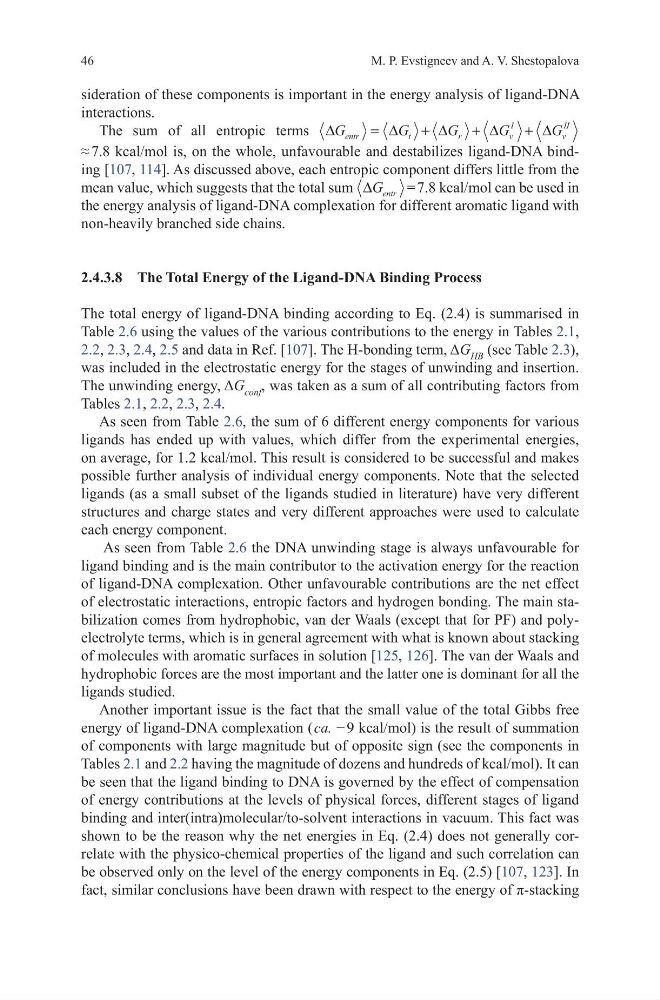
The sum of all entropic terms ∆
∆
∆
∆
∆
G
G
G
G
G
entr
t
r
v
I
v
II
=
+
+
+
≈ 7.8 kcal/mol is, on the whole, unfavourable and destabilizes ligand-DNA binding [107, 114]. As discussed above, each entropic component differs little from the
mean value, which suggests that the total sum ∆G entr = 7.8 kcal/mol can be used in
the energy analysis of ligand-DNA complexation for different aromatic ligand with
non-heavily branched side chains.
2.4.3.8 The Total Energy of the Ligand-DNA Binding Process
The total energy of ligand-DNA binding according to Eq. (2.4) is summarised in
Table 2.6 using the values of the various contributions to the energy in Tables 2.1,
2.2, 2.3, 2.4, 2.5 and data in Ref. [107]. The H-bonding term, ΔG HB (see Table 2.3),
was included in the electrostatic energy for the stages of unwinding and insertion.
The unwinding energy, ΔG conf , was taken as a sum of all contributing factors from
Tables 2.1, 2.2, 2.3, 2.4.
As seen from Table 2.6, the sum of 6 different energy components for various
ligands has ended up with values, which differ from the experimental energies,
on average, for 1.2 kcal/mol. This result is considered to be successful and makes
possible further analysis of individual energy components. Note that the selected
ligands (as a small subset of the ligands studied in literature) have very different
structures and charge states and very different approaches were used to calculate
each energy component.
As seen from Table 2.6 the DNA unwinding stage is always unfavourable for
ligand binding and is the main contributor to the activation energy for the reaction
of ligand-DNA complexation. Other unfavourable contributions are the net effect
of electrostatic interactions, entropic factors and hydrogen bonding. The main stabilization comes from hydrophobic, van der Waals (except that for PF) and polyelectrolyte terms, which is in general agreement with what is known about stacking
of molecules with aromatic surfaces in solution [125, 126]. The van der Waals and
hydrophobic forces are the most important and the latter one is dominant for all the
ligands studied.
Another important issue is the fact that the small value of the total Gibbs free
energy of ligand-DNA complexation ( ca. − 9 kcal/mol) is the result of summation
of components with large magnitude but of opposite sign (see the components in
Tables 2.1 and 2.2 having the magnitude of dozens and hundreds of kcal/mol). It can
be seen that the ligand binding to DNA is governed by the effect of compensation
of energy contributions at the levels of physical forces, different stages of ligand
binding and inter(intra)molecular/to-solvent interactions in vacuum. This fact was
shown to be the reason why the net energies in Eq. (2.4) does not generally correlate with the physico-chemical properties of the ligand and such correlation can
be observed only on the level of the energy components in Eq. (2.5) [107, 123]. In
fact, similar conclusions have been drawn with respect to the energy of π-stacking
M. P. Evstigneev and A. V. Shestopalova
sideration of these components is important in the energy analysis of ligand-DNA
interactions.
The sum of all entropic terms ∆
∆
∆
∆
∆
G
G
G
G
G
entr
t
r
v
I
v
II
=
+
+
+
≈ 7.8 kcal/mol is, on the whole, unfavourable and destabilizes ligand-DNA binding [107, 114]. As discussed above, each entropic component differs little from the
mean value, which suggests that the total sum ∆G entr = 7.8 kcal/mol can be used in
the energy analysis of ligand-DNA complexation for different aromatic ligand with
non-heavily branched side chains.
2.4.3.8 The Total Energy of the Ligand-DNA Binding Process
The total energy of ligand-DNA binding according to Eq. (2.4) is summarised in
Table 2.6 using the values of the various contributions to the energy in Tables 2.1,
2.2, 2.3, 2.4, 2.5 and data in Ref. [107]. The H-bonding term, ΔG HB (see Table 2.3),
was included in the electrostatic energy for the stages of unwinding and insertion.
The unwinding energy, ΔG conf , was taken as a sum of all contributing factors from
Tables 2.1, 2.2, 2.3, 2.4.
As seen from Table 2.6, the sum of 6 different energy components for various
ligands has ended up with values, which differ from the experimental energies,
on average, for 1.2 kcal/mol. This result is considered to be successful and makes
possible further analysis of individual energy components. Note that the selected
ligands (as a small subset of the ligands studied in literature) have very different
structures and charge states and very different approaches were used to calculate
each energy component.
As seen from Table 2.6 the DNA unwinding stage is always unfavourable for
ligand binding and is the main contributor to the activation energy for the reaction
of ligand-DNA complexation. Other unfavourable contributions are the net effect
of electrostatic interactions, entropic factors and hydrogen bonding. The main stabilization comes from hydrophobic, van der Waals (except that for PF) and polyelectrolyte terms, which is in general agreement with what is known about stacking
of molecules with aromatic surfaces in solution [125, 126]. The van der Waals and
hydrophobic forces are the most important and the latter one is dominant for all the
ligands studied.
Another important issue is the fact that the small value of the total Gibbs free
energy of ligand-DNA complexation ( ca. − 9 kcal/mol) is the result of summation
of components with large magnitude but of opposite sign (see the components in
Tables 2.1 and 2.2 having the magnitude of dozens and hundreds of kcal/mol). It can
be seen that the ligand binding to DNA is governed by the effect of compensation
of energy contributions at the levels of physical forces, different stages of ligand
binding and inter(intra)molecular/to-solvent interactions in vacuum. This fact was
shown to be the reason why the net energies in Eq. (2.4) does not generally correlate with the physico-chemical properties of the ligand and such correlation can
be observed only on the level of the energy components in Eq. (2.5) [107, 123]. In
fact, similar conclusions have been drawn with respect to the energy of π-stacking