

44
M. P. Evstigneev and A. V. Shestopalova
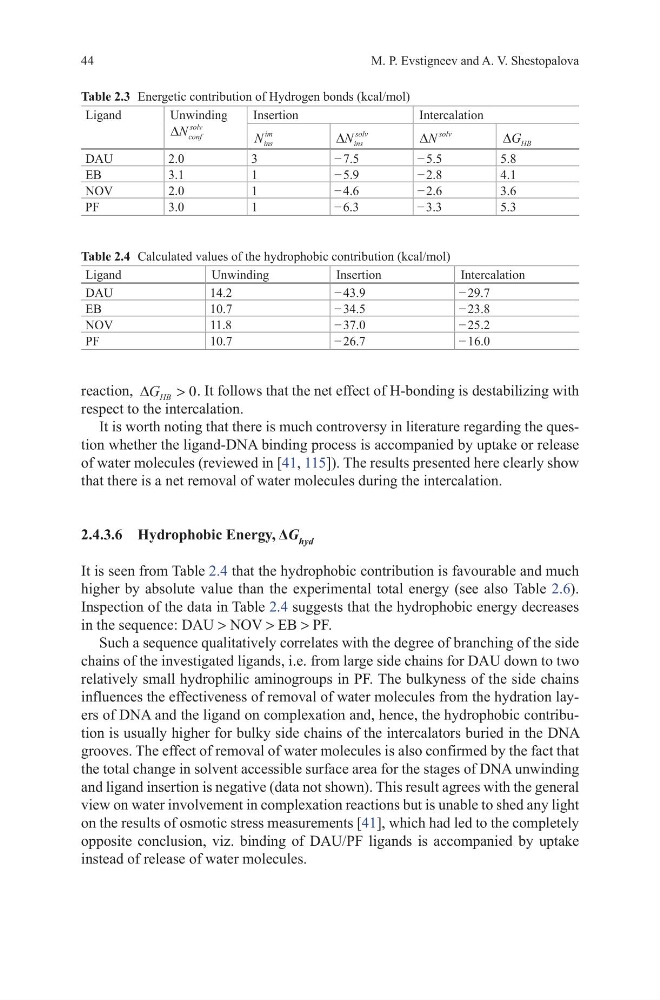
reaction, ∆G HB > 0. It follows that the net effect of H-bonding is destabilizing with
respect to the intercalation.
It is worth noting that there is much controversy in literature regarding the question whether the ligand-DNA binding process is accompanied by uptake or release
of water molecules (reviewed in [41, 115]). The results presented here clearly show
that there is a net removal of water molecules during the intercalation.
2.4.3.6 Hydrophobic Energy, ΔG hyd
It is seen from Table 2.4 that the hydrophobic contribution is favourable and much
higher by absolute value than the experimental total energy (see also Table 2.6).
Inspection of the data in Table 2.4 suggests that the hydrophobic energy decreases
in the sequence: DAU > NOV > EB > PF.
Such a sequence qualitatively correlates with the degree of branching of the side
chains of the investigated ligands, i.e. from large side chains for DAU down to two
relatively small hydrophilic aminogroups in PF. The bulkyness of the side chains
influences the effectiveness of removal of water molecules from the hydration layers of DNA and the ligand on complexation and, hence, the hydrophobic contribution is usually higher for bulky side chains of the intercalators buried in the DNA
grooves. The effect of removal of water molecules is also confirmed by the fact that
the total change in solvent accessible surface area for the stages of DNA unwinding
and ligand insertion is negative (data not shown). This result agrees with the general
view on water involvement in complexation reactions but is unable to shed any light
on the results of osmotic stress measurements [41], which had led to the completely
opposite conclusion, viz. binding of DAU/PF ligands is accompanied by uptake
instead of release of water molecules.
Table 2.3 Energetic contribution of Hydrogen bonds (kcal/mol)
Ligand
Unwinding
∆N conf
solv
Insertion
Intercalation
N ins
im
∆N ins
solv
∆N
solv
∆G HB
DAU
2.0
3
− 7.5
− 5.5
5.8
EB
3.1
1
− 5.9
− 2.8
4.1
NOV
2.0
1
− 4.6
− 2.6
3.6
PF
3.0
1
− 6.3
− 3.3
5.3
Table 2.4 Calculated values of the hydrophobic contribution (kcal/mol)
Ligand
Unwinding
Insertion
Intercalation
DAU
14.2
− 43.9
− 29.7
EB
10.7
− 34.5
− 23.8
NOV
11.8
− 37.0
− 25.2
PF
10.7
− 26.7
− 16.0
M. P. Evstigneev and A. V. Shestopalova
reaction, ∆G HB > 0. It follows that the net effect of H-bonding is destabilizing with
respect to the intercalation.
It is worth noting that there is much controversy in literature regarding the question whether the ligand-DNA binding process is accompanied by uptake or release
of water molecules (reviewed in [41, 115]). The results presented here clearly show
that there is a net removal of water molecules during the intercalation.
2.4.3.6 Hydrophobic Energy, ΔG hyd
It is seen from Table 2.4 that the hydrophobic contribution is favourable and much
higher by absolute value than the experimental total energy (see also Table 2.6).
Inspection of the data in Table 2.4 suggests that the hydrophobic energy decreases
in the sequence: DAU > NOV > EB > PF.
Such a sequence qualitatively correlates with the degree of branching of the side
chains of the investigated ligands, i.e. from large side chains for DAU down to two
relatively small hydrophilic aminogroups in PF. The bulkyness of the side chains
influences the effectiveness of removal of water molecules from the hydration layers of DNA and the ligand on complexation and, hence, the hydrophobic contribution is usually higher for bulky side chains of the intercalators buried in the DNA
grooves. The effect of removal of water molecules is also confirmed by the fact that
the total change in solvent accessible surface area for the stages of DNA unwinding
and ligand insertion is negative (data not shown). This result agrees with the general
view on water involvement in complexation reactions but is unable to shed any light
on the results of osmotic stress measurements [41], which had led to the completely
opposite conclusion, viz. binding of DAU/PF ligands is accompanied by uptake
instead of release of water molecules.
Table 2.3 Energetic contribution of Hydrogen bonds (kcal/mol)
Ligand
Unwinding
∆N conf
solv
Insertion
Intercalation
N ins
im
∆N ins
solv
∆N
solv
∆G HB
DAU
2.0
3
− 7.5
− 5.5
5.8
EB
3.1
1
− 5.9
− 2.8
4.1
NOV
2.0
1
− 4.6
− 2.6
3.6
PF
3.0
1
− 6.3
− 3.3
5.3
Table 2.4 Calculated values of the hydrophobic contribution (kcal/mol)
Ligand
Unwinding
Insertion
Intercalation
DAU
14.2
− 43.9
− 29.7
EB
10.7
− 34.5
− 23.8
NOV
11.8
− 37.0
− 25.2
PF
10.7
− 26.7
− 16.0