

38
M. P. Evstigneev and A. V. Shestopalova
where ΔG conf is the energetic contribution due to conformational changes of the
molecules during the complexation process, ΔG vdW and ΔG el are the contributions
from van der Waals (VDW) and electrostatic (EL) interactions, respectively, ΔG pe
is the polyelectrolyte contribution, ΔG hyd is the hydrophobic (HYD) contribution,
ΔG HB is the contribution from hydrogen bonds (HB).
The entropic term, ΔG entr , originates from the loss of translational (ΔG t ), rotational (ΔG r ) degrees of freedom, change in the mode of vibrations of chemical
bonds (the high frequency term or type I vibrations,
I
v
G
∆ ) and appearance of new
mechanical oscillations of the ligand in the binding site (the low frequency term or
type II vibrations ∆G v
II
), i.e.
(2.6)
Recently, it has been shown that the ΔG entr term also contains hidden systematic
contribution from the entropy dependence on the number of bound ligands [109]
and the change in rigidity of NA on sequential ligand binding [110]. However, both
factors have been reported to give negligible contribution to ΔG entr for the case of
small ligands having much smaller dimensions than the DNA receptor, and may be
excluded from the analysis of energetics.
Briefly, the computation of each of the terms in Eq. (2.4), Eq. (2.5) was performed according to the following protocols. The calculation of the VDW interactions was performed by averaging the VDW part of the interaction energy during
the course of MD [107, 108]. The energies of electrostatic interactions were calculated by means of solution of non-linear Poisson-Boltzmann equation [111], and the
overall approach used was shown to depend relatively weakly on the underlying
method of atomic charges computation [112]. The energy of hydrophobic interactions was computed from the change in solvent accessible surface area, which
had been proved to give more consistent results as compared to the alternative approaches [107, 113]. Calculation of the vibrations of chemical bonds was performed
by normal mode analysis [107, 108, 114]. Calculation of mechanical vibrations of
the molecules in complex was performed by means of estimation of the rigidity factor against small translational shifts [107, 108, 114].
∆
∆
∆
∆
∆
G
G
G
G
G
entr
t
r
v
I
v
II
=
+
+
+
1$
1$
'1$
LP
FRQI
*
∆
LP
LQV
*
∆
VROY
1$
*
∆
1$
FRQI
*
∆
VROY
1$
*
∆
1$
'
VROY
'
*
∆
'1$
LQV
*
∆
VROY
'1$
* −
∆
)RUPDWLRQRIWKHELQGLQJVLWH
,QVHUWLRQ
9DFXXP
6ROXWLRQ
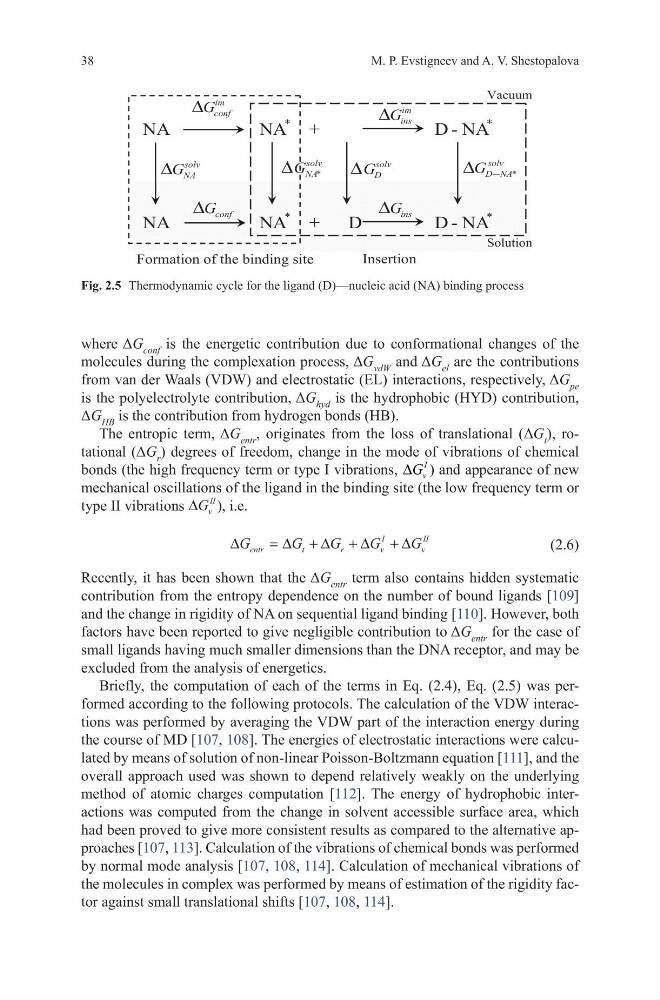
Fig. 2.5 Thermodynamic cycle for the ligand (D)—nucleic acid (NA) binding process
M. P. Evstigneev and A. V. Shestopalova
where ΔG conf is the energetic contribution due to conformational changes of the
molecules during the complexation process, ΔG vdW and ΔG el are the contributions
from van der Waals (VDW) and electrostatic (EL) interactions, respectively, ΔG pe
is the polyelectrolyte contribution, ΔG hyd is the hydrophobic (HYD) contribution,
ΔG HB is the contribution from hydrogen bonds (HB).
The entropic term, ΔG entr , originates from the loss of translational (ΔG t ), rotational (ΔG r ) degrees of freedom, change in the mode of vibrations of chemical
bonds (the high frequency term or type I vibrations,
I
v
G
∆ ) and appearance of new
mechanical oscillations of the ligand in the binding site (the low frequency term or
type II vibrations ∆G v
II
), i.e.
(2.6)
Recently, it has been shown that the ΔG entr term also contains hidden systematic
contribution from the entropy dependence on the number of bound ligands [109]
and the change in rigidity of NA on sequential ligand binding [110]. However, both
factors have been reported to give negligible contribution to ΔG entr for the case of
small ligands having much smaller dimensions than the DNA receptor, and may be
excluded from the analysis of energetics.
Briefly, the computation of each of the terms in Eq. (2.4), Eq. (2.5) was performed according to the following protocols. The calculation of the VDW interactions was performed by averaging the VDW part of the interaction energy during
the course of MD [107, 108]. The energies of electrostatic interactions were calculated by means of solution of non-linear Poisson-Boltzmann equation [111], and the
overall approach used was shown to depend relatively weakly on the underlying
method of atomic charges computation [112]. The energy of hydrophobic interactions was computed from the change in solvent accessible surface area, which
had been proved to give more consistent results as compared to the alternative approaches [107, 113]. Calculation of the vibrations of chemical bonds was performed
by normal mode analysis [107, 108, 114]. Calculation of mechanical vibrations of
the molecules in complex was performed by means of estimation of the rigidity factor against small translational shifts [107, 108, 114].
∆
∆
∆
∆
∆
G
G
G
G
G
entr
t
r
v
I
v
II
=
+
+
+
1$
1$
'1$
LP
FRQI
*
∆
LP
LQV
*
∆
VROY
1$
*
∆
1$
FRQI
*
∆
VROY
1$
*
∆
1$
'
VROY
'
*
∆
'1$
LQV
*
∆
VROY
'1$
* −
∆
)RUPDWLRQRIWKHELQGLQJVLWH
,QVHUWLRQ
9DFXXP
6ROXWLRQ
Fig. 2.5 Thermodynamic cycle for the ligand (D)—nucleic acid (NA) binding process