

39
A special note should be given to the method of explicit account of the energy of
H-bonds, ∆G HB . The energy contribution from hydrogen bonds to water molecules
on complexation was estimated from the change in hydration index of the system
( N
im
or ΔN
solv
representing the average number of intermolecular H-bonds and the
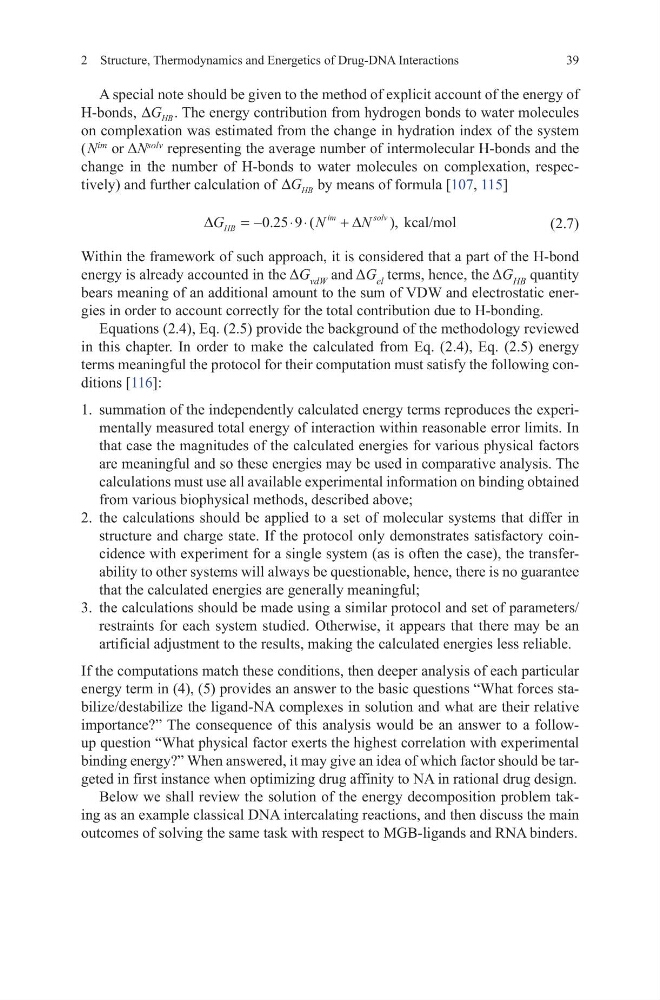
change in the number of H-bonds to water molecules on complexation, respectively) and further calculation of ∆G HB by means of formula [107, 115]
(2.7)
Within the framework of such approach, it is considered that a part of the H-bond
energy is already accounted in the ΔG vdW and ΔG el terms, hence, the ΔG HB quantity
bears meaning of an additional amount to the sum of VDW and electrostatic energies in order to account correctly for the total contribution due to H-bonding.
Equations (2.4), Eq. (2.5) provide the background of the methodology reviewed
in this chapter. In order to make the calculated from Eq. (2.4), Eq. (2.5) energy
terms meaningful the protocol for their computation must satisfy the following conditions [116]:
1. summation of the independently calculated energy terms reproduces the experimentally measured total energy of interaction within reasonable error limits. In
that case the magnitudes of the calculated energies for various physical factors
are meaningful and so these energies may be used in comparative analysis. The
calculations must use all available experimental information on binding obtained
from various biophysical methods, described above;
2. the calculations should be applied to a set of molecular systems that differ in
structure and charge state. If the protocol only demonstrates satisfactory coincidence with experiment for a single system (as is often the case), the transferability to other systems will always be questionable, hence, there is no guarantee
that the calculated energies are generally meaningful;
3. the calculations should be made using a similar protocol and set of parameters/
restraints for each system studied. Otherwise, it appears that there may be an
artificial adjustment to the results, making the calculated energies less reliable.
If the computations match these conditions, then deeper analysis of each particular
energy term in (4), (5) provides an answer to the basic questions “What forces stabilize/destabilize the ligand-NA complexes in solution and what are their relative
importance?” The consequence of this analysis would be an answer to a followup question “What physical factor exerts the highest correlation with experimental
binding energy?” When answered, it may give an idea of which factor should be targeted in first instance when optimizing drug affinity to NA in rational drug design.
Below we shall review the solution of the energy decomposition problem taking as an example classical DNA intercalating reactions, and then discuss the main
outcomes of solving the same task with respect to MGB-ligands and RNA binders.
∆
∆
G
N
N
HB
im
solv
= −
⋅ ⋅
+
0 25 9
.
(
), kcal/mol
2 Structure, Thermodynamics and Energetics of Drug-DNA Interactions
A special note should be given to the method of explicit account of the energy of
H-bonds, ∆G HB . The energy contribution from hydrogen bonds to water molecules
on complexation was estimated from the change in hydration index of the system
( N
im
or ΔN
solv
representing the average number of intermolecular H-bonds and the
change in the number of H-bonds to water molecules on complexation, respectively) and further calculation of ∆G HB by means of formula [107, 115]
(2.7)
Within the framework of such approach, it is considered that a part of the H-bond
energy is already accounted in the ΔG vdW and ΔG el terms, hence, the ΔG HB quantity
bears meaning of an additional amount to the sum of VDW and electrostatic energies in order to account correctly for the total contribution due to H-bonding.
Equations (2.4), Eq. (2.5) provide the background of the methodology reviewed
in this chapter. In order to make the calculated from Eq. (2.4), Eq. (2.5) energy
terms meaningful the protocol for their computation must satisfy the following conditions [116]:
1. summation of the independently calculated energy terms reproduces the experimentally measured total energy of interaction within reasonable error limits. In
that case the magnitudes of the calculated energies for various physical factors
are meaningful and so these energies may be used in comparative analysis. The
calculations must use all available experimental information on binding obtained
from various biophysical methods, described above;
2. the calculations should be applied to a set of molecular systems that differ in
structure and charge state. If the protocol only demonstrates satisfactory coincidence with experiment for a single system (as is often the case), the transferability to other systems will always be questionable, hence, there is no guarantee
that the calculated energies are generally meaningful;
3. the calculations should be made using a similar protocol and set of parameters/
restraints for each system studied. Otherwise, it appears that there may be an
artificial adjustment to the results, making the calculated energies less reliable.
If the computations match these conditions, then deeper analysis of each particular
energy term in (4), (5) provides an answer to the basic questions “What forces stabilize/destabilize the ligand-NA complexes in solution and what are their relative
importance?” The consequence of this analysis would be an answer to a followup question “What physical factor exerts the highest correlation with experimental
binding energy?” When answered, it may give an idea of which factor should be targeted in first instance when optimizing drug affinity to NA in rational drug design.
Below we shall review the solution of the energy decomposition problem taking as an example classical DNA intercalating reactions, and then discuss the main
outcomes of solving the same task with respect to MGB-ligands and RNA binders.
∆
∆
G
N
N
HB
im
solv
= −
⋅ ⋅
+
0 25 9
.
(
), kcal/mol
2 Structure, Thermodynamics and Energetics of Drug-DNA Interactions