

37
In this section we shall briefly review the solution of the energy decomposition
problem for various types of NA binding drugs, viz. DNA aromatic intercalators,
DNA minor groove binders (or MGB-ligands), RNA aptamer binders.
2.4.2 General Computational Approach to Study the Energetics
of Binding
When studying the ligand-NA binding processes in aqueous media, two important
factors must be taken into consideration:
1. binding of the ligand must be accompanied by formation of the binding site on
NA, which is commonly referred to as DNA unwinding ( i.e. transition of the
DNA helix from a regular B-form into an unwound DNA) for the intercalation
process [103], and DNA/RNA adaptation—for the DNA minor groove and RNA
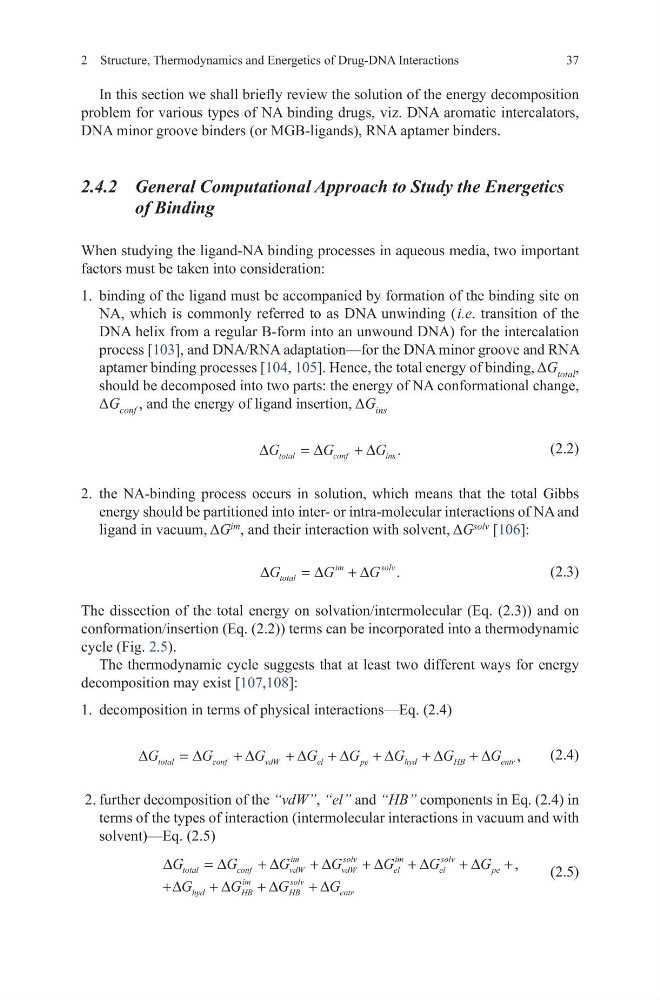
aptamer binding processes [104, 105]. Hence, the total energy of binding, ΔG total ,
should be decomposed into two parts: the energy of NA conformational change,
ΔG conf , and the energy of ligand insertion, ΔG ins
(2.2)
2. the NA-binding process occurs in solution, which means that the total Gibbs
energy should be partitioned into inter- or intra-molecular interactions of NA and
ligand in vacuum, ΔG
im
, and their interaction with solvent, ΔG
solv
[106]:
(2.3)
The dissection of the total energy on solvation/intermolecular (Eq. (2.3)) and on
conformation/insertion (Eq. (2.2)) terms can be incorporated into a thermodynamic
cycle (Fig. 2.5).
The thermodynamic cycle suggests that at least two different ways for energy
decomposition may exist [107,108]:
1. decomposition in terms of physical interactions—Eq. (2.4)
(2.4)
2. further decomposition of the “vdW”, “el” and “HB” components in Eq. (2.4) in
terms of the types of interaction (intermolecular interactions in vacuum and with
solvent)—Eq. (2.5)
(2.5)
∆
∆
∆
G
G
G
total
c onf
ins
=
+
.
∆
∆
∆
G
G
G
total
im
solv
=
+
.
∆
∆
∆
∆
∆
∆
∆
∆
G
G
G
G
G
G
G
G
total
c onf
vdW
e l
p e
h yd
HB
entr
=
+
+
+
+
+
+
,
∆
∆
∆
∆
∆
∆
∆
∆
G
G
G
G
G
G
G
G
total
c onf
vdW
im
vdW
solv
el
im
el
solv
pe
h
=
+
+
+
+
+
+
+
y yd
HB
im
HB
solv
entr
G
G
G
+
+
+
∆
∆
∆
,
2 Structure, Thermodynamics and Energetics of Drug-DNA Interactions
In this section we shall briefly review the solution of the energy decomposition
problem for various types of NA binding drugs, viz. DNA aromatic intercalators,
DNA minor groove binders (or MGB-ligands), RNA aptamer binders.
2.4.2 General Computational Approach to Study the Energetics
of Binding
When studying the ligand-NA binding processes in aqueous media, two important
factors must be taken into consideration:
1. binding of the ligand must be accompanied by formation of the binding site on
NA, which is commonly referred to as DNA unwinding ( i.e. transition of the
DNA helix from a regular B-form into an unwound DNA) for the intercalation
process [103], and DNA/RNA adaptation—for the DNA minor groove and RNA
aptamer binding processes [104, 105]. Hence, the total energy of binding, ΔG total ,
should be decomposed into two parts: the energy of NA conformational change,
ΔG conf , and the energy of ligand insertion, ΔG ins
(2.2)
2. the NA-binding process occurs in solution, which means that the total Gibbs
energy should be partitioned into inter- or intra-molecular interactions of NA and
ligand in vacuum, ΔG
im
, and their interaction with solvent, ΔG
solv
[106]:
(2.3)
The dissection of the total energy on solvation/intermolecular (Eq. (2.3)) and on
conformation/insertion (Eq. (2.2)) terms can be incorporated into a thermodynamic
cycle (Fig. 2.5).
The thermodynamic cycle suggests that at least two different ways for energy
decomposition may exist [107,108]:
1. decomposition in terms of physical interactions—Eq. (2.4)
(2.4)
2. further decomposition of the “vdW”, “el” and “HB” components in Eq. (2.4) in
terms of the types of interaction (intermolecular interactions in vacuum and with
solvent)—Eq. (2.5)
(2.5)
∆
∆
∆
G
G
G
total
c onf
ins
=
+
.
∆
∆
∆
G
G
G
total
im
solv
=
+
.
∆
∆
∆
∆
∆
∆
∆
∆
G
G
G
G
G
G
G
G
total
c onf
vdW
e l
p e
h yd
HB
entr
=
+
+
+
+
+
+
,
∆
∆
∆
∆
∆
∆
∆
∆
G
G
G
G
G
G
G
G
total
c onf
vdW
im
vdW
solv
el
im
el
solv
pe
h
=
+
+
+
+
+
+
+
y yd
HB
im
HB
solv
entr
G
G
G
+
+
+
∆
∆
∆
,
2 Structure, Thermodynamics and Energetics of Drug-DNA Interactions