

492
N. Ya. Golovenko et al.
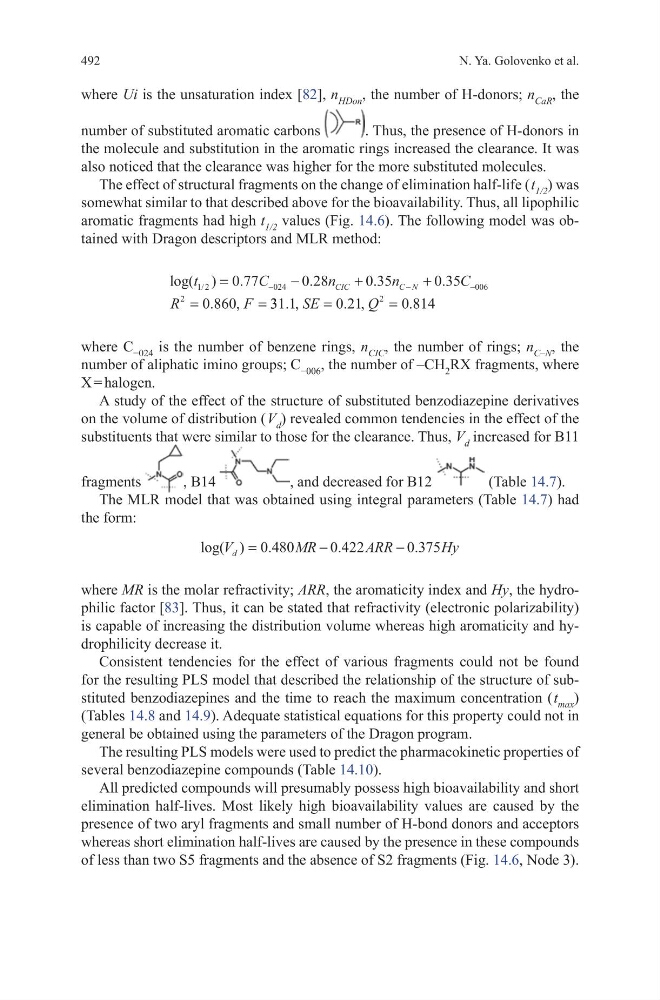
where Ui is the unsaturation index [82], n HDon , the number of H-donors; n CaR , the
number of substituted aromatic carbons
. Thus, the presence of H-donors in
the molecule and substitution in the aromatic rings increased the clearance. It was
also noticed that the clearance was higher for the more substituted molecules.
The effect of structural fragments on the change of elimination half-life ( t 1/2 ) was
somewhat similar to that described above for the bioavailability. Thus, all lipophilic
aromatic fragments had high t 1/2 values (Fig. 14.6). The following model was obtained with Dragon descriptors and MLR method:
where C −024 is the number of benzene rings, n CIC , the number of rings; n C–N , the
number of aliphatic imino groups; C −006 , the number of –CH 2 RX fragments, where
X = halogen.
A study of the effect of the structure of substituted benzodiazepine derivatives
on the volume of distribution ( V d ) revealed common tendencies in the effect of the
substituents that were similar to those for the clearance. Thus, V d increased for B11
fragments
, B14
, and decreased for B12
(Table 14.7).
The MLR model that was obtained using integral parameters (Table 14.7) had
the form:
where MR is the molar refractivity; ARR, the aromaticity index and Hy, the hydrophilic factor [83]. Thus, it can be stated that refractivity (electronic polarizability)
is capable of increasing the distribution volume whereas high aromaticity and hydrophilicity decrease it.
Consistent tendencies for the effect of various fragments could not be found
for the resulting PLS model that described the relationship of the structure of substituted benzodiazepines and the time to reach the maximum concentration ( t max )
(Tables 14.8 and 14.9). Adequate statistical equations for this property could not in
general be obtained using the parameters of the Dragon program.
The resulting PLS models were used to predict the pharmacokinetic properties of
several benzodiazepine compounds (Table 14.10).
All predicted compounds will presumably possess high bioavailability and short
elimination half-lives. Most likely high bioavailability values are caused by the
presence of two aryl fragments and small number of H-bond donors and acceptors
whereas short elimination half-lives are caused by the presence in these compounds
of less than two S5 fragments and the absence of S2 fragments (Fig. 14.6, Node 3).
log( )
.
.
.
.
. ,
/
t
C
n
n
C
R
F
CIC
CN
1 2
024
006
2
0 77
028
0 35
035
0 860
=
−
+
+
=
=
−
−
−
3 31 1
021
0 814
2
. ,
. ,
.
SE
Q
=
=
log( )
.
.
.
V
M R
ARR
Hy
d =
−
−
0 480
0 422
0 375
N. Ya. Golovenko et al.
where Ui is the unsaturation index [82], n HDon , the number of H-donors; n CaR , the
number of substituted aromatic carbons
. Thus, the presence of H-donors in
the molecule and substitution in the aromatic rings increased the clearance. It was
also noticed that the clearance was higher for the more substituted molecules.
The effect of structural fragments on the change of elimination half-life ( t 1/2 ) was
somewhat similar to that described above for the bioavailability. Thus, all lipophilic
aromatic fragments had high t 1/2 values (Fig. 14.6). The following model was obtained with Dragon descriptors and MLR method:
where C −024 is the number of benzene rings, n CIC , the number of rings; n C–N , the
number of aliphatic imino groups; C −006 , the number of –CH 2 RX fragments, where
X = halogen.
A study of the effect of the structure of substituted benzodiazepine derivatives
on the volume of distribution ( V d ) revealed common tendencies in the effect of the
substituents that were similar to those for the clearance. Thus, V d increased for B11
fragments
, B14
, and decreased for B12
(Table 14.7).
The MLR model that was obtained using integral parameters (Table 14.7) had
the form:
where MR is the molar refractivity; ARR, the aromaticity index and Hy, the hydrophilic factor [83]. Thus, it can be stated that refractivity (electronic polarizability)
is capable of increasing the distribution volume whereas high aromaticity and hydrophilicity decrease it.
Consistent tendencies for the effect of various fragments could not be found
for the resulting PLS model that described the relationship of the structure of substituted benzodiazepines and the time to reach the maximum concentration ( t max )
(Tables 14.8 and 14.9). Adequate statistical equations for this property could not in
general be obtained using the parameters of the Dragon program.
The resulting PLS models were used to predict the pharmacokinetic properties of
several benzodiazepine compounds (Table 14.10).
All predicted compounds will presumably possess high bioavailability and short
elimination half-lives. Most likely high bioavailability values are caused by the
presence of two aryl fragments and small number of H-bond donors and acceptors
whereas short elimination half-lives are caused by the presence in these compounds
of less than two S5 fragments and the absence of S2 fragments (Fig. 14.6, Node 3).
log( )
.
.
.
.
. ,
/
t
C
n
n
C
R
F
CIC
CN
1 2
024
006
2
0 77
028
0 35
035
0 860
=
−
+
+
=
=
−
−
−
3 31 1
021
0 814
2
. ,
. ,
.
SE
Q
=
=
log( )
.
.
.
V
M R
ARR
Hy
d =
−
−
0 480
0 422
0 375