

493
14 Quantitative Structure-Property Relationship Analysis …
14.4.2 Prediction of Absorption and Bioavailability Using
Physiologically Based Modeling
Oral drug absorption is a complex process. It consists of multiple steps that may
include drug disintegration and dissolution, degradation, gastric emptying, intestinal transit, intestinal permeation and transport, intestinal and hepatic metabolism.
The factors that may have impact on the rate and extent of drug absorption are
dosage form, physico-chemical and biopharmaceutical properties of the API, and
physiology of the GI. Knowledge of how these steps and factors influence absorption has fostered the development of predictive models for oral drug absorption.
Pharmacokinetic models are used to describe the time-dependent distribution and
disposition of an API in a living system. In contrast to the QSAR, gastrointestinal
absorption model (Physiologically Based Absorption Modeling, PBPK) models vary in complexity and capability according to their intended purpose. PBPK
models differ from one or two compartment models by representing physiological, physico-chemical and biochemical processes in the species of interest. In most
PBPK models, tissues are represented by specific compartments, each with a unique
set of physiological (blood flows, drug fate in the GI tract), physico-chemical (partition coefficients) and biochemical (metabolic rates) parameter values. Target tissues
are generally represented individually. The absorption model connected to a distribution model predicts the in vivo pharmacokinetic profiles.
PBPK approaches are classified into three categories [82]: quasiequilibrium
models, steady-state models, and dynamic models. The classification of these models is based upon their dependence on spatial and temporal variables. The quasiequilibrium models, which are independent of spatial and temporal variables, include
the pH-partition hypothesis and absorption potential concept. The steady-state models are limited to prediction of the extent but not the rate of oral drug absorption.
The dynamic models consider spatial and temporal variables and can predict both
the rate and extent of oral drug absorption. The dynamic models include dispersion
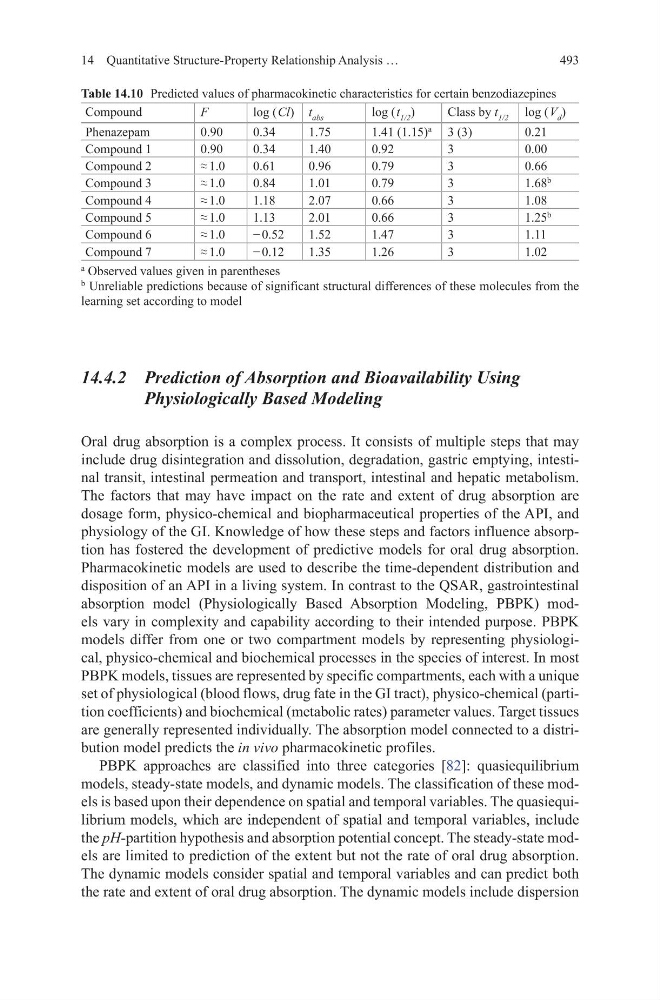
Table 14.10 Predicted values of pharmacokinetic characteristics for certain benzodiazepines
Compound
F
log ( Cl) t abs
log ( t 1/2 )
Class by t 1/2 log ( V d )
Phenazepam
0.90
0.34
1.75
1.41 (1.15)
a
3 (3)
0.21
Compound 1
0.90
0.34
1.40
0.92
3
0.00
Compound 2
≈ 1.0
0.61
0.96
0.79
3
0.66
Compound 3
≈ 1.0
0.84
1.01
0.79
3
1.68
b
Compound 4
≈ 1.0
1.18
2.07
0.66
3
1.08
Compound 5
≈ 1.0
1.13
2.01
0.66
3
1.25
b
Compound 6
≈ 1.0
− 0.52
1.52
1.47
3
1.11
Compound 7
≈ 1.0
− 0.12
1.35
1.26
3
1.02
a
Observed values given in parentheses
b
Unreliable predictions because of significant structural differences of these molecules from the
learning set according to model
14 Quantitative Structure-Property Relationship Analysis …
14.4.2 Prediction of Absorption and Bioavailability Using
Physiologically Based Modeling
Oral drug absorption is a complex process. It consists of multiple steps that may
include drug disintegration and dissolution, degradation, gastric emptying, intestinal transit, intestinal permeation and transport, intestinal and hepatic metabolism.
The factors that may have impact on the rate and extent of drug absorption are
dosage form, physico-chemical and biopharmaceutical properties of the API, and
physiology of the GI. Knowledge of how these steps and factors influence absorption has fostered the development of predictive models for oral drug absorption.
Pharmacokinetic models are used to describe the time-dependent distribution and
disposition of an API in a living system. In contrast to the QSAR, gastrointestinal
absorption model (Physiologically Based Absorption Modeling, PBPK) models vary in complexity and capability according to their intended purpose. PBPK
models differ from one or two compartment models by representing physiological, physico-chemical and biochemical processes in the species of interest. In most
PBPK models, tissues are represented by specific compartments, each with a unique
set of physiological (blood flows, drug fate in the GI tract), physico-chemical (partition coefficients) and biochemical (metabolic rates) parameter values. Target tissues
are generally represented individually. The absorption model connected to a distribution model predicts the in vivo pharmacokinetic profiles.
PBPK approaches are classified into three categories [82]: quasiequilibrium
models, steady-state models, and dynamic models. The classification of these models is based upon their dependence on spatial and temporal variables. The quasiequilibrium models, which are independent of spatial and temporal variables, include
the pH-partition hypothesis and absorption potential concept. The steady-state models are limited to prediction of the extent but not the rate of oral drug absorption.
The dynamic models consider spatial and temporal variables and can predict both
the rate and extent of oral drug absorption. The dynamic models include dispersion
Table 14.10 Predicted values of pharmacokinetic characteristics for certain benzodiazepines
Compound
F
log ( Cl) t abs
log ( t 1/2 )
Class by t 1/2 log ( V d )
Phenazepam
0.90
0.34
1.75
1.41 (1.15)
a
3 (3)
0.21
Compound 1
0.90
0.34
1.40
0.92
3
0.00
Compound 2
≈ 1.0
0.61
0.96
0.79
3
0.66
Compound 3
≈ 1.0
0.84
1.01
0.79
3
1.68
b
Compound 4
≈ 1.0
1.18
2.07
0.66
3
1.08
Compound 5
≈ 1.0
1.13
2.01
0.66
3
1.25
b
Compound 6
≈ 1.0
− 0.52
1.52
1.47
3
1.11
Compound 7
≈ 1.0
− 0.12
1.35
1.26
3
1.02
a
Observed values given in parentheses
b
Unreliable predictions because of significant structural differences of these molecules from the
learning set according to model