

491
14 Quantitative Structure-Property Relationship Analysis …
should also be noted that more O atoms in the molecule led to lower bioavailability.
In all probability, this was caused to a large extent by the ability of the O atoms to
act as acceptors in forming H-bonds. This parameter ( n O ) correlated to a large extent
with the number of acceptor centers for H-bonds ( R = 0.9). This agreed completely
with the classical “rule of 5” [81]. Tendencies opposite to bioavailability (see above)
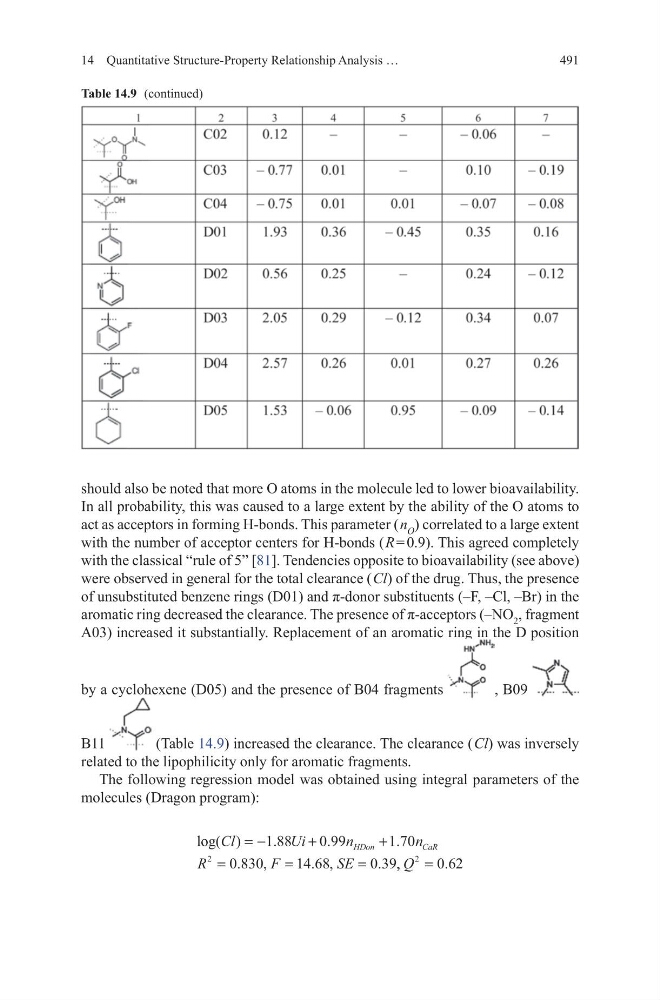
were observed in general for the total clearance ( Cl) of the drug. Thus, the presence
of unsubstituted benzene rings (D01) and π-donor substituents (–F, –Cl, –Br) in the
aromatic ring decreased the clearance. The presence of π-acceptors (–NO 2 , fragment
A03) increased it substantially. Replacement of an aromatic ring in the D position
by a cyclohexene (D05) and the presence of B04 fragments
, B09
B11
(Table 14.9) increased the clearance. The clearance ( Cl) was inversely
related to the lipophilicity only for aromatic fragments.
The following regression model was obtained using integral parameters of the
molecules (Dragon program):
log( )
.
.
.
. ,
. ,
.
Cl
Ui
n
n
R
F
SE
HDon
C aR
= −
+
+
=
=
=
1 88
099
1 70
0 830
14 68
0 39
2
, ,
.
Q
2
0 62
=
Table 14.9 (continued)
14 Quantitative Structure-Property Relationship Analysis …
should also be noted that more O atoms in the molecule led to lower bioavailability.
In all probability, this was caused to a large extent by the ability of the O atoms to
act as acceptors in forming H-bonds. This parameter ( n O ) correlated to a large extent
with the number of acceptor centers for H-bonds ( R = 0.9). This agreed completely
with the classical “rule of 5” [81]. Tendencies opposite to bioavailability (see above)
were observed in general for the total clearance ( Cl) of the drug. Thus, the presence
of unsubstituted benzene rings (D01) and π-donor substituents (–F, –Cl, –Br) in the
aromatic ring decreased the clearance. The presence of π-acceptors (–NO 2 , fragment
A03) increased it substantially. Replacement of an aromatic ring in the D position
by a cyclohexene (D05) and the presence of B04 fragments
, B09
B11
(Table 14.9) increased the clearance. The clearance ( Cl) was inversely
related to the lipophilicity only for aromatic fragments.
The following regression model was obtained using integral parameters of the
molecules (Dragon program):
log( )
.
.
.
. ,
. ,
.
Cl
Ui
n
n
R
F
SE
HDon
C aR
= −
+
+
=
=
=
1 88
099
1 70
0 830
14 68
0 39
2
, ,
.
Q
2
0 62
=
Table 14.9 (continued)