

485
14 Quantitative Structure-Property Relationship Analysis …
Several integral parameters (describing the properties of the molecule in general)
that were generated by the Dragon program were also used to construct statistical
equations [71].
Thus, simplex and integral descriptors (over 10,000 total) were calculated in the
initial stage for all molecules. Atoms in simplexes were differentiated based on the
following characteristics: (1) atom type, (2) partial charge, (3) rigidity, (4) nucleophilicity, (5) electrophilicity [72], (6) lipophilicity of the atom [73], (7) atomic refraction, (8) ability of the atom to act as a H donor or acceptor in forming H-bonds,
and (9) ability of the atom for Van-der-Waals attraction and (10) repulsion [74].
MLR, PLS [75] and classification trees [76] were used for building the models. Descriptors were selected using genetic algorithm [77] and trend-vector method [78].
Considering the small number of studied compounds, the model was not validated
for a test set to avoid a loss of the required structural information. The model was
checked for consistency using an iterative procedure [41].
Table 14.7 lists the observed values of the studied pharmacokinetic properties. It
should be noted that this series is not sufficiently representative at high distribution
volumes ( V d ) and small bioavailability. Therefore, developed QSPR models have
limited applicability domain.
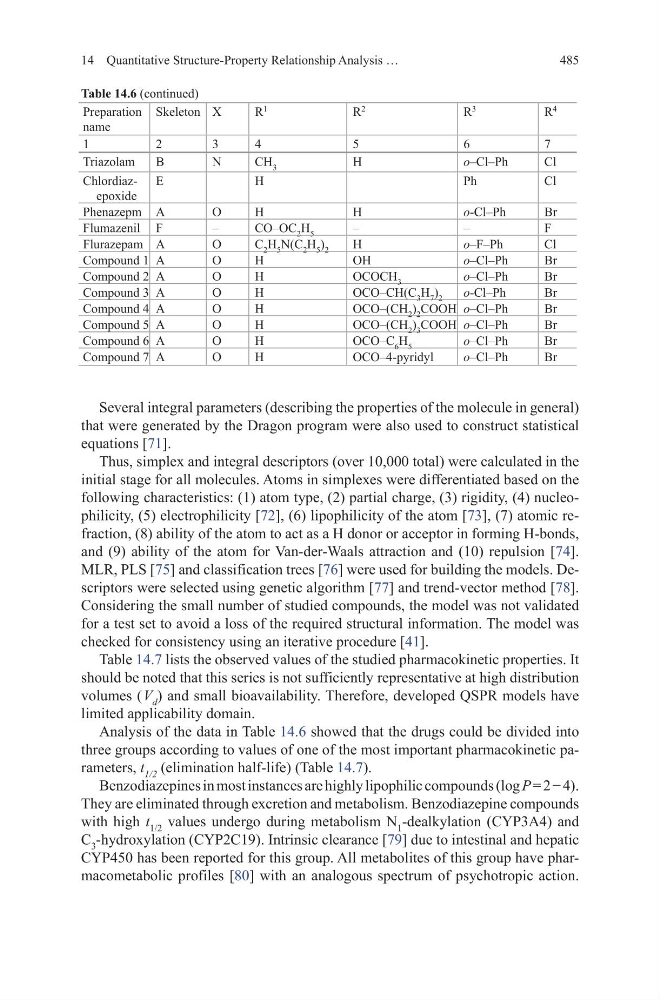
Analysis of the data in Table 14.6 showed that the drugs could be divided into
three groups according to values of one of the most important pharmacokinetic parameters, t 1/2 (elimination half-life) (Table 14.7).
Benzodiazepines in most instances are highly lipophilic compounds (log P = 2 − 4).
They are eliminated through excretion and metabolism. Benzodiazepine compounds
with high t 1/2 values undergo during metabolism N 1 -dealkylation (CYP3A4) and
C 3 -hydroxylation (CYP2C19). Intrinsic clearance [79] due to intestinal and hepatic
CYP450 has been reported for this group. All metabolites of this group have pharmacometabolic profiles [80] with an analogous spectrum of psychotropic action.
Preparation
name
Skeleton X
R
1
R
2
R
3
R
4
1
2
3
4
5
6
7
Triazolam
B
N
CH 3
H
o–Cl–Ph
Cl
Chlordiazepoxide
E
H
Ph
Cl
Phenazepm A
O
H
H
o-Cl–Ph
Br
Flumazenil F
–
CO–OC 2 H 5
–
–
F
Flurazepam A
O
C 2 H 5 N(C 2 H 5 ) 2
H
o–F–Ph
Cl
Compound 1 A
O
H
OH
o–Cl–Ph
Br
Compound 2 A
O
H
OCOCH 3
o–Cl–Ph
Br
Compound 3 A
O
H
OCO–CH(C 3 H 7 ) 2
o-Cl–Ph
Br
Compound 4 A
O
H
OCO–(CH 2 ) 2 COOH o–Cl–Ph
Br
Compound 5 A
O
H
OCO–(CH 2 ) 3 COOH o–Cl–Ph
Br
Compound 6 A
O
H
OCO–C 6 H 5
o–Cl–Ph
Br
Compound 7 A
O
H
OCO–4-pyridyl
o–Cl–Ph
Br
Table 14.6 (continued)
14 Quantitative Structure-Property Relationship Analysis …
Several integral parameters (describing the properties of the molecule in general)
that were generated by the Dragon program were also used to construct statistical
equations [71].
Thus, simplex and integral descriptors (over 10,000 total) were calculated in the
initial stage for all molecules. Atoms in simplexes were differentiated based on the
following characteristics: (1) atom type, (2) partial charge, (3) rigidity, (4) nucleophilicity, (5) electrophilicity [72], (6) lipophilicity of the atom [73], (7) atomic refraction, (8) ability of the atom to act as a H donor or acceptor in forming H-bonds,
and (9) ability of the atom for Van-der-Waals attraction and (10) repulsion [74].
MLR, PLS [75] and classification trees [76] were used for building the models. Descriptors were selected using genetic algorithm [77] and trend-vector method [78].
Considering the small number of studied compounds, the model was not validated
for a test set to avoid a loss of the required structural information. The model was
checked for consistency using an iterative procedure [41].
Table 14.7 lists the observed values of the studied pharmacokinetic properties. It
should be noted that this series is not sufficiently representative at high distribution
volumes ( V d ) and small bioavailability. Therefore, developed QSPR models have
limited applicability domain.
Analysis of the data in Table 14.6 showed that the drugs could be divided into
three groups according to values of one of the most important pharmacokinetic parameters, t 1/2 (elimination half-life) (Table 14.7).
Benzodiazepines in most instances are highly lipophilic compounds (log P = 2 − 4).
They are eliminated through excretion and metabolism. Benzodiazepine compounds
with high t 1/2 values undergo during metabolism N 1 -dealkylation (CYP3A4) and
C 3 -hydroxylation (CYP2C19). Intrinsic clearance [79] due to intestinal and hepatic
CYP450 has been reported for this group. All metabolites of this group have pharmacometabolic profiles [80] with an analogous spectrum of psychotropic action.
Preparation
name
Skeleton X
R
1
R
2
R
3
R
4
1
2
3
4
5
6
7
Triazolam
B
N
CH 3
H
o–Cl–Ph
Cl
Chlordiazepoxide
E
H
Ph
Cl
Phenazepm A
O
H
H
o-Cl–Ph
Br
Flumazenil F
–
CO–OC 2 H 5
–
–
F
Flurazepam A
O
C 2 H 5 N(C 2 H 5 ) 2
H
o–F–Ph
Cl
Compound 1 A
O
H
OH
o–Cl–Ph
Br
Compound 2 A
O
H
OCOCH 3
o–Cl–Ph
Br
Compound 3 A
O
H
OCO–CH(C 3 H 7 ) 2
o-Cl–Ph
Br
Compound 4 A
O
H
OCO–(CH 2 ) 2 COOH o–Cl–Ph
Br
Compound 5 A
O
H
OCO–(CH 2 ) 3 COOH o–Cl–Ph
Br
Compound 6 A
O
H
OCO–C 6 H 5
o–Cl–Ph
Br
Compound 7 A
O
H
OCO–4-pyridyl
o–Cl–Ph
Br
Table 14.6 (continued)