

400
P. M. Vassiliev et al.
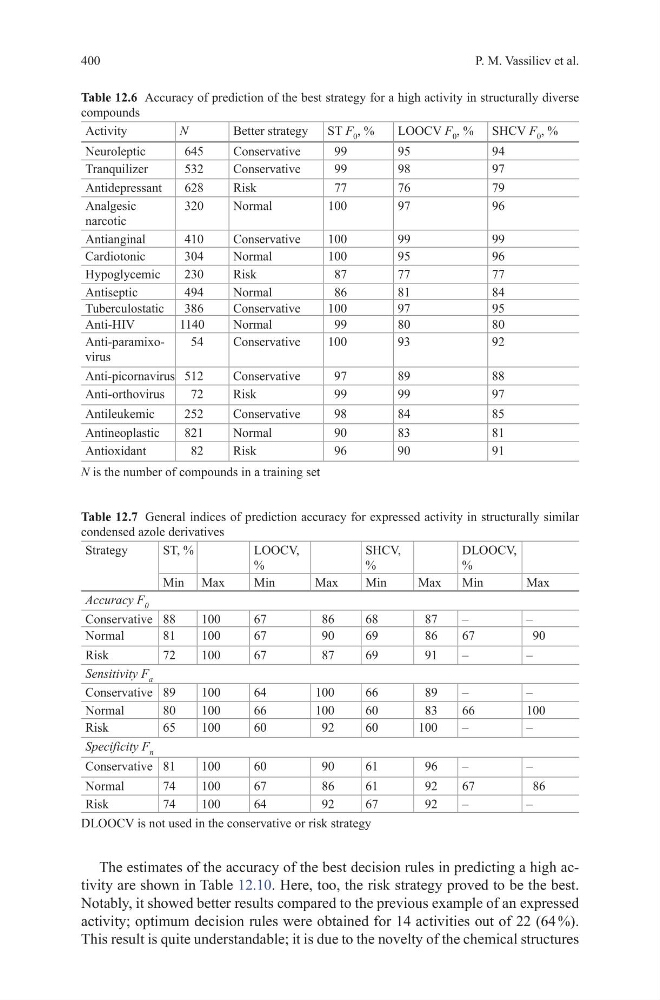
The estimates of the accuracy of the best decision rules in predicting a high activity are shown in Table 12.10. Here, too, the risk strategy proved to be the best.
Notably, it showed better results compared to the previous example of an expressed
activity; optimum decision rules were obtained for 14 activities out of 22 (64 %).
This result is quite understandable; it is due to the novelty of the chemical structures
Table 12.7 General indices of prediction accuracy for expressed activity in structurally similar
condensed azole derivatives
Strategy
ST, %
LOOCV,
%
SHCV,
%
DLOOCV,
%
Min Max
Min
Max
Min
Max
Min
Max
Accuracy F 0
Conservative 88
100
67
86
68
87
–
–
Normal
81
100
67
90
69
86
67
90
Risk
72
100
67
87
69
91
–
–
Sensitivity F a
Conservative 89
100
64
100
66
89
–
–
Normal
80
100
66
100
60
83
66
100
Risk
65
100
60
92
60
100
–
–
Specificity F n
Conservative 81
100
60
90
61
96
–
–
Normal
74
100
67
86
61
92
67
86
Risk
74
100
64
92
67
92
–
–
DLOOCV is not used in the conservative or risk strategy
Table 12.6 Accuracy of prediction of the best strategy for a high activity in structurally diverse
compounds
Activity
N
Better strategy
ST F 0 , %
LOOCV F 0 , % SHCV F 0 , %
Neuroleptic
645
Conservative
99
95
94
Tranquilizer
532
Conservative
99
98
97
Antidepressant
628
Risk
77
76
79
Analgesic
narcotic
320
Normal
100
97
96
Antianginal
410
Conservative
100
99
99
Cardiotonic
304
Normal
100
95
96
Hypoglycemic
230
Risk
87
77
77
Antiseptic
494
Normal
86
81
84
Tuberculostatic
386
Conservative
100
97
95
Anti-HIV
1140
Normal
99
80
80
Anti-paramixovirus
54
Conservative
100
93
92
Anti-picornavirus 512
Conservative
97
89
88
Anti-orthovirus
72
Risk
99
99
97
Antileukemic
252
Conservative
98
84
85
Antineoplastic
821
Normal
90
83
81
Antioxidant
82
Risk
96
90
91
N is the number of compounds in a training set
P. M. Vassiliev et al.
The estimates of the accuracy of the best decision rules in predicting a high activity are shown in Table 12.10. Here, too, the risk strategy proved to be the best.
Notably, it showed better results compared to the previous example of an expressed
activity; optimum decision rules were obtained for 14 activities out of 22 (64 %).
This result is quite understandable; it is due to the novelty of the chemical structures
Table 12.7 General indices of prediction accuracy for expressed activity in structurally similar
condensed azole derivatives
Strategy
ST, %
LOOCV,
%
SHCV,
%
DLOOCV,
%
Min Max
Min
Max
Min
Max
Min
Max
Accuracy F 0
Conservative 88
100
67
86
68
87
–
–
Normal
81
100
67
90
69
86
67
90
Risk
72
100
67
87
69
91
–
–
Sensitivity F a
Conservative 89
100
64
100
66
89
–
–
Normal
80
100
66
100
60
83
66
100
Risk
65
100
60
92
60
100
–
–
Specificity F n
Conservative 81
100
60
90
61
96
–
–
Normal
74
100
67
86
61
92
67
86
Risk
74
100
64
92
67
92
–
–
DLOOCV is not used in the conservative or risk strategy
Table 12.6 Accuracy of prediction of the best strategy for a high activity in structurally diverse
compounds
Activity
N
Better strategy
ST F 0 , %
LOOCV F 0 , % SHCV F 0 , %
Neuroleptic
645
Conservative
99
95
94
Tranquilizer
532
Conservative
99
98
97
Antidepressant
628
Risk
77
76
79
Analgesic
narcotic
320
Normal
100
97
96
Antianginal
410
Conservative
100
99
99
Cardiotonic
304
Normal
100
95
96
Hypoglycemic
230
Risk
87
77
77
Antiseptic
494
Normal
86
81
84
Tuberculostatic
386
Conservative
100
97
95
Anti-HIV
1140
Normal
99
80
80
Anti-paramixovirus
54
Conservative
100
93
92
Anti-picornavirus 512
Conservative
97
89
88
Anti-orthovirus
72
Risk
99
99
97
Antileukemic
252
Conservative
98
84
85
Antineoplastic
821
Normal
90
83
81
Antioxidant
82
Risk
96
90
91
N is the number of compounds in a training set