

339
11 Computational Toxicology in Drug Discovery: Opportunities and Limitations
Name
Definition
ACD/Percepta It predicts ADME, toxicological, and physicochemical property endpoints:
http://www.acdlabs.com/products/percepta/
Admensa
Interactive
Computer system of QSAR modeling is developed for ADME optimization:
http://www.bioportfolio.com/biotech_news/Inpharmatica_3.htm
ASTER
ASTER (Assessment Tools for the Evaluation of Risk) was developed in US
EPA. It is a database of toxic effects AQUIRE (AQUatic toxicity Information
Retrieval) integrated with an expert system QSAR and valuation techniques for
activity prediction: http://www.epa.gov/med/Prods_Pubs/aster.htm
CATABOL
A hybrid expert system for predicting the biotransformation pathways, works
together with model which calculates the probabilities of individual transformation of molecule: http://oasis-lmc.org/?section=software&swid=1
Cerius
2
Molecular modeling package providing computer models for predicting ADME
and toxic properties of compounds: http://accelrys.com/products/cerius2/
DEREK
DEREK (Deductive Estimation of Risk from Existing Knowledge). An expert
system is based on rules. It identifies the so-called toxicophores fragments
of the molecule associated with the corresponding activity) and provides the
related commentary for them and references to the available information:
http://www.lhasalimited.org/
DIGEP-Pred
Web-service for prediction of drug-induced changes in the gene expression
profile based on the structural formula of drug-like ompounds: http://www.
way2drug.com/GE
DISCAS
The cascade model with an ability to analyze local correlations in the training
sets with a large number of variables: http://www.clab.kwansei.ac.jp/mining/
discas/discas.html
DvD
An R/Cytoscape plug-in assessing system-wide gene expression data to predict
drug side effects and drug repositioning: http://www.ebi.ac.uk/saezrodriguez/
DVD
ECOSAR
Ecological Structure Activity Relationships (ECOSAR)—a computer prediction system for assessing the aquatic toxicity of industrial compounds. It was
developed in 1979 by US EPA. The program is based on the SAR calculates
acute and chronic toxicity for aqueous organisms (fish, aquatic invertebrates
and plants): http://www.epa.gov/oppt/newchems/tools/21ecosar.htm
GUSAR
Software for modeling of any quantitative and qualitative relationships based
on self-consistent regression and neighborhoods of atoms descriptors (QNA,
MNA). GUSAR provides prediction of rat acute toxicity (LD50), ligand interaction with several antitargets and some ecotoxicological end-points: http://
www.way2drug.com/GUSAR
HazardExpert An expert system is based on rules. The program had been developed in
1992 by Smithing Darvas. Program identifies toxicophores (fragments of the
molecule associated with the corresponding activity). It is based on US EPA
database: Toxic Fragments Knowledge Base: http://www.compudrug.com/
Lazar
Lazy Structure-Activity Relationships. Gets the prediction from the toxicity
data by searching similar compounds in the database which are associated with
a given toxic activity: http://in-silico.de/
MCASE
MCASE (Multiple Computer Automated Structure Evaluation). Program automatically generates its own descriptors (Biophores) from the training set, which
are related to the activity. Biophores may be a group of atoms and distances
between them, the physico-chemical parameters. The program estimates the statistical significance of each Biophore for active and inactive compounds, and on
the basis of these estimations it makes a prediction: http://www.multicase.com/
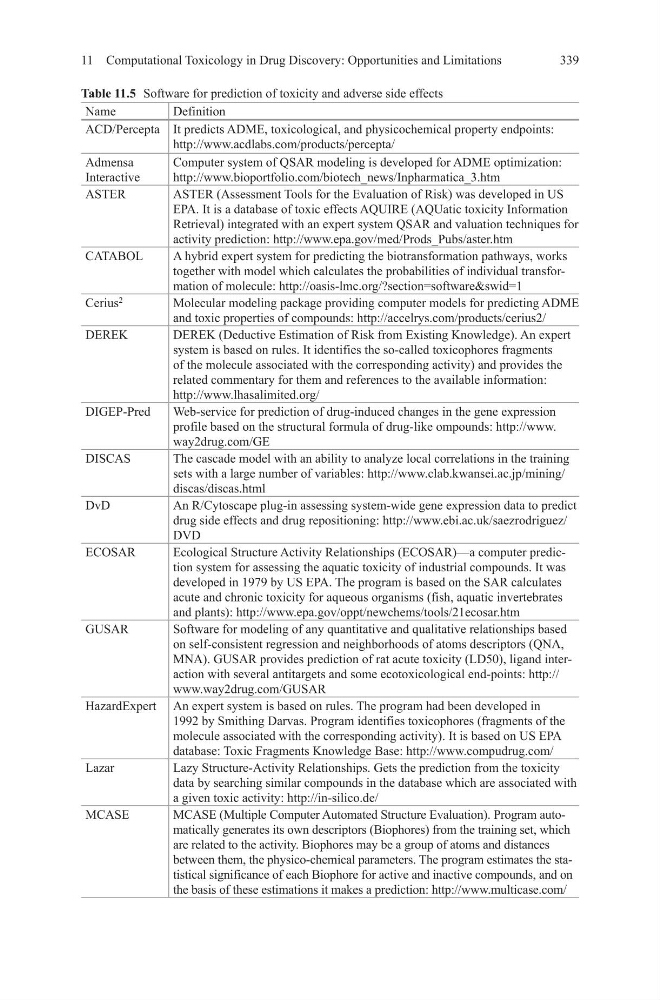
Table 11.5 Software for prediction of toxicity and adverse side effects
11 Computational Toxicology in Drug Discovery: Opportunities and Limitations
Name
Definition
ACD/Percepta It predicts ADME, toxicological, and physicochemical property endpoints:
http://www.acdlabs.com/products/percepta/
Admensa
Interactive
Computer system of QSAR modeling is developed for ADME optimization:
http://www.bioportfolio.com/biotech_news/Inpharmatica_3.htm
ASTER
ASTER (Assessment Tools for the Evaluation of Risk) was developed in US
EPA. It is a database of toxic effects AQUIRE (AQUatic toxicity Information
Retrieval) integrated with an expert system QSAR and valuation techniques for
activity prediction: http://www.epa.gov/med/Prods_Pubs/aster.htm
CATABOL
A hybrid expert system for predicting the biotransformation pathways, works
together with model which calculates the probabilities of individual transformation of molecule: http://oasis-lmc.org/?section=software&swid=1
Cerius
2
Molecular modeling package providing computer models for predicting ADME
and toxic properties of compounds: http://accelrys.com/products/cerius2/
DEREK
DEREK (Deductive Estimation of Risk from Existing Knowledge). An expert
system is based on rules. It identifies the so-called toxicophores fragments
of the molecule associated with the corresponding activity) and provides the
related commentary for them and references to the available information:
http://www.lhasalimited.org/
DIGEP-Pred
Web-service for prediction of drug-induced changes in the gene expression
profile based on the structural formula of drug-like ompounds: http://www.
way2drug.com/GE
DISCAS
The cascade model with an ability to analyze local correlations in the training
sets with a large number of variables: http://www.clab.kwansei.ac.jp/mining/
discas/discas.html
DvD
An R/Cytoscape plug-in assessing system-wide gene expression data to predict
drug side effects and drug repositioning: http://www.ebi.ac.uk/saezrodriguez/
DVD
ECOSAR
Ecological Structure Activity Relationships (ECOSAR)—a computer prediction system for assessing the aquatic toxicity of industrial compounds. It was
developed in 1979 by US EPA. The program is based on the SAR calculates
acute and chronic toxicity for aqueous organisms (fish, aquatic invertebrates
and plants): http://www.epa.gov/oppt/newchems/tools/21ecosar.htm
GUSAR
Software for modeling of any quantitative and qualitative relationships based
on self-consistent regression and neighborhoods of atoms descriptors (QNA,
MNA). GUSAR provides prediction of rat acute toxicity (LD50), ligand interaction with several antitargets and some ecotoxicological end-points: http://
www.way2drug.com/GUSAR
HazardExpert An expert system is based on rules. The program had been developed in
1992 by Smithing Darvas. Program identifies toxicophores (fragments of the
molecule associated with the corresponding activity). It is based on US EPA
database: Toxic Fragments Knowledge Base: http://www.compudrug.com/
Lazar
Lazy Structure-Activity Relationships. Gets the prediction from the toxicity
data by searching similar compounds in the database which are associated with
a given toxic activity: http://in-silico.de/
MCASE
MCASE (Multiple Computer Automated Structure Evaluation). Program automatically generates its own descriptors (Biophores) from the training set, which
are related to the activity. Biophores may be a group of atoms and distances
between them, the physico-chemical parameters. The program estimates the statistical significance of each Biophore for active and inactive compounds, and on
the basis of these estimations it makes a prediction: http://www.multicase.com/
Table 11.5 Software for prediction of toxicity and adverse side effects