

340
A. Zakharov and A. Lagunin
the available training and test sets with data on oral acute toxicity measured in LD 50
(mmol/kg) values for 7286 compounds. It was demonstrated that GUSAR models
had the highest accuracy in comparison with the models from T.E.S.T. program and
provided the highest speed of prediction (18 times faster).
The developed models are freely available on the web site: http://www.way2drug.com/gusar/acutoxpredict.html. The characteristics of the models are given
in Table 11.7. The service includes an on-line chemical editor [36] for drawing the
studied structure. It provides acute toxicity prediction results in the different units,
but does not support the batch prediction mode.
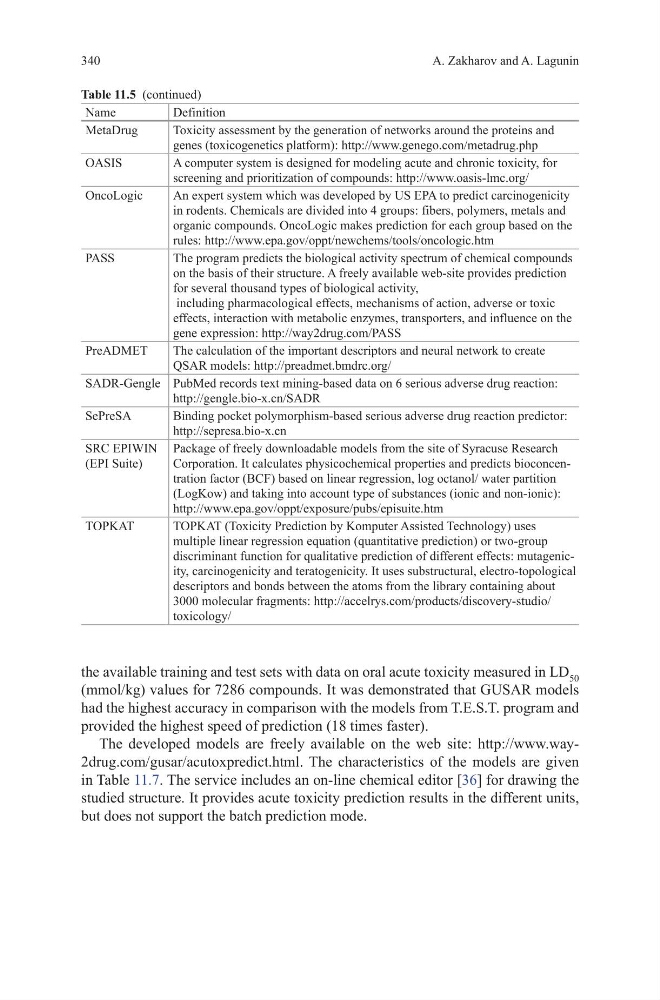
Name
Definition
MetaDrug
Toxicity assessment by the generation of networks around the proteins and
genes (toxicogenetics platform): http://www.genego.com/metadrug.php
OASIS
A computer system is designed for modeling acute and chronic toxicity, for
screening and prioritization of compounds: http://www.oasis-lmc.org/
OncoLogic
An expert system which was developed by US EPA to predict carcinogenicity
in rodents. Chemicals are divided into 4 groups: fibers, polymers, metals and
organic compounds. OncoLogic makes prediction for each group based on the
rules: http://www.epa.gov/oppt/newchems/tools/oncologic.htm
PASS
The program predicts the biological activity spectrum of chemical compounds
on the basis of their structure. A freely available web-site provides prediction
for several thousand types of biological activity,
including pharmacological effects, mechanisms of action, adverse or toxic
effects, interaction with metabolic enzymes, transporters, and influence on the
gene expression: http://way2drug.com/PASS
PreADMET
The calculation of the important descriptors and neural network to create
QSAR models: http://preadmet.bmdrc.org/
SADR-Gengle PubMed records text mining-based data on 6 serious adverse drug reaction:
http://gengle.bio-x.cn/SADR
SePreSA
Binding pocket polymorphism-based serious adverse drug reaction predictor:
http://sepresa.bio-x.cn
SRC EPIWIN
(EPI Suite)
Package of freely downloadable models from the site of Syracuse Research
Corporation. It calculates physicochemical properties and predicts bioconcentration factor (BCF) based on linear regression, log octanol/ water partition
(LogKow) and taking into account type of substances (ionic and non-ionic):
http://www.epa.gov/oppt/exposure/pubs/episuite.htm
TOPKAT
TOPKAT (Toxicity Prediction by Komputer Assisted Technology) uses
multiple linear regression equation (quantitative prediction) or two-group
discriminant function for qualitative prediction of different effects: mutagenicity, carcinogenicity and teratogenicity. It uses substructural, electro-topological
descriptors and bonds between the atoms from the library containing about
3000 molecular fragments: http://accelrys.com/products/discovery-studio/
toxicology/
Table 11.5 (continued)
A. Zakharov and A. Lagunin
the available training and test sets with data on oral acute toxicity measured in LD 50
(mmol/kg) values for 7286 compounds. It was demonstrated that GUSAR models
had the highest accuracy in comparison with the models from T.E.S.T. program and
provided the highest speed of prediction (18 times faster).
The developed models are freely available on the web site: http://www.way2drug.com/gusar/acutoxpredict.html. The characteristics of the models are given
in Table 11.7. The service includes an on-line chemical editor [36] for drawing the
studied structure. It provides acute toxicity prediction results in the different units,
but does not support the batch prediction mode.
Name
Definition
MetaDrug
Toxicity assessment by the generation of networks around the proteins and
genes (toxicogenetics platform): http://www.genego.com/metadrug.php
OASIS
A computer system is designed for modeling acute and chronic toxicity, for
screening and prioritization of compounds: http://www.oasis-lmc.org/
OncoLogic
An expert system which was developed by US EPA to predict carcinogenicity
in rodents. Chemicals are divided into 4 groups: fibers, polymers, metals and
organic compounds. OncoLogic makes prediction for each group based on the
rules: http://www.epa.gov/oppt/newchems/tools/oncologic.htm
PASS
The program predicts the biological activity spectrum of chemical compounds
on the basis of their structure. A freely available web-site provides prediction
for several thousand types of biological activity,
including pharmacological effects, mechanisms of action, adverse or toxic
effects, interaction with metabolic enzymes, transporters, and influence on the
gene expression: http://way2drug.com/PASS
PreADMET
The calculation of the important descriptors and neural network to create
QSAR models: http://preadmet.bmdrc.org/
SADR-Gengle PubMed records text mining-based data on 6 serious adverse drug reaction:
http://gengle.bio-x.cn/SADR
SePreSA
Binding pocket polymorphism-based serious adverse drug reaction predictor:
http://sepresa.bio-x.cn
SRC EPIWIN
(EPI Suite)
Package of freely downloadable models from the site of Syracuse Research
Corporation. It calculates physicochemical properties and predicts bioconcentration factor (BCF) based on linear regression, log octanol/ water partition
(LogKow) and taking into account type of substances (ionic and non-ionic):
http://www.epa.gov/oppt/exposure/pubs/episuite.htm
TOPKAT
TOPKAT (Toxicity Prediction by Komputer Assisted Technology) uses
multiple linear regression equation (quantitative prediction) or two-group
discriminant function for qualitative prediction of different effects: mutagenicity, carcinogenicity and teratogenicity. It uses substructural, electro-topological
descriptors and bonds between the atoms from the library containing about
3000 molecular fragments: http://accelrys.com/products/discovery-studio/
toxicology/
Table 11.5 (continued)