

338
A. Zakharov and A. Lagunin
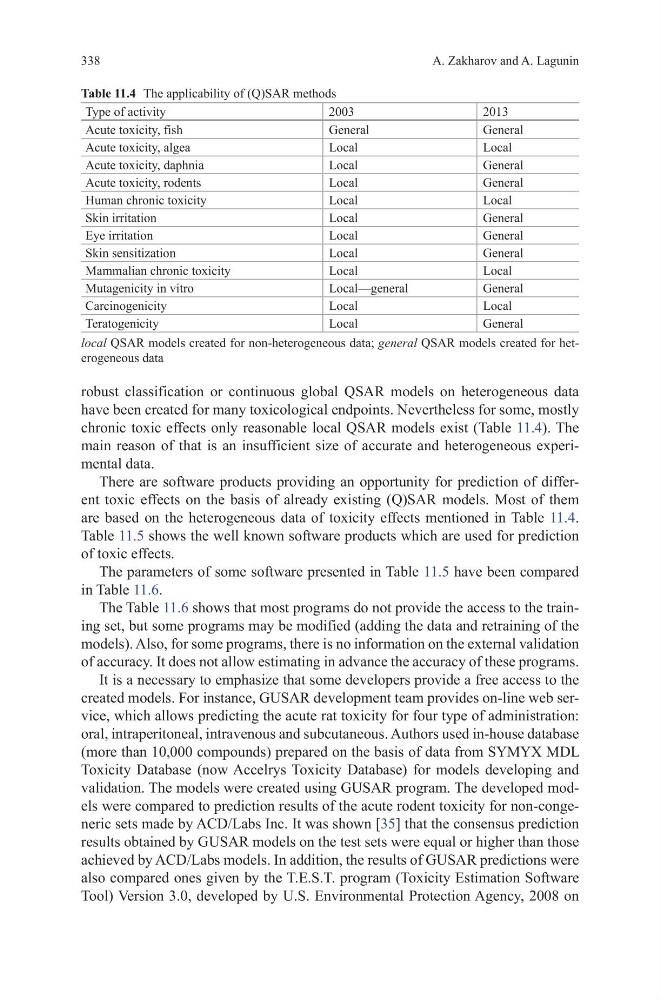
robust classification or continuous global QSAR models on heterogeneous data
have been created for many toxicological endpoints. Nevertheless for some, mostly
chronic toxic effects only reasonable local QSAR models exist (Table 11.4). The
main reason of that is an insufficient size of accurate and heterogeneous experimental data.
There are software products providing an opportunity for prediction of different toxic effects on the basis of already existing (Q)SAR models. Most of them
are based on the heterogeneous data of toxicity effects mentioned in Table 11.4.
Table 11.5 shows the well known software products which are used for prediction
of toxic effects.
The parameters of some software presented in Table 11.5 have been compared
in Table 11.6.
The Table 11.6 shows that most programs do not provide the access to the training set, but some programs may be modified (adding the data and retraining of the
models). Also, for some programs, there is no information on the external validation
of accuracy. It does not allow estimating in advance the accuracy of these programs.
It is a necessary to emphasize that some developers provide a free access to the
created models. For instance, GUSAR development team provides on-line web service, which allows predicting the acute rat toxicity for four type of administration:
oral, intraperitoneal, intravenous and subcutaneous. Authors used in-house database
(more than 10,000 compounds) prepared on the basis of data from SYMYX MDL
Toxicity Database (now Accelrys Toxicity Database) for models developing and
validation. The models were created using GUSAR program. The developed models were compared to prediction results of the acute rodent toxicity for non-congeneric sets made by ACD/Labs Inc. It was shown [35] that the consensus prediction
results obtained by GUSAR models on the test sets were equal or higher than those
achieved by ACD/Labs models. In addition, the results of GUSAR predictions were
also compared ones given by the T.E.S.T. program (Toxicity Estimation Software
Tool) Version 3.0, developed by U.S. Environmental Protection Agency, 2008 on
Table 11.4 The applicability of (Q)SAR methods
Type of activity
2003
2013
Acute toxicity, fish
General
General
Acute toxicity, algea
Local
Local
Acute toxicity, daphnia
Local
General
Acute toxicity, rodents
Local
General
Human chronic toxicity
Local
Local
Skin irritation
Local
General
Eye irritation
Local
General
Skin sensitization
Local
General
Mammalian chronic toxicity
Local
Local
Mutagenicity in vitro
Local—general
General
Carcinogenicity
Local
Local
Teratogenicity
Local
General
local QSAR models created for non-heterogeneous data; general QSAR models created for heterogeneous data
A. Zakharov and A. Lagunin
robust classification or continuous global QSAR models on heterogeneous data
have been created for many toxicological endpoints. Nevertheless for some, mostly
chronic toxic effects only reasonable local QSAR models exist (Table 11.4). The
main reason of that is an insufficient size of accurate and heterogeneous experimental data.
There are software products providing an opportunity for prediction of different toxic effects on the basis of already existing (Q)SAR models. Most of them
are based on the heterogeneous data of toxicity effects mentioned in Table 11.4.
Table 11.5 shows the well known software products which are used for prediction
of toxic effects.
The parameters of some software presented in Table 11.5 have been compared
in Table 11.6.
The Table 11.6 shows that most programs do not provide the access to the training set, but some programs may be modified (adding the data and retraining of the
models). Also, for some programs, there is no information on the external validation
of accuracy. It does not allow estimating in advance the accuracy of these programs.
It is a necessary to emphasize that some developers provide a free access to the
created models. For instance, GUSAR development team provides on-line web service, which allows predicting the acute rat toxicity for four type of administration:
oral, intraperitoneal, intravenous and subcutaneous. Authors used in-house database
(more than 10,000 compounds) prepared on the basis of data from SYMYX MDL
Toxicity Database (now Accelrys Toxicity Database) for models developing and
validation. The models were created using GUSAR program. The developed models were compared to prediction results of the acute rodent toxicity for non-congeneric sets made by ACD/Labs Inc. It was shown [35] that the consensus prediction
results obtained by GUSAR models on the test sets were equal or higher than those
achieved by ACD/Labs models. In addition, the results of GUSAR predictions were
also compared ones given by the T.E.S.T. program (Toxicity Estimation Software
Tool) Version 3.0, developed by U.S. Environmental Protection Agency, 2008 on
Table 11.4 The applicability of (Q)SAR methods
Type of activity
2003
2013
Acute toxicity, fish
General
General
Acute toxicity, algea
Local
Local
Acute toxicity, daphnia
Local
General
Acute toxicity, rodents
Local
General
Human chronic toxicity
Local
Local
Skin irritation
Local
General
Eye irritation
Local
General
Skin sensitization
Local
General
Mammalian chronic toxicity
Local
Local
Mutagenicity in vitro
Local—general
General
Carcinogenicity
Local
Local
Teratogenicity
Local
General
local QSAR models created for non-heterogeneous data; general QSAR models created for heterogeneous data