

337
11 Computational Toxicology in Drug Discovery: Opportunities and Limitations
Name
Source
Definition
ASNN
VCCLAB
Creates a non-linear model based on neural network.
Freely available: http://www.vcclab.org/
CHEMBENCH Carolina Exploratory
Center for Cheminformatics Research
A freely available portal providing cheminformatics
research support to molecular modelers, medicinal
chemists and quantitative biologists by integrating
robust model builders, property and activity predictors,
virtual libraries of available chemicals with predicted
biological and drug-like properties: http://chembench.
mml.unc.edu/
GUSAR
GeneXplain
Software for creation of (Q)SAR models on the basis of
atom-centric QNA and MNA descriptors: http://www.
genexplain.com/
KNIME
KNIME.com AG
A graphical workbench for the analysis process: data
transformation, predictive analytics, visualization and
reporting. It includes plug-ins for descriptors generation,
creation of QSAR models: http://www.knime.org/
MATLAB
The MathWorks
Interactive environment, using its own language, and
includes almost all of the most commonly used machine
learning methods in QSAR: http://www.mathworks.
com/
MOE
Chemical Computing
Group
Construction of QSAR/QSPR models using probabilistic methods and decision trees, PCR and PLS methods:
http://www.chemcomp.com/software-chem.htm
PLS
VCCLAB
Partial Least Squares (PLS). The original two-step
descriptors selection procedure: http://www.vcclab.org/
PNN
VCCLAB
Polynomial Neural Network (PNN): http://www.vcclab.
org/
R
R-project
A freeware product for statistical calculation and graphics creation. R provides a wide range of tools
(linear and nonlinear modeling, classical statistical
tests, consistent analysis, classification, clustering):
http://www.r-project.org/
Small-molecule
drug discovery
suite
Schrodinger
2D/3D QSAR with a large selection of fingerprint
options, shape-based screening, with or without atom
properties, ligand-based pharmacophore modelling, R-group analysis: http://www.schrodinger.com/
productsuite/1/
StarDrop
Optibrium
The software for QSAR modeling, data analysis and
structures optimization: http://www.optibrium.com/
Statistica
StatSoft
Data processing environment includes almost all of the
most frequently used mathematical methods in QSAR:
http://www.statsoft.com/
Discoverystudio
Accelrys
The software package for QSAR modeling, for data
analysis and structures optimization: http://accelrys.
com/products/discovery-studio/
WEKA
University of Waikato A collection of machine learning algorithms for data
analysis. It contains tools for data pre-processing, classification, regression, clustering and visualization: http://
www.cs.waikato.ac.nz/ml/weka/
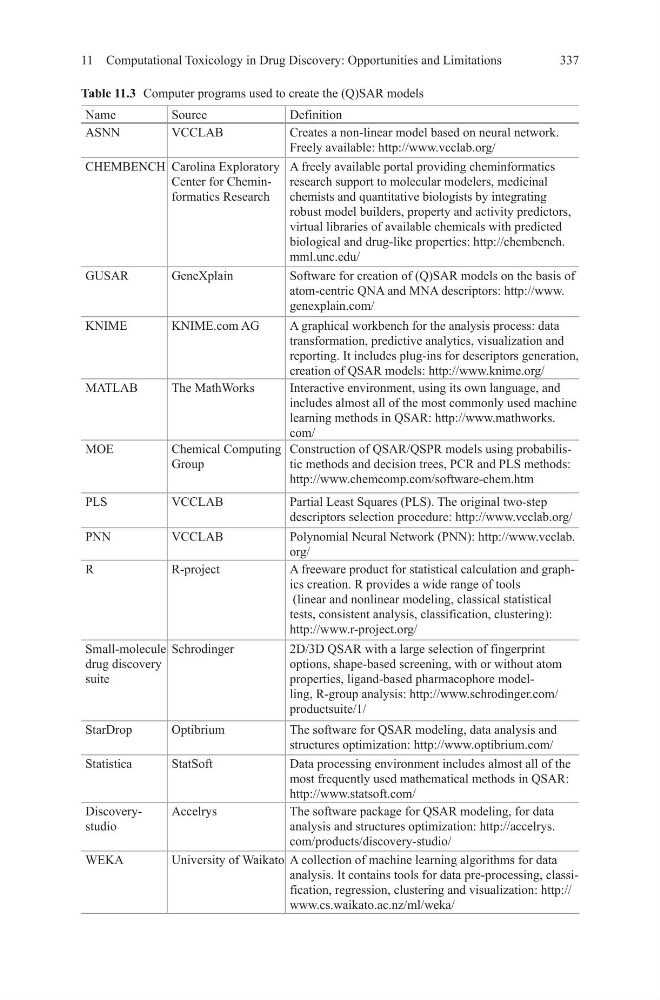
Table 11.3 Computer programs used to create the (Q)SAR models
11 Computational Toxicology in Drug Discovery: Opportunities and Limitations
Name
Source
Definition
ASNN
VCCLAB
Creates a non-linear model based on neural network.
Freely available: http://www.vcclab.org/
CHEMBENCH Carolina Exploratory
Center for Cheminformatics Research
A freely available portal providing cheminformatics
research support to molecular modelers, medicinal
chemists and quantitative biologists by integrating
robust model builders, property and activity predictors,
virtual libraries of available chemicals with predicted
biological and drug-like properties: http://chembench.
mml.unc.edu/
GUSAR
GeneXplain
Software for creation of (Q)SAR models on the basis of
atom-centric QNA and MNA descriptors: http://www.
genexplain.com/
KNIME
KNIME.com AG
A graphical workbench for the analysis process: data
transformation, predictive analytics, visualization and
reporting. It includes plug-ins for descriptors generation,
creation of QSAR models: http://www.knime.org/
MATLAB
The MathWorks
Interactive environment, using its own language, and
includes almost all of the most commonly used machine
learning methods in QSAR: http://www.mathworks.
com/
MOE
Chemical Computing
Group
Construction of QSAR/QSPR models using probabilistic methods and decision trees, PCR and PLS methods:
http://www.chemcomp.com/software-chem.htm
PLS
VCCLAB
Partial Least Squares (PLS). The original two-step
descriptors selection procedure: http://www.vcclab.org/
PNN
VCCLAB
Polynomial Neural Network (PNN): http://www.vcclab.
org/
R
R-project
A freeware product for statistical calculation and graphics creation. R provides a wide range of tools
(linear and nonlinear modeling, classical statistical
tests, consistent analysis, classification, clustering):
http://www.r-project.org/
Small-molecule
drug discovery
suite
Schrodinger
2D/3D QSAR with a large selection of fingerprint
options, shape-based screening, with or without atom
properties, ligand-based pharmacophore modelling, R-group analysis: http://www.schrodinger.com/
productsuite/1/
StarDrop
Optibrium
The software for QSAR modeling, data analysis and
structures optimization: http://www.optibrium.com/
Statistica
StatSoft
Data processing environment includes almost all of the
most frequently used mathematical methods in QSAR:
http://www.statsoft.com/
Discoverystudio
Accelrys
The software package for QSAR modeling, for data
analysis and structures optimization: http://accelrys.
com/products/discovery-studio/
WEKA
University of Waikato A collection of machine learning algorithms for data
analysis. It contains tools for data pre-processing, classification, regression, clustering and visualization: http://
www.cs.waikato.ac.nz/ml/weka/
Table 11.3 Computer programs used to create the (Q)SAR models