

S. Okovytyy
314
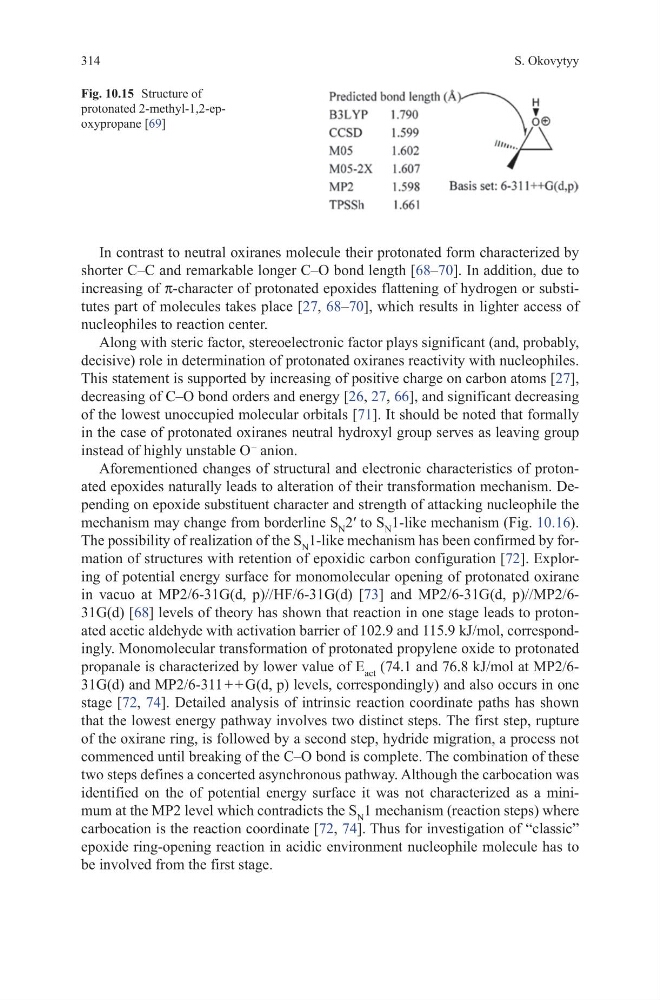
In contrast to neutral oxiranes molecule their protonated form characterized by
shorter C–C and remarkable longer C–O bond length [68–70]. In addition, due to
increasing of π-character of protonated epoxides flattening of hydrogen or substitutes part of molecules takes place [27, 68–70], which results in lighter access of
nucleophiles to reaction center.
Along with steric factor, stereoelectronic factor plays significant (and, probably,
decisive) role in determination of protonated oxiranes reactivity with nucleophiles.
This statement is supported by increasing of positive charge on carbon atoms [27],
decreasing of C–O bond orders and energy [26, 27, 66], and significant decreasing
of the lowest unoccupied molecular orbitals [71]. It should be noted that formally
in the case of protonated oxiranes neutral hydroxyl group serves as leaving group
instead of highly unstable O
–
anion.
Aforementioned changes of structural and electronic characteristics of protonated epoxides naturally leads to alteration of their transformation mechanism. Depending on epoxide substituent character and strength of attacking nucleophile the
mechanism may change from borderline S N 2′ to S N 1-like mechanism (Fig. 10.16).
The possibility of realization of the S N 1-like mechanism has been confirmed by formation of structures with retention of epoxidic carbon configuration [72]. Exploring of potential energy surface for monomolecular opening of protonated oxirane
in vacuo at MP2/6-31G(d, p)//HF/6-31G(d) [73] and MP2/6-31G(d, p)//MP2/631G(d) [68] levels of theory has shown that reaction in one stage leads to protonated acetic aldehyde with activation barrier of 102.9 and 115.9 kJ/mol, correspondingly. Monomolecular transformation of protonated propylene oxide to protonated
propanale is characterized by lower value of Е act (74.1 and 76.8 kJ/mol at MP2/631G(d) and MP2/6-311 + + G(d, p) levels, correspondingly) and also occurs in one
stage [72, 74]. Detailed analysis of intrinsic reaction coordinate paths has shown
that the lowest energy pathway involves two distinct steps. The first step, rupture
of the oxirane ring, is followed by a second step, hydride migration, a process not
commenced until breaking of the C–O bond is complete. The combination of these
two steps defines a concerted asynchronous pathway. Although the carbocation was
identified on the of potential energy surface it was not characterized as a minimum at the MP2 level which contradicts the S N 1 mechanism (reaction steps) where
carbocation is the reaction coordinate [72, 74]. Thus for investigation of “classic”
epoxide ring-opening reaction in acidic environment nucleophile molecule has to
be involved from the first stage.
Fig. 10.15 Structure of
protonated 2-methyl-1,2-epoxypropane [69]
314
In contrast to neutral oxiranes molecule their protonated form characterized by
shorter C–C and remarkable longer C–O bond length [68–70]. In addition, due to
increasing of π-character of protonated epoxides flattening of hydrogen or substitutes part of molecules takes place [27, 68–70], which results in lighter access of
nucleophiles to reaction center.
Along with steric factor, stereoelectronic factor plays significant (and, probably,
decisive) role in determination of protonated oxiranes reactivity with nucleophiles.
This statement is supported by increasing of positive charge on carbon atoms [27],
decreasing of C–O bond orders and energy [26, 27, 66], and significant decreasing
of the lowest unoccupied molecular orbitals [71]. It should be noted that formally
in the case of protonated oxiranes neutral hydroxyl group serves as leaving group
instead of highly unstable O
–
anion.
Aforementioned changes of structural and electronic characteristics of protonated epoxides naturally leads to alteration of their transformation mechanism. Depending on epoxide substituent character and strength of attacking nucleophile the
mechanism may change from borderline S N 2′ to S N 1-like mechanism (Fig. 10.16).
The possibility of realization of the S N 1-like mechanism has been confirmed by formation of structures with retention of epoxidic carbon configuration [72]. Exploring of potential energy surface for monomolecular opening of protonated oxirane
in vacuo at MP2/6-31G(d, p)//HF/6-31G(d) [73] and MP2/6-31G(d, p)//MP2/631G(d) [68] levels of theory has shown that reaction in one stage leads to protonated acetic aldehyde with activation barrier of 102.9 and 115.9 kJ/mol, correspondingly. Monomolecular transformation of protonated propylene oxide to protonated
propanale is characterized by lower value of Е act (74.1 and 76.8 kJ/mol at MP2/631G(d) and MP2/6-311 + + G(d, p) levels, correspondingly) and also occurs in one
stage [72, 74]. Detailed analysis of intrinsic reaction coordinate paths has shown
that the lowest energy pathway involves two distinct steps. The first step, rupture
of the oxirane ring, is followed by a second step, hydride migration, a process not
commenced until breaking of the C–O bond is complete. The combination of these
two steps defines a concerted asynchronous pathway. Although the carbocation was
identified on the of potential energy surface it was not characterized as a minimum at the MP2 level which contradicts the S N 1 mechanism (reaction steps) where
carbocation is the reaction coordinate [72, 74]. Thus for investigation of “classic”
epoxide ring-opening reaction in acidic environment nucleophile molecule has to
be involved from the first stage.
Fig. 10.15 Structure of
protonated 2-methyl-1,2-epoxypropane [69]