

313
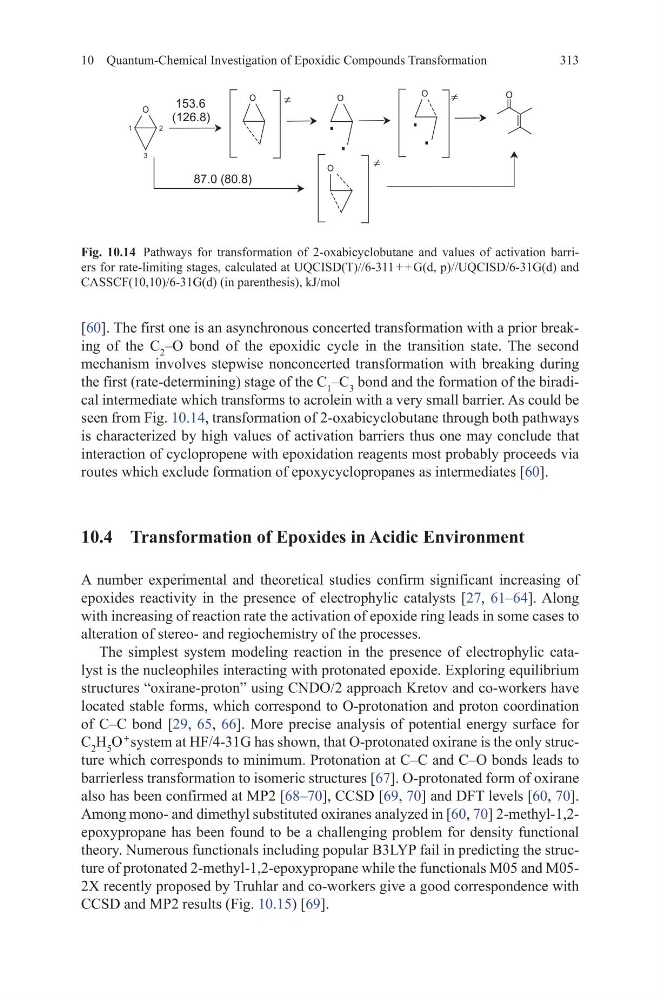
[60]. The first one is an asynchronous concerted transformation with a prior breaking of the C 2 –O bond of the epoxidic cycle in the transition state. The second
mechanism involves stepwise nonconcerted transformation with breaking during
the first (rate-determining) stage of the C 1 –C 3 bond and the formation of the biradical intermediate which transforms to acrolein with a very small barrier. As could be
seen from Fig. 10.14, transformation of 2-oxabicyclobutane through both pathways
is characterized by high values of activation barriers thus one may conclude that
interaction of cyclopropene with epoxidation reagents most probably proceeds via
routes which exclude formation of epoxycyclopropanes as intermediates [60].
10.4 Transformation of Epoxides in Acidic Environment
A number experimental and theoretical studies confirm significant increasing of
epoxides reactivity in the presence of electrophylic catalysts [27, 61–64]. Along
with increasing of reaction rate the activation of epoxide ring leads in some cases to
alteration of stereo- and regiochemistry of the processes.
The simplest system modeling reaction in the presence of electrophylic catalyst is the nucleophiles interacting with protonated epoxide. Exploring equilibrium
structures “oxirane-proton” using CNDO/2 approach Kretov and co-workers have
located stable forms, which correspond to O-protonation and proton coordination
of C–C bond [29, 65, 66]. More precise analysis of potential energy surface for
С 2 Н 5 О
+
system at HF/4-31G has shown, that O-protonated oxirane is the only structure which corresponds to minimum. Protonation at C–C and C–O bonds leads to
barrierless transformation to isomeric structures [67]. O-protonated form of oxirane
also has been confirmed at MP2 [68–70], CCSD [69, 70] and DFT levels [60, 70].
Among mono- and dimethyl substituted oxiranes analyzed in [60, 70] 2-methyl-1,2epoxypropane has been found to be a challenging problem for density functional
theory. Numerous functionals including popular B3LYP fail in predicting the structure of protonated 2-methyl-1,2-epoxypropane while the functionals M05 and M052X recently proposed by Truhlar and co-workers give a good correspondence with
CCSD and MP2 results (Fig. 10.15) [69].
2
2
2
2
2
2
≠
≠
≠
Fig. 10.14 Pathways for transformation of 2-oxabicyclobutane and values of activation barriers for rate-limiting stages, calculated at UQCISD(T)//6-311 + + G(d, p)//UQCISD/6-31G(d) and
CASSCF(10,10)/6-31G(d) (in parenthesis), kJ/mol
10 Quantum-Chemical Investigation of Epoxidic Compounds Transformation
[60]. The first one is an asynchronous concerted transformation with a prior breaking of the C 2 –O bond of the epoxidic cycle in the transition state. The second
mechanism involves stepwise nonconcerted transformation with breaking during
the first (rate-determining) stage of the C 1 –C 3 bond and the formation of the biradical intermediate which transforms to acrolein with a very small barrier. As could be
seen from Fig. 10.14, transformation of 2-oxabicyclobutane through both pathways
is characterized by high values of activation barriers thus one may conclude that
interaction of cyclopropene with epoxidation reagents most probably proceeds via
routes which exclude formation of epoxycyclopropanes as intermediates [60].
10.4 Transformation of Epoxides in Acidic Environment
A number experimental and theoretical studies confirm significant increasing of
epoxides reactivity in the presence of electrophylic catalysts [27, 61–64]. Along
with increasing of reaction rate the activation of epoxide ring leads in some cases to
alteration of stereo- and regiochemistry of the processes.
The simplest system modeling reaction in the presence of electrophylic catalyst is the nucleophiles interacting with protonated epoxide. Exploring equilibrium
structures “oxirane-proton” using CNDO/2 approach Kretov and co-workers have
located stable forms, which correspond to O-protonation and proton coordination
of C–C bond [29, 65, 66]. More precise analysis of potential energy surface for
С 2 Н 5 О
+
system at HF/4-31G has shown, that O-protonated oxirane is the only structure which corresponds to minimum. Protonation at C–C and C–O bonds leads to
barrierless transformation to isomeric structures [67]. O-protonated form of oxirane
also has been confirmed at MP2 [68–70], CCSD [69, 70] and DFT levels [60, 70].
Among mono- and dimethyl substituted oxiranes analyzed in [60, 70] 2-methyl-1,2epoxypropane has been found to be a challenging problem for density functional
theory. Numerous functionals including popular B3LYP fail in predicting the structure of protonated 2-methyl-1,2-epoxypropane while the functionals M05 and M052X recently proposed by Truhlar and co-workers give a good correspondence with
CCSD and MP2 results (Fig. 10.15) [69].
2
2
2
2
2
2
≠
≠
≠
Fig. 10.14 Pathways for transformation of 2-oxabicyclobutane and values of activation barriers for rate-limiting stages, calculated at UQCISD(T)//6-311 + + G(d, p)//UQCISD/6-31G(d) and
CASSCF(10,10)/6-31G(d) (in parenthesis), kJ/mol
10 Quantum-Chemical Investigation of Epoxidic Compounds Transformation