

315
Comparison of activation barriers values for hydrolysis of oxirane, catalyzed
by oxonium ion, clearly demonstrates the preference of rear-side attack of nucleophile if compared with front-side attack, where transition state destabilized by Coulomb and Pauli repulsion between the electron rich OH
δ −
and CH 2 O
δ −
fragments
(Fig. 10.17) [32].
For unsymmetrical epoxides using isotopic labeling in the H 2
18
O molecule
Long and Pritchard [56] showed that hydrolysis reaction was regioselective
with formation of so-called abnormal products resulted from nucleiphilic attack
on the more substituted carbon atom [56]. As it could be seen from Fig. 10.18,
for hydrolysis of protonated propylene oxide in vacuo formation of abnormal
product is in 5.02 kJ/mol favored relative to attack on the less substituted carbon
atom [72].
In contrast to oxirane and methyloxirane, corresponding carbocations have been
located at MP2/6-31G(d) level of theory on the potential energy surface of protonated epoxide derivatives of benzene (26), and naphthalene (27). Epoxide (26)
transformation to carbonium ion requires activation energy 8 kJ/mol, in case of
naphthalene oxide (27) pathways for C a –O and C b –O bond cleavage are characterized by values of activation energy equal to 1 and 6 kJ/mol, correspondingly. In all
cases carbonium ions formed are more stable if compared to protonated epoxide
(on 52 kJ/mol for 26 and − 53 and 29 kJ/mol for C a –O and C b –O bond cleavage in
27) [75].
H
X
H
X
X
H
X
X
H
C
H
X
C
HO
H
H
H
H
C
C
H
+
O
H
H
C
C
OH
H
H
C
C
HO
H
H
C
C
OH
H
H
C
C
Nu
Nu
HO
CO -
CO -
cleavage
cleavage
Nu
Nu
+
+
+
+
+
H
β
β
α
α
CO -cleavage
α
CO -cleavage
β
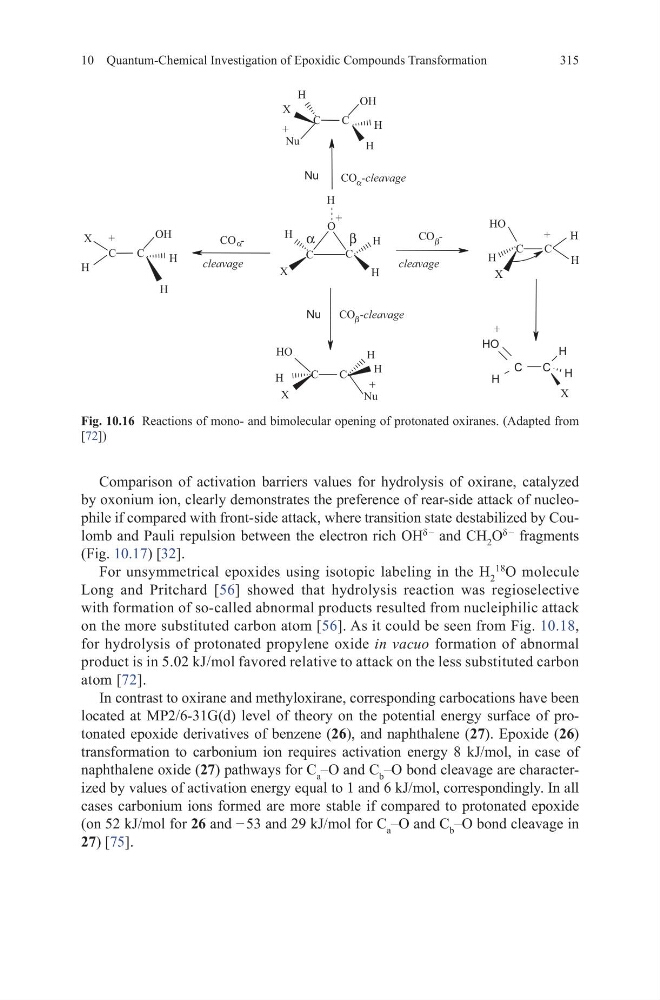
Fig. 10.16 Reactions of mono- and bimolecular opening of protonated oxiranes. (Adapted from
[72])
10 Quantum-Chemical Investigation of Epoxidic Compounds Transformation
Comparison of activation barriers values for hydrolysis of oxirane, catalyzed
by oxonium ion, clearly demonstrates the preference of rear-side attack of nucleophile if compared with front-side attack, where transition state destabilized by Coulomb and Pauli repulsion between the electron rich OH
δ −
and CH 2 O
δ −
fragments
(Fig. 10.17) [32].
For unsymmetrical epoxides using isotopic labeling in the H 2
18
O molecule
Long and Pritchard [56] showed that hydrolysis reaction was regioselective
with formation of so-called abnormal products resulted from nucleiphilic attack
on the more substituted carbon atom [56]. As it could be seen from Fig. 10.18,
for hydrolysis of protonated propylene oxide in vacuo formation of abnormal
product is in 5.02 kJ/mol favored relative to attack on the less substituted carbon
atom [72].
In contrast to oxirane and methyloxirane, corresponding carbocations have been
located at MP2/6-31G(d) level of theory on the potential energy surface of protonated epoxide derivatives of benzene (26), and naphthalene (27). Epoxide (26)
transformation to carbonium ion requires activation energy 8 kJ/mol, in case of
naphthalene oxide (27) pathways for C a –O and C b –O bond cleavage are characterized by values of activation energy equal to 1 and 6 kJ/mol, correspondingly. In all
cases carbonium ions formed are more stable if compared to protonated epoxide
(on 52 kJ/mol for 26 and − 53 and 29 kJ/mol for C a –O and C b –O bond cleavage in
27) [75].
H
X
H
X
X
H
X
X
H
C
H
X
C
HO
H
H
H
H
C
C
H
+
O
H
H
C
C
OH
H
H
C
C
HO
H
H
C
C
OH
H
H
C
C
Nu
Nu
HO
CO -
CO -
cleavage
cleavage
Nu
Nu
+
+
+
+
+
H
β
β
α
α
CO -cleavage
α
CO -cleavage
β
Fig. 10.16 Reactions of mono- and bimolecular opening of protonated oxiranes. (Adapted from
[72])
10 Quantum-Chemical Investigation of Epoxidic Compounds Transformation